
Human-rated spacecraft: what NASA human rating means
Source
NASA NPR 8705.2C, sections 1.2.2 and 1.3; NASA-STD-8719.29 (2023), section 4.1.2
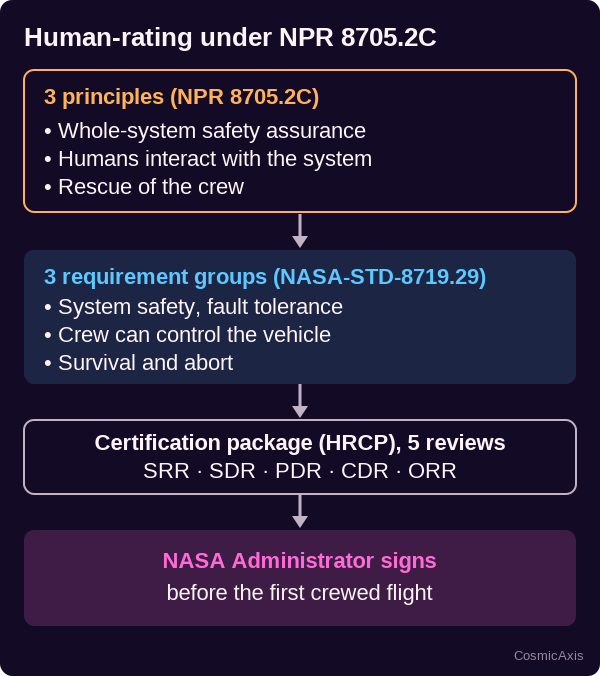
A human-rated spacecraft is a crewed system NASA has certified as safe enough to carry people under NPR 8705.2C: it meets human needs, lets the crew control it, controls hazards and can save the crew. The NASA Administrator signs before the first crewed flight; Crew Dragon was certified on 10 November 2020.
01Knowledge
What is human rating, and which systems does it cover?
Human rating is the NASA process of designing, evaluating and certifying a space system as safe enough to carry people, ending in a human-rating certification signed by the NASA Administrator. The governing document is NPR 8705.2C, effective 10 July 2017, last amended (Change 2) on 19 January 2024.
NPR 8705.2C (section 1.2.2) defines it through three principles:
- Whole-system assurance: the whole system is designed, evaluated and assured to conduct crewed missions safely.
- Humans in the system: people can interact with the system to increase safety and mission success.
- Crew rescue: the system can bring the crew safely out of a hazardous situation.
The certification covers a whole crewed system (the spacecraft with its launch vehicle, a planetary surface base, a spacesuit for spacewalks), never single parts. It is issued before the first crewed flight and held for the whole life cycle; the ISS and Soyuz are exempt (section P.2). It is the goal of the human-rating phase of testing and certification.
How do NPR 8705.2C and NASA-STD-8719.29 differ?
NPR 8705.2C sets the certification procedure (who approves, what is submitted, at which review), while the standard NASA-STD-8719.29 (approved 11 December 2023) holds the technical requirements a spacecraft must meet. The standard copies the old technical-requirements chapter of the NPR verbatim, adding or changing none; Change 2 deleted that chapter from the NPR (change history).
NASA-STD-8719.29 (section 4.1.2) sorts the requirements into three groups:
| Group | Example requirement | Section | Source, date viewed |
|---|---|---|---|
| System safety | Tolerate ≥ 1 failure before a catastrophic event | 4.3.1 | NASA-STD-8719.29, 2026-10-03 |
| System safety | Tolerate ≥ 1 human error | 4.3.3 | NASA-STD-8719.29, 2026-10-03 |
| Crew control | Manually control flight path and attitude | 4.5.1 | NASA-STD-8719.29, 2026-10-03 |
| Survival and abort | Abort from the pad to orbit insertion | 4.7.1.2 | NASA-STD-8719.29, 2026-10-03 |
One-failure fault tolerance is only a floor; the actual level and the redundancy scheme come from design and safety analysis. NPR 8705.2C (section 2.2.5) also requires the human limits of NASA-STD-3001.
How much control must the crew have over the spacecraft?
The crew must be able to monitor, operate and control the spacecraft in every function needed for the mission, to prevent a catastrophe or avoid aborting the mission (NASA-STD-8719.29, section 4.4.1).
- Override of automation (4.4.2): the crew can switch to manual control, even over an automatic abort command, as long as the switch does not cause a catastrophe.
- Manual control of flight path and attitude (4.5.1), except during atmospheric flight at launch.
- No dependence on the ground (4.3.9): functions that keep the crew alive must work with communications lost.
People also make errors, so the system must tolerate at least 1 human error, even with 1 system failure already present (4.3.3, 4.3.4). NPR 8705.2C (section 2.3.12) sets the order: design so the error cannot happen, then reduce its likelihood and allow correction, and last limit the consequences.
How are abort and safe haven requirements defined?
A program must define a crew survival strategy for every phase of the reference mission, based on abort, safe haven and rescue (NPR 8705.2C, section 2.3.2). NASA-STD-8719.29 requires:
- Before launch: the crew can escape on their own to a safe haven (4.7.1.1).
- During launch: abort from the pad to orbit insertion on loss of thrust or control; the spacecraft triggers the abort itself when it detects that the rocket is about to fail catastrophically, and crew and ground can also trigger it (4.7.1.2–4.7.1.4).
- In orbit: the spacecraft deorbits itself to a safe landing (4.7.2).
- After landing: the capsule is the safe haven until rescue arrives, and it reports its position to rescuers (4.7.7). That requirement came from the Soyuz flight returning Expedition 6, which landed short of its target area and could not report where.
By the rationale of section 4.7.1.2, three crewed rockets have failed catastrophically on ascent or on the pad: one Space Shuttle (the 1986 Challenger O-ring failure) and two Soyuz; both Soyuz crews lived thanks to the launch escape system. Abort does not count toward fault tolerance (4.3.2), because once abort is triggered the catastrophic event has already happened.
What does the HRCP contain, and which reviews must it pass?
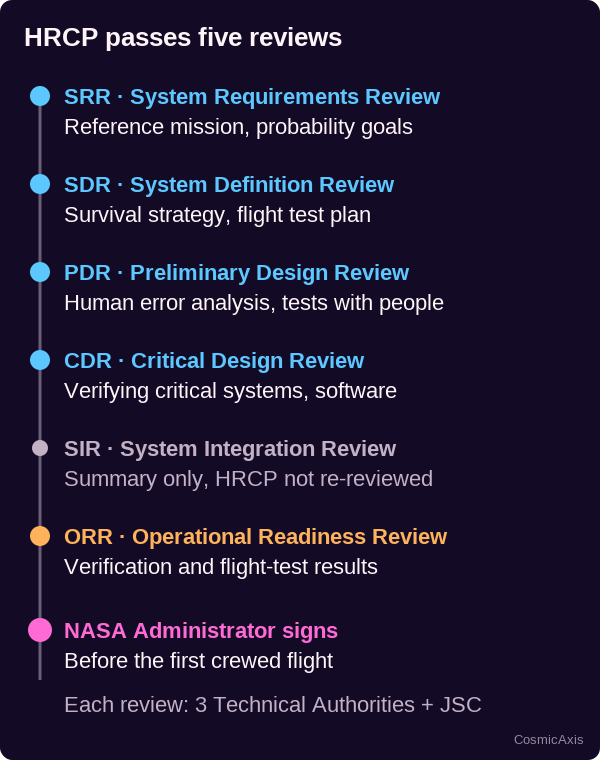
The Human-Rating Certification Package (HRCP) is a program document set built up over 5 reviews, from the reference mission to the results of verification and validation and flight tests (NPR 8705.2C, section 1.3.1).
Source
NASA NPR 8705.2C, section 1.3.2, chapter 2 and appendix D
The five reviews are System Requirements Review (SRR), System Definition Review (SDR), Preliminary Design Review (PDR), Critical Design Review (CDR) and Operational Readiness Review (ORR). At each, three Technical Authorities (safety, engineering, health and medical) and the Johnson Space Center (JSC) Director must agree; disagreements go to the NASA Administrator (section 1.3.2).
From SRR, the program records probabilistic safety requirements, derived from a threshold (the maximum acceptable risk) and a long-term goal, both approved by the NASA Administrator (sections 1.4.2, 2.3.6). The numbers come from probabilistic risk assessment (PRA), combined with FMEA and fault tree analysis (FTA) (section 2.3.7.1). The flight test program should include uncrewed flights before crewed ones (section 2.5.2).
After ORR, the NASA Administrator decides whether to grant certification (section 2.6.3). It is revisited at each flight readiness review; a major change must seek recertification (section 2.6.4).
02Practice
How can you check in Python whether a hypothetical design is human-rated?
A reduced checklist holds the yes-or-no requirements of NASA-STD-8719.29, plus a comparison of the loss-of-crew (LOC) probability against the Commercial Crew program limits in CCT-REQ-1130 revision E-1: mean LOC ≤ 1/200 for a whole 210-day ISS mission, ≤ 1/500 for launch plus return (section 3.2.1.1), and an abort system reliability ≥ 0.995 (section 3.3.1.5).
“Ship X” is a hypothetical CosmicAxis design. Launch LOC is p_launch = p_lv · (1 − c · R_abort), where p_lv is the probability of a catastrophic launch-vehicle failure (assumed 1/100), c is the fraction of failures detected in time to abort (no unit) and R_abort = 0.995. Return and in-orbit LOC are assumed 1/1500 and 1/400. Phases are treated as independent and combined by LOC = 1 − (1 − p₁)(1 − p₂)…, where p_i is the LOC of phase i.
# Ship X is a HYPOTHETICAL design; every p and c is a CosmicAxis assumption
CHECKLIST = {  # NASA-STD-8719.29 section -> does Ship X have it?
    "4.3.1 tolerates >= 1 failure": True,
    "4.4.2 override automation": False,
    "4.5.1 manual control": True,
    "4.7.1.2 launch abort": True,
}
LIMIT_ALL, LIMIT_LR = 1 / 200, 1 / 500  # CCT-REQ-1130 E-1, section 3.2.1.1
R_ABORT = 0.995                         # section 3.3.1.5

def combine(*p):  # LOC of independent phases in series: 1 - prod(1 - p_i)
    surv = 1.0
    for x in p:
        surv *= 1 - x
    return 1 - surv

def evaluate(c, p_lv=0.01, p_ret=1 / 1500, p_orb=1 / 400):
    p_launch = p_lv * (1 - c * R_ABORT)
    lr, full = combine(p_launch, p_ret), combine(p_launch, p_ret, p_orb)
    fmt = lambda p, lim: f"1/{1 / p:.0f} {'pass' if p <= lim else 'FAIL'}"
    print(f"c = {c}: launch+return {fmt(lr, LIMIT_LR)}, whole mission {fmt(full, LIMIT_ALL)}")

print("Missing:", [k for k, ok in CHECKLIST.items() if not ok])
for c in (0.9, 0.5):
    evaluate(c)
# Missing: ['4.4.2 override automation']
# c = 0.9: launch+return 1/584 pass, whole mission 1/238 pass
# c = 0.5: launch+return 1/176 FAIL, whole mission 1/122 FAIL
Running it in Python 3.14 (calculated by CosmicAxis) gives two lessons:
- Passing the probability limits is not enough: at c = 0.9, Ship X passes both limits but lacks requirement 4.4.2; NASA-STD-8719.29 (section 4.2.2) states that a probability number alone does not prove a system safe.
- Timely detection matters as much as the abort system: lowering c from 0.9 to 0.5 raises launch-plus-return LOC from 1/584 to 1/176, failing the 1/500 limit.
Exercise: find the smallest c for which Ship X still meets the 1/500 limit.
03Reality
How was Crew Dragon certified by NASA to carry people?
Crew Dragon was the first commercial spacecraft certified by NASA for crew: on 10 November 2020, after the flight readiness review for Crew-1, NASA completed certification of the whole system of the Crew Dragon capsule, the Falcon 9 rocket and ground systems.
The path followed “uncrewed first, crewed after” (NASA, 10 November 2020):
- From 2016: dozens of parachute tests.
- March 2019, Demo-1: uncrewed test flight, 5 days docked to the ISS.
- January 2020: in-flight abort test, before second 90.
- 30 May–2 August 2020, Demo-2: test flight with two astronauts.
A Crew Dragon capsule was also lost on the ground before certification, in the April 2019 Crew Dragon explosion during a static fire.
Commercial Crew uses its own requirement set: CCT-REQ-1130 revision E-1 cites NPR 8705.2B (the version before 2C) and adds stricter requirements, such as guidance for the deorbit burn, entry and landing tolerating 2 failures, or 1 failure with dissimilar backup (section 3.2.3.1 a). Boeing’s Starliner tolerated only 1 failure in two places in this group; per NASA on 28 September 2026, Starliner must still finish testing and certification before it carries people again.
How do Russia and the Artemis program certify crewed spacecraft differently from NASA?
Russia certifies Soyuz through its own flight readiness process, and NPR 8705.2C exempts Soyuz (section P.2 c). Per NASA/SP-2010-578, before each Soyuz flight the Russian Ministry of Defense signs a document confirming that crew requirements were independently checked, and the Central Research Institute of Machine Building assesses each flight independently. The report (August 2010) records that the US, Russia and China each solved human rating on their own; with Soyuz, NASA chose “trust but verify”.
NASA’s main assurance on Soyuz is its long flight history plus joint assessments with Russian engineers. In hindsight (section 8.0), NASA experts concluded that Soyuz meets most high-level NPR 8705.2 requirements: fault tolerance, abort, human factors, automation, manual control and flight testing.
For vehicles going far from Earth, NPR 8705.2C admits it does not yet cover requirements specific to the Moon and Mars (section P.2 l). For Artemis, HEOMD-003 revision B (21 May 2024) governs: revision A (6 November 2021) dropped the mandatory HRCP and let programs plan their own certification; revision B states that human rating is a design certification, accompanied by certification of each flight.
04Milestone
Milestone: check yourself
If you can do all of these, move on to the next article in this phase.
- Can you state the three human-rating principles of NPR 8705.2C?
- Can you tell NPR 8705.2C and NASA-STD-8719.29 apart?
- Can you name the 5 HRCP reviews and who signs the certification?
- Can you explain why the fraction of failures detected in time decides whether a design passes the loss-of-crew limit?
Frequently asked questions
Is the Soyuz spacecraft human-rated by NASA?
No. NPR 8705.2C (section P.2 c) exempts the ISS and Soyuz; NASA relies on Soyuz's long flight history and joint assessments with Russia (NASA/SP-2010-578).
Does modifying a spacecraft after certification require recertification?
Yes, for major changes. Under NPR 8705.2C section 2.6.4, a major change to design, manufacturing or test must seek recertification before the next flight.
How does a human-rated rocket differ from an ordinary rocket?
A human-rated rocket is part of the crewed system: the spacecraft must monitor it and trigger an abort by itself when it is about to fail catastrophically (NASA-STD-8719.29, section 4.7.1.3).
References
- NASA NPR 8705.2C, Preface — accessed
- NASA NPR 8705.2C, chapter 1 — accessed
- NASA NPR 8705.2C, chapter 2 — accessed
- NASA NPR 8705.2C, change history — accessed
- NASA-STD-8719.29 (11 December 2023) — accessed
- NASA CCT-REQ-1130 Rev. E-1 (12 October 2016) — accessed
- NASA — Crew Dragon certification (10 November 2020) — accessed
- NASA — Starliner plans (28 September 2026) — accessed
- NASA/SP-2010-578 — NASA Astronauts on Soyuz (August 2010) — accessed
- NASA HEOMD-003 Rev. B (21 May 2024) — accessed
Cite this article
CosmicAxis. (2026). Human-Rated Spacecraft: NASA Human-Rating Requirements. https://cosmicaxis.space/en/human-rated-spacecraft/