
Challenger O-Ring Failure (1986)
Source
Rogers Commission Report, vol. 1, chapters III and V (1986)
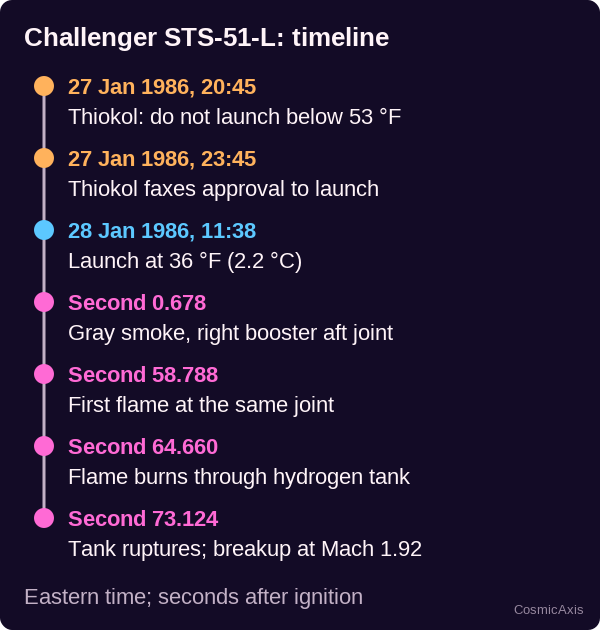
Space Shuttle Challenger broke apart 73 seconds after launch on 28 January 1986, killing all 7 astronauts. The Rogers Commission (June 1986) found that the O-ring seals in the aft field joint of the right solid rocket booster failed because the design was too sensitive to temperature; the air was only 36 °F (2.2 °C) at launch.
01Knowledge
What happened to Space Shuttle Challenger in 1986?
Space Shuttle Challenger broke apart 73 seconds after liftoff at 11:38 a.m. Eastern time on 28 January 1986, and all 7 astronauts of mission STS-51-L died (Rogers Commission, vol. 1, chapter III). It was the 25th flight of the shuttle program and the 10th flight of Challenger (NASA).
President Ronald Reagan appointed the Rogers Commission, named after its chairman William P. Rogers, which was sworn in on 6 February 1986 and reported on 6 June 1986. Challenger is the central lesson of the human-rating phase: testing and certifying spacecraft that carry people.
How do the booster field joints and O-rings work?
A field joint is the connection where the segments of a solid rocket motor are assembled at the launch site, and each joint is sealed by two circular rubber O-rings with a diameter of 0.280 inch, or 7.11 mm (Rogers, chapter IV; CosmicAxis conversion).
The shuttle lifts off on two solid rocket boosters and three main engines fed from the external tank. Each solid motor is stacked from four segments, so it has three field joints. The booster motor (RSRM) has a specific impulse of 268.5 s in vacuum, and each motor pushes with an average of 2,600,000 lbf (Northrop Grumman).
At each joint, the tang of the upper segment slides into the U-shaped clevis of the lower segment. The primary and secondary O-rings sit between the tang and the inner leg of the clevis. At ignition, hot gas pushes the heat-shielding putty like a piston and presses the primary O-ring into the gap.
That gap, however, widens. A 1977 test showed that under pressure the tang and clevis bend away from each other, a motion called joint rotation (Rogers, chapter VI). The gap at the primary O-ring opens up to 0.029 inch (0.74 mm), nearly its full amount after 600 milliseconds (chapter IV). Because the secondary O-ring was therefore not a true backup, on 17 December 1982 the Marshall center rated the joint Criticality 1 in its failure modes and effects analysis (FMEA).
Why did cold weather stop the O-rings from sealing?
Cold makes O-ring rubber lose its resilience: an O-ring compressed at 75 °F (23.9 °C) springs back to its original shape five times faster than one at 30 °F (−1.1 °C), so a cold O-ring cannot follow the gap as it opens (Rogers, chapter IV, finding 9).
On the morning of 28 January 1986 the air at launch was 36 °F (2.2 °C), 15 °F colder than the coldest previous launch. The coldest point on the failed joint was estimated at 28 ± 5 °F (−2.2 °C). The two segments of this joint had grown out of round after repeated reuse, so the gap at launch averaged only 0.004 inch (0.10 mm) and the O-ring was squeezed against all three surfaces of its groove. Rain water in the clevis may also have frozen (findings 5, 6, 10, 13).
The commission concluded that the cause was a failure of the pressure seal in the aft field joint of the right solid rocket motor, due to a design unacceptably sensitive to temperature and other factors.
How did the 73 seconds of STS-51-L unfold?
The first sign of failure appeared 0.678 seconds after ignition: gray smoke puffed from the aft field joint of the right booster, on the side facing the external tank (Rogers, chapter III).
| Seconds after ignition (s) | Event | Source, date accessed |
|---|---|---|
| 0.678 | First gray smoke at the aft joint | Rogers III, 2026-09-29 |
| 0.836–2.500 | 8 more puffs, increasingly black | Rogers III, 2026-09-29 |
| 58.788 | First flame at the same joint | Rogers III, 2026-09-29 |
| 60.004 | Right booster pressure falls below left | Rogers III, 2026-09-29 |
| 64.660 | Flame burns through the liquid hydrogen tank | Rogers III, 2026-09-29 |
| 72.204 | Right booster begins to swivel out of line | Rogers III, 2026-09-29 |
| 73.124 | Bottom of the hydrogen tank begins to fail | Rogers III, 2026-09-29 |
| 73.618 | Last valid telemetry data | Rogers III, 2026-09-29 |
Black smoke showed that grease, insulation and rubber in the joint were burning. The smoke stopped after second 3.375; the commission believed aluminum oxide residue may have plugged the gap until strong wind shear from second 37 to 64 broke it loose (chapters III and IV). Joseph Kerwin’s medical report (July 1986) records that the crew cabin separated from the rest of the vehicle and hit the ocean about 2 minutes 45 seconds later; the cause of death could not be determined with certainty.
How did “normalization of deviance” lead to Challenger?
Normalization of deviance is the process by which an organization gradually accepts something its design does not allow, because it has happened many times without causing an accident; the CAIB used the concept from sociologist Diane Vaughan’s book The Challenger Launch Decision (1996) (CAIB, section 8.2).
The Rogers Commission’s anomaly table shows that 7 of the 23 flights with inspection results before Challenger already had field joint O-rings that were eroded, passed hot gas (blow-by) or were heated (chapter VI, figure 2; CosmicAxis count). Flight 51-C in January 1985, with the joint at 53 °F, was the first time the secondary O-ring was affected by heat.
Richard Feynman, a commission member, compared these decisions to Russian roulette (chapter VI). In appendix F he rejected the argument that erosion one third of the O-ring radius deep means a safety factor of three: an O-ring is not designed to erode, so any erosion means the design has a problem. Marshall had also waived the launch constraint for the O-rings six times in a row before 51-L.
The CAIB called the Columbia accident, in which the orbiter broke up during atmospheric reentry on 1 February 2003, an “echo” of Challenger because it repeated this pattern. The Apollo 13 oxygen tank explosion board had asked for the same discipline in 1970: its recommendation 6 requires that when critical equipment shows an anomaly close to launch, every earlier anomaly of that equipment be presented too.
What did the Morton Thiokol teleconference decide the night before launch?
On the night of 27 January 1986, engineers at Morton Thiokol, the maker of the solid motors, recommended not launching with the O-rings below 53 °F, the coldest temperature already flown; after a private caucus, Thiokol management reversed itself and at about 23:45 faxed approval to launch (Rogers, chapter V).
- 20:45 Eastern: Vice president of engineering Bob Lund presented the recommendation not to fly outside the existing data. Lawrence Mulloy of Marshall objected that this might mean no launch until April.
- About 22:30, Thiokol caucus: engineers Arnold Thompson and Roger Boisjoly still objected; senior vice president Jerry Mason told Lund to “take off your engineering hat and put on your management hat”.
- About 23:45: Joe Kilminster signed the fax recommending launch.
Boisjoly testified that engineers were asked that night to prove it unsafe, instead of proving it safe to launch. The commission concluded that Thiokol reversed under pressure from Marshall, against its engineers’ judgment, to accommodate a major customer, and that the final launch decision-makers did not know the contractor’s original recommendation.
02Practice
How can you count the O-ring data by temperature in Python?
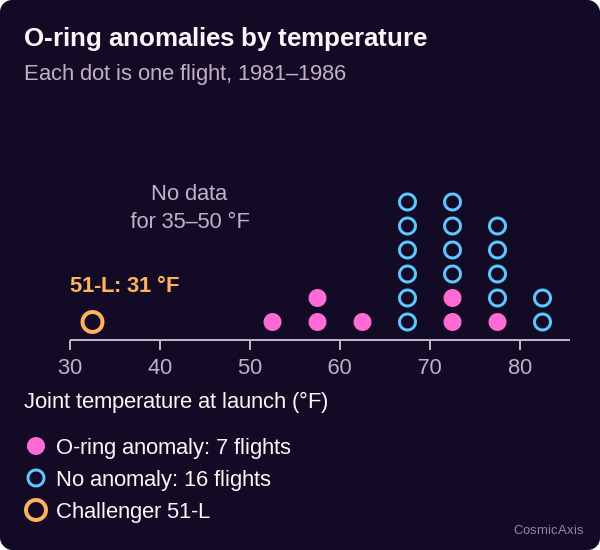
Recounting the Rogers Commission table shows that all 4 flights with the joint below 65 °F had O-ring problems, while only 3 of the 19 flights at 66 °F or above did (CosmicAxis calculation in Python from Rogers, chapter VI, figure 2). The data cover 23 flights from STS-1 to 61-C; STS-4 is excluded because its boosters were lost at sea.
# (flight, joint temperature in °F, number of O-ring anomalies at field joints)
DATA = [
    ("STS-1", 66, 0), ("STS-2", 70, 1), ("STS-3", 80, 0), ("STS-5", 68, 0),
    ("STS-6", 67, 0), ("STS-7", 72, 0), ("STS-8", 73, 0), ("STS-9", 70, 0),
    ("41-B", 57, 1), ("41-C", 63, 1), ("41-D", 70, 1), ("41-G", 67, 0),
    ("51-A", 67, 0), ("51-C", 53, 3), ("51-D", 67, 0), ("51-B", 75, 0),
    ("51-G", 70, 0), ("51-F", 81, 0), ("51-I", 76, 0), ("51-J", 79, 0),
    ("61-A", 75, 2), ("61-B", 76, 0), ("61-C", 58, 1),
]

# Wrong view: look only at flights with anomalies
print(sorted(t for _, t, n in DATA if n > 0))
# [53, 57, 58, 63, 70, 70, 75]

# Right view: look at every flight, split at 65 °F
for label, group in (("cold", [n for _, t, n in DATA if t < 65]),
                     ("warm", [n for _, t, n in DATA if t >= 65])):
    print(label, sum(n > 0 for n in group), "/", len(group))
# cold 4 / 4
# warm 3 / 19

print(min(t for _, t, _ in DATA) - 31)  # 51-L: 31 °F
# 22
Source
Rogers Commission Report, vol. 1, chapter VI, figure 2; redrawn by CosmicAxis
The first printed line is how managers saw the night of 27 January: only flights with anomalies, spread from 53 to 75 °F, so temperature looks irrelevant (chapter VI). Add the 16 flights without anomalies and the pattern appears. The Challenger joint was recorded at 31 °F, 22 °F colder than any earlier data: every prediction that night was an extrapolation. The commission counted 20 flights from 66 °F because it included STS-4.
Exercise: cold, a narrow gap and putty with voids must all occur together to cause the accident; draw them as an AND gate in a fault tree.
03Reality
What did NASA change after Challenger?
The Rogers Commission made 9 recommendations, led by redesigning the joint and seals, testing across the full range of conditions including temperature, and considering static firings in the vertical, flight-like position (Rogers, Recommendations). Others include full authority for the shuttle program director, a safety office reporting directly to the NASA Administrator, a review of all Criticality 1, 1R, 2 and 2R items, and recording flight readiness reviews.
The old motors had been test-fired horizontally, not in flight configuration (chapter VI): testing differently from how you fly is an error that systems engineering must catch.
The new joint adds a capture feature with its own O-ring, a J-shaped insulation seal and heaters that keep the O-rings at 75–120 °F (23.9–48.9 °C) at launch (Thiokol TWR-17272-1). NASA made more than 200 changes, including a crew escape pole and fully pressurized suits for launch. Discovery flew STS-26 on 29 September 1988, after a 32-month stand-down (NASA).
The lesson for new crewed vehicles is that a repeated anomaly is a warning sign, not evidence of safety.
04Milestone
Milestone: check yourself
If you can do all of these, move on to the next article in this phase.
- Can you explain why joint rotation opens the gap when the booster is ignited?
- Can you show why a cold O-ring cannot seal the gap in time?
- Can you run the Python code and explain why looking only at flights with problems hides the role of temperature?
- Can you find one decision in your own project that rests on the argument "it was fine last time"?
Frequently asked questions
How many astronauts were on Space Shuttle Challenger, and who were they?
Challenger carried 7 people: commander Francis R. Scobee, pilot Michael J. Smith, mission specialists Ellison S. Onizuka, Judith A. Resnik and Ronald E. McNair, payload specialist Gregory B. Jarvis, and teacher Christa McAuliffe (NASA).
Did Space Shuttle Challenger explode?
Not by itself: the external tank ruptured and its hydrogen and oxygen burned violently, while the orbiter, flying at Mach 1.92 and 46,000 ft (14 km), was torn apart by aerodynamic forces (Rogers, chapter III).
What did Richard Feynman do in the Challenger investigation?
Physicist Richard Feynman, a Rogers Commission member, wrote appendix F: estimates of the probability of losing a shuttle ranged from 1 in 100 (engineers) to 1 in 100,000 (management), and for a successful technology reality must take precedence over public relations.
References
- Rogers Commission Report, vol. 1, chapter III — accessed
- Rogers Commission Report, vol. 1, chapter IV — accessed
- Rogers Commission Report, vol. 1, chapter V — accessed
- Rogers Commission Report, vol. 1, chapter VI — accessed
- Rogers Commission Report, vol. 1, Recommendations — accessed
- Rogers Commission Report, letter to the President (6 June 1986) — accessed
- Feynman, Rogers Commission Report, vol. 2, appendix F — accessed
- NASA — STS-51L — accessed
- NASA — Challenger Crew Report (Kerwin, July 1986) — accessed
- NASA — 30 Years Ago: STS-26 Returns Shuttle to Flight — accessed
- Thiokol TWR-17272-1, STS-26R Final Report (June 1990) — accessed
- CAIB Report Volume I (August 2003), chapter 8 — accessed
- Northrop Grumman — Propulsion Products Catalog, RSRM section — accessed
Cite this article
CosmicAxis. (2026). Challenger O-Ring Failure: What Caused the 1986 Disaster. https://cosmicaxis.space/en/challenger-o-ring-failure/