
Columbia Disaster (2003)
Source
CAIB Report Volume I (2003), sections 2.3, 2.5, 2.6, 3.4
Space Shuttle Columbia broke up during reentry on 1 February 2003, killing all 7 astronauts. The CAIB report (August 2003) found that 81.7 seconds after launch a piece of foam came off the external tank and breached the left wing near RCC panel 8; during reentry, superheated gas entered the wing and melted its structure.
01Knowledge
What happened to Space Shuttle Columbia in 2003?
Space Shuttle Columbia broke up over Texas on the morning of 1 February 2003, 16 minutes before its planned landing, and all 7 astronauts of mission STS-107 died (Columbia Accident Investigation Board report, vol. 1, August 2003). STS-107 was Columbia’s 28th flight, a 16-day science mission that had met all its objectives.
The Columbia Accident Investigation Board (CAIB) was formed within 2 hours of the loss of signal. More than 25,000 searchers recovered about 38% of the orbiter; two members of the search effort also died in a helicopter accident.
The article on atmospheric reentry places Columbia in the context of returning from orbit. It is the main lesson of the structures and reentry phase.
Which piece of foam breached Columbia’s left wing?
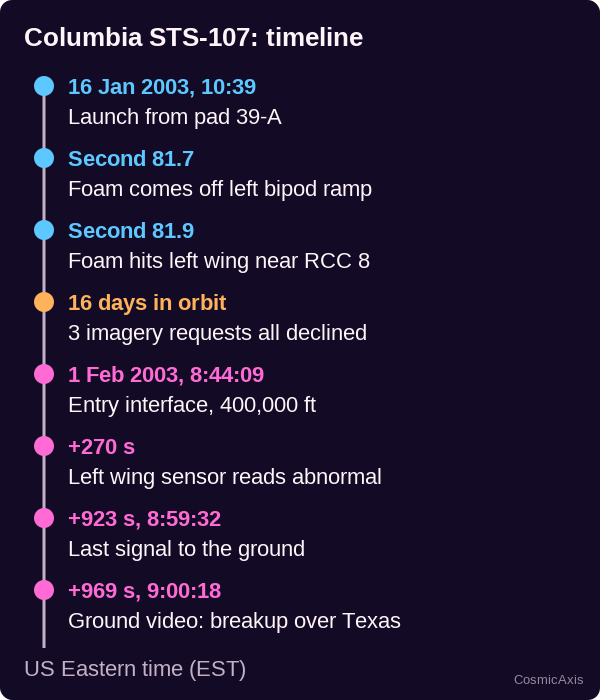
The foam was insulation from the left bipod ramp of the external tank: it came off at second 81.7 after launch and struck the left wing leading edge at second 81.9, near the lower half of Reinforced Carbon-Carbon (RCC) panel 8 (CAIB, section 3.1).
Light foam is slowed quickly by the air: in 0.161 s it dropped from 1,568 to 1,022 mph, while the orbiter did not slow. The CAIB wrote that the orbiter ran into the foam, at a relative speed of about 545 mph, or 877 km/h (CosmicAxis conversion). Image analysis put the foam at 24 ± 3 inches long and 15 ± 3 inches wide.
The CAIB tested this at Southwest Research Institute with a nitrogen gas gun used for bird-strike tests. A foam projectile of 19 × 11.5 × 5.5 inches and 1.67 lb, fired at 777 ft/s at an RCC panel 8 taken from the orbiter Atlantis, punched a hole of about 16 × 17 inches (CAIB, section 3.8).
The projectile weighs 0.757 kg; at 236.2 m/s (775 ft/s, the speed the CAIB estimated for the real impact), kinetic energy is half the mass times the speed squared, E = ½·m·v² = 21.1 kJ (CosmicAxis calculation).
How did the reentry on 1 February 2003 unfold?
The last reentry of Columbia lasted 969 seconds, from the entry interface at 400,000 ft at 8:44:09 Eastern time to the moment ground video showed the orbiter breaking up (CAIB, sections 2.6, 3.6). The first sensor reported an anomaly at second 270, but that data was only in the onboard recorder and was not sent to the ground.
| Time (EST) | Seconds after entry interface (s) | Event | Source, date accessed |
|---|---|---|---|
| 8:44:09 | 0 | Entry interface | CAIB 2.6, 2026-09-29 |
| 8:48:39 | 270 | Left wing spar strain sensor reads abnormally high, recorded onboard only | CAIB 2.6, 2026-09-29 |
| 8:52:16 | 487 | Sensor wiring behind RCC panel 8 burns through: the wing spar is breached | CAIB 3.6 (time computed by CosmicAxis), 2026-09-29 |
| 8:54:24 | 613 | Mission Control sees 4 left wing hydraulic sensors lose readings | CAIB 2.6, 2026-09-29 |
| 8:59:15 | 906 | Pressure lost on both left main tires | CAIB 2.6, 2026-09-29 |
| 8:59:32 | 923 | Last signal | CAIB 2.6, 2026-09-29 |
| 9:00:18 | 969 | Ground video shows the orbiter breaking up | CAIB 2.6, 2026-09-29 |
Hot gas entering the wing melted the aluminum spar. Over Texas, aerodynamic forces in the denser air overcame the severely damaged left wing, and the orbiter lost control at more than 10,000 mph. The CAIB concluded that, in that flight regime and with the orbiter as designed at the time, the crew could not have survived.
Why did NASA not image Columbia’s wing while it was in orbit?
NASA did not image Columbia’s wing in orbit because program management did not approve any of three imaging requests from engineers and managers (CAIB, sections 2.5, 6.3). The CAIB counted at least eight other “missed opportunities”.
- 17 January, flight day 2: the launch image analysis team saw the strike and asked for imagery of the orbiter in orbit. No ground camera clearly recorded the impact; one station was blurred by a poorly maintained lens.
- 21 January: the Debris Assessment Team asked for imagery of the wing; managers declined.
- 24 January: the Mission Management Team heard an oral briefing without data and classified the strike as a post-flight turnaround issue.
Without imagery, engineers used Crater, a Boeing model that estimates how deep debris penetrates the insulating tiles. Crater was validated with debris up to 3 cubic inches; the initial estimate for the STS-107 foam was 1,200 cubic inches, 400 times larger. Outside its validated range, nobody knew how accurate Crater was. This is a lesson in systems engineering: a model result must come with its validated envelope.
What is “normalization of deviance”?
Normalization of deviance is the process by which an organization gradually accepts something the design does not allow, only because it has happened many times without causing an accident; the CAIB borrowed the concept from sociologist Diane Vaughan (CAIB, sections 6.1, 8.2).
Bipod foam fell on 7 of the 72 flights with images clear enough to check, or 9.7% (CosmicAxis calculation; the CAIB gives about 10%). The sixth was STS-112 on 7 October 2002, three months before Columbia, but management did not classify it as an In-Flight Anomaly and downgraded it to an “action item”. Each safe return was taken as proof that the design tolerated the foam, and the “in-family” label (within known experience) drew less attention.
The CAIB called Columbia an “echo” of the Challenger O-ring failure of 1986: the O-rings had also eroded on many earlier flights and were gradually accepted. The board concluded that NASA’s organizational culture contributed to the accident as much as the foam did.
Could the Columbia crew have been rescued?
The Columbia crew could possibly have been rescued by Atlantis if the damage had been identified early: a NASA study done to help the CAIB judged a rescue “challenging but feasible” (CAIB, section 6.4).
- Time limit: the first consumable to run out was the lithium hydroxide canisters that scrub CO₂, the same constraint as in the Apollo 13 oxygen tank explosion. With adjusted activity and sleep schedules, CO₂ scrubbing would last until flight day 30 (15 February).
- Rescue: working three shifts continuously, Atlantis could launch on 10 February, giving a 5-day window to meet Columbia.
- Repair in orbit: packing metal and bags of frozen water into the hole; NASA rated this “high risk”.
A rescue was feasible only if management had identified the damage with certainty before flight day 7.
02Practice
How do you draw a fault tree for “loss of the orbiter during reentry”?
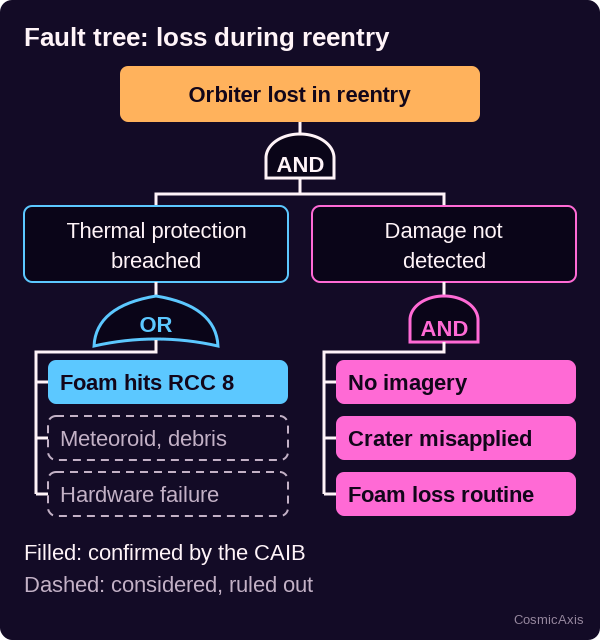
A fault tree for “loss of the orbiter during reentry” runs from the top event down to causes through AND gates and OR gates; the CAIB used this approach, with a fault tree of more than 3,000 elements, to rule out other causes (CAIB, chapter 4).
Source
CAIB Report Volume I (2003), chapters 3, 4, 6; simplified by CosmicAxis
- Read CAIB volume 1, sections 2.6 and 3.6, and build a sensor timeline table like the one above.
- Place the top event, and under it an AND gate: the orbiter is lost only if the thermal protection is breached and the damage goes undetected.
- The “breached” branch uses an OR gate. The CAIB considered meteoroids, space debris, sabotage and hardware failure, and ruled them all out, although a few branches were left “open”.
- The “not detected” branch uses an AND gate: every barrier (imagery, models, risk classification) must fail together for the damage to slip through.
The Python code below recomputes the kinetic energy of the foam projectile and converts seconds after entry interface to clock time:
from datetime import datetime, timedelta

LB, FT = 0.45359237, 0.3048  # exact unit conversions

m = 1.67 * LB  # test foam projectile, kg
v = 775 * FT   # impact velocity, m/s
print(round(0.5 * m * v**2 / 1000, 1))
# 21.1 kJ

ei = datetime(2003, 2, 1, 8, 44, 9)  # EST
for s in (270, 487, 613, 923):
    print(s, (ei + timedelta(seconds=s)).time())
The result for second 613 is 8:54:22, while the CAIB gives 8:54:24: the original report is also 2 seconds off. When numbers do not match, note it instead of adjusting them to look neat.
03Reality
What did NASA change after Columbia?
After Columbia, the CAIB issued 29 recommendations, 15 of which had to be completed before the Space Shuttle flew again (Return to Flight Task Group, July 2005). The main groups:
- Stop foam at the source (R3.2-1).
- Better imagery (R3.4-1 to R3.4-3): at least 3 views at launch, with clear images of the external tank and the underside of the wing.
- Inspection and repair in orbit (R6.4-1) early on every flight.
- An independent technical authority (R7.5-1), separate from schedule and cost pressure, owning the FMEA and hazard reporting systems.
The first return-to-flight mission, STS-114, launched on 26 July 2005 and inspected the thermal protection with the Orbiter Boom Sensor System, a sensor boom with laser scanners mounted on the robotic arm, but launch imagery still showed a piece of foam coming off (NASA). In January 2004, President George W. Bush’s Vision for Space Exploration called for retiring the Space Shuttle after completing the International Space Station. The final flight, STS-135, landed on 21 July 2011, ending 135 flights since 1981.
04Milestone
Milestone: check yourself
If you can do all of these, move on to the next article in this phase.
- Can you explain why a light piece of foam struck the wing at 545 mph, that is, why the orbiter flew into the foam?
- Can you explain why a sensor reported an anomaly at second 270 but Mission Control saw it only at second 613?
- Can you draw a fault tree for the loss of an orbiter during reentry, with both AND gates and OR gates?
- Can you name one example of normalized deviance in your own project?
Frequently asked questions
How many astronauts were on Space Shuttle Columbia, and who were they?
Columbia carried 7 astronauts: commander Rick D. Husband, pilot William C. McCool, payload commander Michael P. Anderson, mission specialists David M. Brown, Kalpana Chawla and Laurel Clark, and payload specialist Ilan Ramon, the first Israeli astronaut (CAIB).
Did Space Shuttle Columbia explode?
No. Columbia broke up in flight: superheated gas melted the structure of the left wing, then aerodynamic forces over Texas overcame the damaged wing and the orbiter lost control at more than 10,000 mph (CAIB).
How did the Columbia disaster differ from the Challenger disaster?
Challenger (1986) was lost during ascent because of a booster O-ring joint; Columbia (2003) was lost during reentry because foam breached the left wing. The CAIB called Columbia an echo of Challenger: both times NASA gradually accepted a deviation that had repeated on many flights.
References
- Columbia Accident Investigation Board — Report Volume I (8/2003) — accessed
- Return to Flight Task Group — Final Report (7/2005), NTRS 20050201800 — accessed
- NASA — STS-114 — accessed
- NASA — The Shuttle's New Boom (OBSS) — accessed
- NASA — 10 Years Ago: STS-135, the Space Shuttle's Grand Finale — accessed
- NASA — Space Shuttle — accessed
Cite this article
CosmicAxis. (2026). Columbia Disaster 2003: Cause, Timeline and Lessons. https://cosmicaxis.space/en/columbia-disaster/