
Ion Thruster: How It Works
Source
NASA Glenn Research Center, Ion Propulsion fact sheet PS-01628
An ion thruster is an electric rocket engine: solar power ionizes xenon gas, then high-voltage grids expel the ions backward at up to about 40 km/s (NASA). It saves a great deal of propellant but pushes gently: each Dawn engine delivered at most 91 mN (NASA JPL).
01Knowledge
How does an ion thruster differ from a chemical rocket engine?
An ion thruster differs from a chemical engine in its energy source: a chemical engine gets its energy from burning its own propellant, while an ion thruster takes electricity from solar panels or a nuclear source and uses an electric field to push gas backward (NASA Glenn). That makes it an electric propulsion engine.
The principle of thrust is the same as in any rocket engine: throw mass backward and the spacecraft moves forward, as explained in how rockets work. The difference is that an ion thruster ejects very little mass, but very fast: up to 90,000 miles per hour, about 40 km/s (NASA Glenn).
A fast exhaust means a high specific impulse (Isp): the ion engine of Deep Space 1 reached 3,100 s, up to 10 times that of conventional chemical propellant (NASA).
How does a gridded ion thruster work?
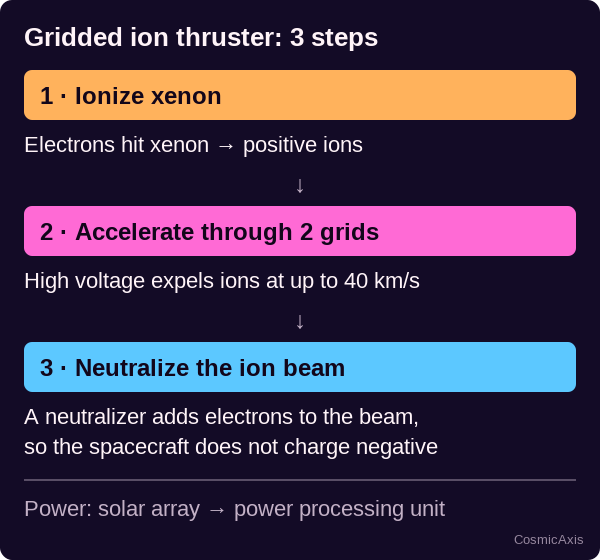
A gridded ion thruster works in three steps: ionize xenon gas, accelerate the ions through two high-voltage grids, then neutralize the ion beam with electrons (NASA Glenn, PS-01628).
- Ionization. A hollow cathode emits electrons. High-energy electrons strike xenon atoms, knock an electron loose and leave a positive ion. The mixture of positive ions and electrons is plasma.
- Acceleration. At the end of the chamber, grids with thousands of precisely aligned holes face the plasma. Ions cross the gap between the screen grid, held at a very high positive voltage, and the accelerator grid, held negative, and leave as a beam. NEXT-C uses a beam voltage of up to 1,800 V (NASA GRC).
- Neutralization. The neutralizer, a second hollow cathode, injects as many electrons as there are ions into the exhaust beam. Without it, the spacecraft would charge negative, ions would be pulled back, thrust would drop and the hull would erode.
A power processing unit (PPU) converts solar-array power into the voltages needed by the cathodes and grids (NASA Glenn).
How does a Hall thruster differ from a gridded ion thruster?
A Hall thruster has no grids: a magnetic field holds the cathode’s electrons in an insulating annular channel, those electrons ionize the gas, and the electric field between anode and cathode pushes the ions out (IEPC-2025-128).
| Engine (mission) | Type, gas | Power (kW) | Thrust (mN) | Isp (s) | Source, date accessed |
|---|---|---|---|---|---|
| NSTAR (Deep Space 1, Dawn) | Gridded ion, xenon | 2.3 | Up to 91 | 3,100 | NASA GRC, NASA JPL, NASA, 2026-09-29 |
| NEXT-C (DART) | Gridded ion, xenon | 0.6–7.4 | 25–235 | Up to 4,220 | NASA GRC, 2026-09-29 |
| AEPS (PPE, now SR-1 Freedom) | Hall, xenon | 12 | 588 | 2,740 | IEPC-2025-128, 2026-09-29 |
| Starlink V2 mini | Hall, argon | 4.2 | 170 | 2,500 | SpaceX, 2026-09-29 |
The two Hall thrusters in the table have an Isp of 2,500–2,740 s, lower than the two gridded ion thrusters (3,100–4,220 s), but they deliver more thrust per kilowatt.
Why is electric power the limit of an ion thruster?
Electric power is the limit because ion thruster thrust is proportional to power and inversely proportional to exhaust velocity: F = 2 · η · P / vₑ, where η is efficiency and P is electric power. The formula follows from the kinetic energy of the exhaust each second, which equals ½ · F · vₑ.
CosmicAxis calculated the following from real numbers:
- Dawn: 91 mN × 28,000 m/s ÷ 2 = 1,274 W of exhaust kinetic power, from the 2.3 kW NSTAR input.
- AEPS: 588 mN at Isp 2,740 s and 12 kW gives an efficiency of 66%, or 49 mN per kilowatt. Producing 1 N of thrust takes about 20 kW of electricity.
- Trade-off: at the same power, doubling Isp halves thrust. Hall thrusters pick a moderate Isp to get thrust; gridded ion thrusters pick a high Isp to save propellant.
Solar power falls with distance from the Sun: at Ceres, three times farther from the Sun than Earth, sunlight is nine times weaker (NASA JPL). In 2024 BepiColombo suffered an abnormal current between the solar array and the power distribution unit; the engines could only run below the minimum thrust needed to enter Mercury orbit in December 2025, so ESA changed the trajectory and moved arrival to November 2026.
The theoretical ceiling for one 1U CubeSat solar face is 4.1 W, a thousand times less than a Starlink thruster draws, so small satellites need very low-power electric propulsion.
02Practice
How much propellant does an ion thruster save for the same delta-v?
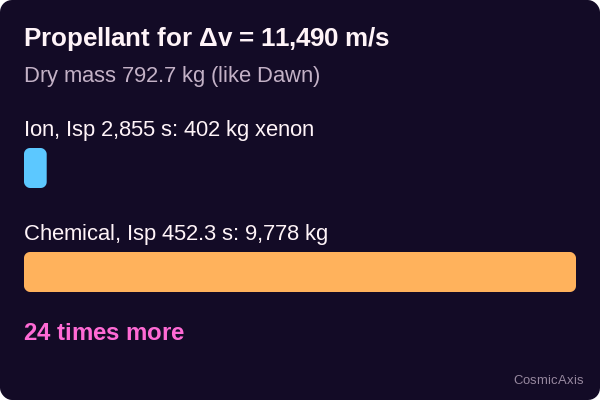
For the same delta-v of 11,490 m/s on a 792.7 kg dry spacecraft, Dawn’s ion engine needs 402 kg of xenon, while a chemical engine with an Isp of 452.3 s like the RS-25, a liquid-propellant engine, needs 9,778 kg, 24 times more (L3Harris). CosmicAxis calculated every number with the rocket equation.
Source
CosmicAxis calculation from NASA JPL Dawn Launch Press Kit and L3Harris RS-25
The inputs come from the Dawn launch press kit (NASA JPL, 2007): 1,217.7 kg at launch, including 425 kg of xenon; each engine pushes at most 91 mN and burns about 3.25 mg of xenon per second. Python (3.14) code:
import math

G0 = 9.80665  # m/s², NIST CODATA

def propellant(dry_kg, dv_ms, isp_s):
    # rocket equation solved for propellant mass
    return dry_kg * (math.exp(dv_ms / (isp_s * G0)) - 1)

def burn_days(prop_kg, thrust_N, isp_s):
    # constant thrust: t = m · Isp · g₀ / F
    return prop_kg * isp_s * G0 / thrust_N / 86400

isp_ion = 0.091 / (3.25e-6 * G0)  # Dawn: 91 mN, 3.25 mg/s
dv = isp_ion * G0 * math.log(1217.7 / (1217.7 - 425))

print(round(isp_ion), "s")                       # Dawn engine Isp
print(round(dv), "m/s")                          # ideal delta-v
print(round(burn_days(425, 0.091, isp_ion)), "days")
print(round(propellant(792.7, 11490, isp_ion)), "kg xenon")
print(round(propellant(792.7, 11490, 452.3)), "kg chemical propellant")
# 2855 s · 12020 m/s · 1514 days · 402 kg xenon · 9778 kg chemical propellant
Reading the results:
- Isp 2,855 s is lower than the 3,100 s of Deep Space 1 because the 3.25 mg/s flow is a rounded figure.
- Ideal delta-v of 12,020 m/s is 4.6% above the 11,490 m/s Dawn actually achieved, because the calculation assumes every gram of xenon is used at maximum thrust.
- 1,514 days of continuous burning would use up the xenon: the price of high Isp is time.
- 9,778 kg of chemical propellant is 92.5% of the spacecraft mass. NASA JPL notes that without ion engines even a mission to Vesta alone would need a much larger spacecraft and launch vehicle.
The practice part stops at the calculation. A real ion thruster needs voltages up to 1,800 V and a large vacuum chamber, so CosmicAxis does not give instructions for building one; work with real engines goes through a university, institute or company laboratory with safety procedures.
03Reality
What did Deep Space 1 and Dawn prove about ion thrusters?
Deep Space 1 proved that an ion thruster can serve as a spacecraft’s main engine, and Dawn proved that ion thrusters can fly a mission around two bodies outside the Earth–Moon system, Vesta and Ceres (NASA JPL).
Deep Space 1 launched on 24/10/1998. On its first start the engine ran only 4.5 minutes and stopped; two weeks later it restarted and ran for 14 days straight. By shutdown on 18/12/2001 it had run 16,265 hours and produced a total delta-v of 4.3 km/s (NASA).
Dawn launched on 27/9/2007 with three NSTAR engines, only one firing at a time. At maximum thrust Dawn took four days to accelerate from 0 to 60 miles per hour (97 km/h). By June 2018 the engines had run 5.87 years and produced a total delta-v of 41,360 km/h, or 11.49 km/s, a record for a spacecraft (NASA JPL).
The figure of 11.49 km/s even exceeds the escape velocity of Earth, 11.186 km/s (NASA NSSDCA). Delta-v is the sum of accumulated accelerations, not the spacecraft’s real speed, but millinewtons applied for long enough still add up to an enormous change in velocity.
Where are ion and Hall thrusters used in 2026?
In 2026, electric propulsion is taking a spacecraft to Mercury, keeping Starlink satellites at altitude, and preparing to fly to Mars.
- BepiColombo (ESA–JAXA) flew to Mercury with four T6 gridded ion thrusters. The last burn ended at 15:24 CEST on 15/6/2026, after an eight-year cruise; the spacecraft is due to enter Mercury orbit on 21/11/2026 (ESA).
- Starlink uses Hall thrusters to maneuver, hold altitude and pull satellites into the atmosphere at end of life. The first generation used krypton, cheaper than xenon but less efficient (Spaceflight Now, 2019); V2 mini uses argon, with 2.4 times the thrust and 1.5 times the Isp of the first generation (SpaceX, 2023).
- The PPE of the Gateway station carries 12 kW AEPS Hall thrusters, designed to move the station to lunar orbit in about 10 months (NASA OIG ML-26-002). On 24/3/2026 NASA stopped Gateway in its current form to focus on infrastructure on the lunar surface, a major change to the Artemis program.
- SR-1 Freedom uses the PPE as its bus: the PPE produces 48 kW of electricity, the engines are 12 kW AEPS Hall thrusters, and a nuclear reactor with a conversion system provides 20 kW of electricity. NASA aims to launch at the end of 2028 to Mars to test nuclear electric propulsion in deep space (NASA, updated 15/9/2026).
Moving the PPE to an uncrewed spacecraft shows that ion thrusters suit cargo and automated vehicles, where long flight time is acceptable; crewed spacecraft still need the large thrust of chemical engines.
04Milestone
Milestone: check yourself
If you can do all of these, move on to the next article in this phase.
- Can you name the three main parts of a gridded ion thruster and explain what the neutralizer does?
- Can you explain why, at the same electric power, higher Isp means lower thrust?
- Can you recompute the 2,855 s Isp of the Dawn engine from 91 mN of thrust and 3.25 mg/s of flow?
- Can you run the Python code that compares 402 kg of xenon with 9,778 kg of chemical propellant for the same delta-v?
Frequently asked questions
What propellant does an ion thruster use?
Ion thrusters usually use xenon: it ionizes easily, its atoms are heavy, it is inert, and it can be stored densely in a tank (NASA). First-generation Starlink used cheaper krypton; Starlink V2 mini uses argon (SpaceX, 2023).
How does an ion thruster differ from a Hall thruster?
A gridded ion thruster uses two high-voltage grids and reaches a higher Isp (NEXT-C up to 4,220 s). A Hall thruster has no grids: a magnetic field traps electrons in a ring-shaped channel, giving more thrust per kilowatt (AEPS 588 mN at 12 kW) (NASA).
What is a plasma thruster, and is it an ion thruster?
Plasma thruster is a general name for electric engines that work with plasma, a gas of positive ions and electrons. Gridded ion thrusters and Hall thrusters both belong to this group (NASA).
References
- NASA Glenn — Ion Propulsion, fact sheet PS-01628 — accessed
- NASA Glenn — NEXT-C fact sheet — accessed
- Forbes et al. — AEPS 12kW Hall Thruster, IEPC-2025-128 — accessed
- NASA JPL — Dawn Launch Press Kit (2007) — accessed
- NASA JPL — Dawn's Engines Complete Firing (28/6/2018) — accessed
- NASA — Deep Space 1 — accessed
- L3Harris — RS-25 spec sheet (2024) — accessed
- ESA — BepiColombo's new trajectory (2/9/2024) — accessed
- ESA — End of the blue glow (24/6/2026) — accessed
- Spaceflight Now — Starlink satellite design (15/5/2019) — accessed
- SpaceX — Argon Hall thruster tech specs (26/2/2023) — accessed
- NASA Release — National Space Policy initiatives (24/3/2026) — accessed
- NASA — Space Reactor-1 Freedom (15/9/2026) — accessed
- NASA OIG ML-26-002 (24/6/2026) — accessed
- NASA NSSDCA — Earth Fact Sheet — accessed
Cite this article
CosmicAxis. (2026). Ion Thruster: How It Works, Hall Thrusters and Dawn. https://cosmicaxis.space/en/ion-thruster/