
Specific Impulse (Isp): Formula and Units
Source
NASA Glenn Research Center; L3Harris RS-25 spec sheet; NIST CODATA
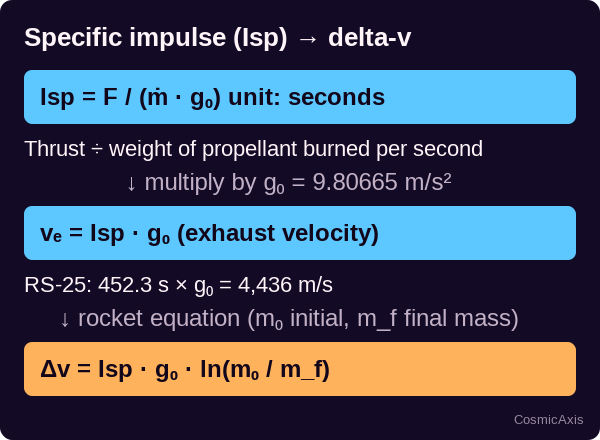
Specific impulse (Isp) is the thrust a rocket engine produces per unit weight of propellant burned each second, measured in seconds. Higher Isp means a more propellant-efficient engine: the RS-25 reaches 452.3 s in vacuum (L3Harris) and the NEXT-C ion thruster up to 4,220 s (NASA).
01Knowledge
How does specific impulse differ from the impulse in a physics textbook?
Specific impulse is the impulse of a rocket’s thrust divided by the weight of the propellant burned to produce it. In school physics, the impulse of a force equals force times the time it acts: I = F · Δt, in N·s. A rocket engine pushing with 1,000 N for 10 seconds delivers a total impulse of 10,000 N·s.
Total impulse alone does not say whether an engine is good, because a bigger engine simply burns more propellant. Dividing total impulse by the weight of propellant burned gives specific impulse (Isp). The word “specific” means “divided by weight” (NASA Glenn Research Center).
A real example: the solid rocket motor (RSRM) of the Space Shuttle boosters, whose joint seals failed in the Challenger O-ring failure, had a total impulse of 297,001,731 lbf·s in vacuum and carried 1,106,059 lbm of propellant (Northrop Grumman). Dividing one by the other gives Isp = 268.5 s, because 1 lbm weighs exactly 1 lbf at standard gravity.
Why is specific impulse measured in seconds?
Specific impulse is measured in seconds because Isp is a velocity divided by an acceleration: (m/s) ÷ (m/s²) = s. NASA Glenn defines Isp = V_eq / g₀, where V_eq is the equivalent exhaust velocity and g₀ is standard gravity. The value g₀ = 9.80665 m/s² is exact by definition (NIST CODATA).
To convert Isp into exhaust velocity, multiply by g₀: vₑ = Isp · g₀. The RS-25 engine has an Isp of 452.3 s in vacuum (L3Harris), so its exhaust leaves at an equivalent velocity of 452.3 × 9.80665 = 4,436 m/s.
An intuitive reading of the unit: Isp is the number of seconds that 1 kg of propellant can sustain a thrust equal to its own weight (9.80665 N). The RS-25’s propellant “holds” that thrust for 452.3 seconds, the RSRM’s only 268.5 seconds.
How is specific impulse related to thrust?
Specific impulse equals thrust divided by the weight of propellant burned per second: Isp = F / (ṁ · g₀), where ṁ is the propellant mass flow rate in kg/s (NASA Glenn Research Center). Rearranged, the same formula gives rocket thrust: F = ṁ · vₑ.
The F-1 engine of the Saturn V checks the formula. NASA MSFC lists the F-1 as pushing 1,522,000 lbf at sea level with a propellant flow of 5,737 lb/s. Dividing the two gives 265.3 s, matching the published Isp of 265.4 s.
High Isp and large thrust are different things (specific impulse vs thrust). The NEXT-C ion thruster has a maximum Isp of 4,220 s, 9.3 times that of the RS-25, but its thrust is only 25–235 mN (NASA GRC). A thrust of 235 mN equals the weight of a 24 g object on the ground.
Why is Isp higher in vacuum than at sea level?
The same engine has a higher Isp in vacuum than at sea level because outside air pushes back on the nozzle exit. NASA Glenn’s thrust equation contains the term A_e · (p_e − p₀): the exit area times the difference between exhaust pressure and ambient pressure. In vacuum p₀ = 0, so the pressure term is at its largest and thrust rises without burning more propellant.
The F-1 engine has an Isp of 265.4 s at sea level and 304.1 s in vacuum (NASA MSFC), which is 14.6% higher. The RS-25 is published with an Isp only in vacuum, 452.3 s, but its thrust is published for both conditions: 418,000 lbf at sea level and 512,300 lbf in vacuum (L3Harris). At the same power level the propellant flow does not change, so Isp is proportional to thrust: the RS-25’s sea-level Isp is about 452.3 × 418,000 / 512,300 = 369.0 s (calculated by CosmicAxis).
What is the Isp of solid, liquid and ion engines?
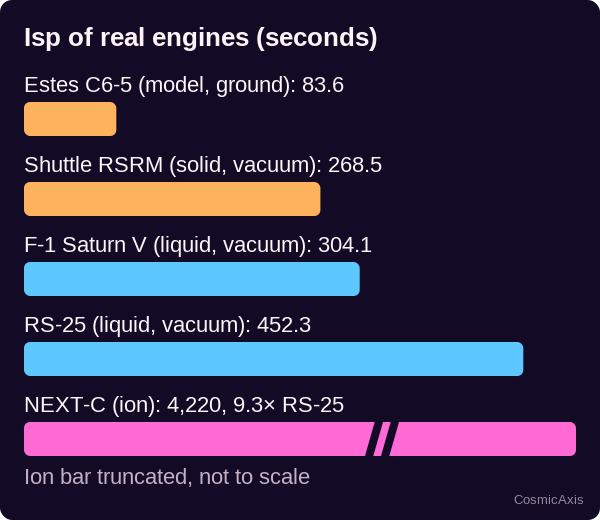
Solid-fuel engines have the lowest Isp, oxygen–hydrogen liquid engines the highest among chemical engines, and ion thrusters deliver an exhaust velocity more than 10 times that of conventional chemical rockets (NASA GRC).
Source
Estes; Northrop Grumman; NASA MSFC; L3Harris; NASA GRC; CosmicAxis calculated Isp of Estes C6-5 and RSRM
| Engine | Type | Isp (s) | Condition | Source, date accessed |
|---|---|---|---|---|
| Estes C6-5 (model rocket) | Solid, commercial | 83.6 | Ground level; calculated by CosmicAxis from 10.00 N·s and 12.2 g | Estes, 2026-09-28 |
| RSRM (Space Shuttle) | Solid | 268.5 | Vacuum; calculated by CosmicAxis from total impulse and propellant mass | Northrop Grumman, 2026-09-28 |
| F-1 (Saturn V) | Liquid: LOX + kerosene | 265.4 / 304.1 | Sea level / vacuum | NASA MSFC, 2026-09-28 |
| RS-25 (Space Shuttle, SLS) | Liquid: LOX + liquid hydrogen | 452.3 | Vacuum | L3Harris, 2026-09-28 |
| NEXT-C (DART spacecraft) | Xenon ion | Up to 4,220 | Vacuum | NASA GRC, 2026-09-28 |
The highest Isp is not automatically the best choice. NASA MSFC notes that kerosene is denser than liquid hydrogen, so its tanks are much smaller and cheaper, despite a considerably lower Isp. Solid motors have a low Isp but very high thrust: each RSRM pushes with an average of 2,600,000 lbf (Northrop Grumman). Choosing an engine is a trade-off between Isp, thrust, tank mass and cost, which is the kind of problem systems engineering exists to handle. The RS-25, successor to the Space Shuttle main engine, is now the core-stage engine of the SLS rocket in the Artemis program (L3Harris). On the SLS, however, its four RS-25 engines are discarded after each flight, which is one reason the rocket launch cost of an Artemis mission is at least 4.2 billion USD (NASA OIG).
Why does Isp matter in the rocket equation?
Isp matters because delta-v is directly proportional to Isp: Δv = Isp · g₀ · ln(m₀ / m_f), where m₀ is the initial mass and m_f is the mass at engine cutoff.
Reaching a 200 km low Earth orbit takes a total delta-v of 9,159 m/s according to a NASA Langley study (NASA TM-2015-218760). Solving the rocket equation backwards gives the mass ratio m₀/m_f = e^(Δv / (Isp · g₀)):
- Isp 268.5 s (like the RSRM): mass ratio 32.4, meaning 96.9% of liftoff mass must be propellant.
- Isp 304.1 s (like the F-1 in vacuum): ratio 21.6, propellant 95.4%.
- Isp 452.3 s (like the RS-25 in vacuum): ratio 7.9, propellant 87.3%.
These figures are ideal single-stage limits, calculated by CosmicAxis. With a low Isp, almost nothing is left for structure, engines and payload, which is why real rockets are staged. Raising Isp by 1% raises delta-v by exactly 1%, while adding 1% more propellant raises delta-v by much less. Isp also sets the propellant needed to brake: the Space Shuttle used the atmosphere to slow from orbital velocity, burning its engines only briefly (Columbia’s deorbit burn lasted 2 minutes 38 seconds) before atmospheric reentry (CAIB).
02Practice
How can you practice specific impulse safely?
The safe way to practice is to calculate Isp from the published specifications of a certified commercial model rocket motor, then simulate the flight in software. CosmicAxis does not give instructions for building engines or mixing propellant in any form, because homemade motors can kill.
The manufacturer Estes lists the C6-5 model motor at a total impulse of 10.00 N·s with 12.2 g of propellant. The Isp works out to 10.00 / (0.0122 × 9.80665) = 83.6 s. The letter “C” in the motor code is the total-impulse class (the NAR sorts motors by letter class), and the final “5” is the delay time of 5 seconds (Estes). The Python code below does that calculation:
# m/s², NIST CODATA
G0 = 9.80665

def isp(total_impulse_Ns, propellant_kg):
    # specific impulse, seconds
    return total_impulse_Ns / (propellant_kg * G0)

print(round(isp(10.00, 0.0122), 1))
# 83.6 s: Estes C6-5
The next step is OpenRocket, a free model rocket simulator with a built-in database of commercial solid motors that computes peak altitude, velocity and stability for each motor.
To use larger motors, follow the certification ladder of the US National Association of Rocketry (NAR) or Tripoli. NAR Level 1 certification allows H and I motors, Level 2 allows J, K and L, Level 3 allows M, N and O; each level requires the previous one (NAR). The CosmicAxis practice ladder goes from model rockets to a flight computer and then to a CubeSat, and does not pass through building your own engine.
03Reality
What does Falcon 1 teach about thrust in a vacuum?
Falcon 1 shows that a thrust too small to measure on the ground can still ruin a whole flight in a vacuum. The third Falcon 1 flight (August 2, 2008) failed at stage separation because the new regeneratively cooled Merlin 1C kept producing residual thrust longer than predicted: the leftover chamber pressure of roughly 10 psi barely showed on the test stand in Texas, where the outside pressure is 14.5 psi, but in a vacuum it was enough to push the first stage back into the second (NASA MSFC, 2010). On the ground, atmospheric pressure swamps the residual thrust; in a vacuum p₀ = 0, so the residual thrust shows itself in full, exactly as in the vacuum section above. This is the kind of chain reaction that failure-mode analysis such as FMEA has to catch before flight.
Every document used in this article is public; the L3Harris RS-25 sheet and the Northrop Grumman catalog both state that they contain no technical data controlled under ITAR export rules. Learners building a crewed spacecraft can use the principles and published figures; the details of building a real engine are outside what is shared publicly.
04Milestone
Milestone: check yourself
If you can do all of these, move on to the next article in this phase.
- Can you explain why specific impulse is measured in seconds?
- Can you convert Isp to exhaust velocity (and back) using g₀ = 9.80665 m/s²?
- Can you calculate the Isp of a commercial model rocket motor from the total impulse and propellant mass printed on its package?
- Can you explain why the same engine has a higher Isp in vacuum than at sea level?
Frequently asked questions
What are the units of specific impulse?
Specific impulse (Isp) is measured in seconds (s), the same in SI and imperial units, because Isp equals exhaust velocity divided by standard gravity g₀ = 9.80665 m/s². Isp quoted in N·s/kg (that is, m/s) is the exhaust velocity itself: vₑ = Isp · g₀.
How does specific impulse differ from thrust?
Thrust says how hard an engine pushes, in newtons; Isp says how much impulse each kilogram of propellant delivers. The NEXT-C ion thruster has a maximum Isp of 4,220 s but only 25–235 mN of thrust (NASA GRC), while the F-1 engine has an Isp of 265.4 s at sea level and pushes with 1,522,000 lbf (NASA MSFC).
How are specific impulse and delta-v related?
Delta-v is directly proportional to specific impulse: Δv = Isp · g₀ · ln(m₀/m_f). To reach 9,159 m/s to low Earth orbit, an engine with Isp 452.3 s needs a mass ratio of 7.9, while an engine with Isp 268.5 s needs 32.4.
Why are ion thrusters with high Isp not used to launch rockets from the ground?
Ion thrusters cannot launch from the ground because their thrust is far too small: the 235 mN maximum of NEXT-C equals the weight of a 24 g object.
References
- NASA Glenn Research Center — Specific Impulse — accessed
- NIST CODATA — Standard acceleration of gravity (g_n) — accessed
- Betts — Waking a Giant: Saturn F-1 Engine, NASA MSFC — accessed
- L3Harris — RS-25 spec sheet, 07/2024 — accessed
- Northrop Grumman — Propulsion Products Catalog, RSRM section — accessed
- Tartabini et al. — NASA/TM-2015-218760, section 5.0 — accessed
- NASA Glenn Research Center — NEXT-C fact sheet — accessed
- Richards — JANNAF Lessons Learned Panel Discussion, NASA MSFC, 5/2010 — accessed
- NASA SP-2014-617 — Commercial Orbital Transportation Services — accessed
- Estes Rockets — C6-5 Engines — accessed
- National Association of Rocketry — High Power Rocketry Certification — accessed
- OpenRocket — accessed
Cite this article
CosmicAxis. (2026). Specific Impulse (Isp): What It Is and Why It Is in Seconds. https://cosmicaxis.space/en/specific-impulse/