
Escape velocity: first, second and third cosmic velocity
Source
GM constants: NASA JPL; calculated by CosmicAxis
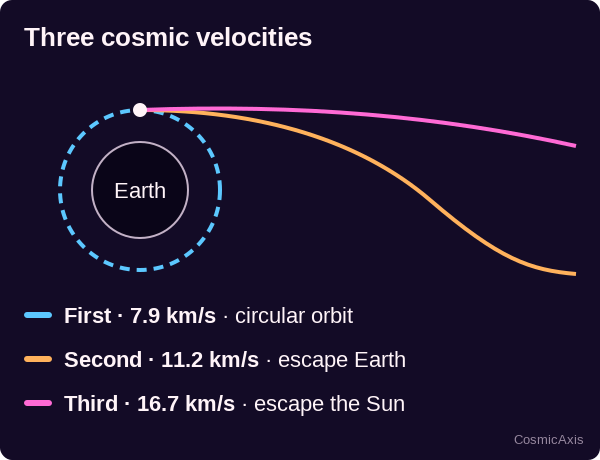
Earth's first cosmic velocity is 7.9 km/s (circular orbit at the surface), the second is 11.2 km/s (escape velocity, leaving Earth) and the third is 16.7 km/s (leaving the Solar System). CosmicAxis calculated them from NASA JPL GM constants, ignoring the atmosphere.
01Knowledge
What are the first, second and third cosmic velocities of Earth?
Earth’s three cosmic velocities are 7.9 km/s, 11.2 km/s and 16.7 km/s: the minimum speeds at the surface, ignoring air, to orbit Earth, escape Earth and escape the Solar System. These three numbers underpin orbital mechanics.
| Level | Goal | Velocity (km/s) | Source, date |
|---|---|---|---|
| First cosmic velocity | Circular orbit at the surface | 7.910 | CosmicAxis calculation from NASA JPL GM, 2026-09-29 |
| Second (escape velocity) | Escape Earth’s gravity | 11.186 | CosmicAxis calculation; NASA NSSDCA lists 11.186, 2026-09-29 |
| Third | Escape the Solar System | 16.65 | CosmicAxis calculation from NASA JPL solar GM, 2026-09-29 |
None of the three depends on the object’s mass: a 1 kg satellite and a space station weighing hundreds of tonnes need the same speed. Mass only sets how much propellant must be burned; how engines produce that speed is in how rockets work.
What is the formula for the first cosmic velocity?
The first cosmic velocity equals the square root of Earth’s gravitational parameter divided by its radius: v₁ = √(GM / R). With GM = 398,600.435507 km³/s² (NASA JPL) and a mean radius of 6,371.0 km (NASA NSSDCA), v₁ = 7.910 km/s.
Proof: for a circular path, gravity GMm / R² must equal the centripetal force mv² / R. Cancel m and R to get v² = GM / R. Since g = GM / R², the formula can also be written v₁ = √(g · R); textbook problems often round, for example g = 9.8 m/s² and R = 6,400 km give 7,920 m/s.
Books differ because they pick different radii: the equatorial radius of 6,378.137 km gives 7,905 m/s (the figure the delta-v budget article used), the mean radius gives 7,910 m/s. Both round to 7.9 km/s. The formula also shows that higher satellites fly slower, so v₁ is the largest possible circular orbital velocity.
Why is the second cosmic velocity √2 times the first?
The second cosmic velocity is √2 times the first because kinetic energy must cancel the gravitational potential energy: v₂ = √(2GM / R) = 1.4142 × 7.910 = 11.186 km/s.
The proof uses conservation of energy. Gravitational potential energy at the surface is −GMm / R and zero infinitely far away. An object just escapes if it arrives infinitely far away at zero speed, so total energy is zero: mv² / 2 − GMm / R = 0, hence v² = 2GM / R.
The second cosmic velocity is also called escape velocity. The 11.186 km/s figure matches the “Escape velocity” value in NASA NSSDCA’s Earth fact sheet exactly. It does not depend on direction, as long as the object does not hit air or ground. A speed between the first and second velocities gives an ellipse, flatter the faster the object goes: Apollo used such a very flat ellipse to reach the Moon, and so does the Artemis program today.
How is the third cosmic velocity calculated?
The third cosmic velocity is the minimum launch speed from the ground to escape both Earth and the Sun, equal to 16.65 km/s when launching in the direction of Earth’s motion around the Sun (CosmicAxis calculation). It takes three steps:
- Earth’s speed around the Sun: √(GM☉ / au), with GM☉ = 1.32712440041 × 10¹¹ km³/s² and 1 au = 149,597,870.7 km (NASA JPL), gives 29.785 km/s. NASA NSSDCA lists a mean of 29.78 km/s.
- The part to add: escape speed from the Sun at 1 au is √2 × 29.785 = 42.122 km/s. An object riding with Earth already has 29.785 km/s, so it needs only 12.337 km/s more. This is the hyperbolic excess velocity (v∞). Passing close to a planet, a spacecraft keeps the magnitude of v∞ relative to that planet but changes direction, which changes its speed relative to the Sun without propellant: a gravity assist.
- Combine with Earth’s gravity: to still have v∞ after leaving Earth, energy conservation gives v₃² = v₂² + v∞², so v₃ = √(11.186² + 12.337²) = 16.65 km/s.
This figure ignores the atmosphere and Earth’s rotation. Earth’s orbit is not perfectly circular either: its speed varies from 29.29 to 30.29 km/s over the year (NASA NSSDCA), so the real v₃ depends on launch date.
How fast does the International Space Station fly?
The International Space Station (ISS) flies at 7.64–7.69 km/s, one orbit every 92–94 minutes, at the altitudes NASA publishes of 370–460 km (CosmicAxis calculation using v = √(GM / r) and T = 2π · √(r³ / GM)).
NASA says the ISS loses altitude gradually to drag from the very thin upper atmosphere and must periodically fire engines to reboost. More than 15 orbits a day set the rhythm of life aboard the station.
Why does reaching low orbit take more delta-v than the first cosmic velocity?
Reaching low orbit takes more delta-v than the first cosmic velocity because the rocket loses speed to gravity and drag on the way up (about 1,375 m/s in NASA’s example in the delta-v article), partly offset by Earth’s rotation to the east.
Source
NASA NSSDCA, ESA, Vietnam Ministry of Foreign Affairs; calculated by CosmicAxis
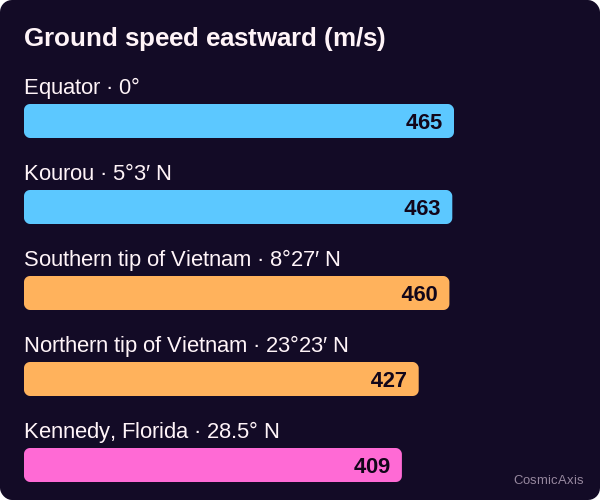
The ground at latitude φ moves east at 2π · R · cos φ / T, with R = 6,378.137 km and a rotation period T = 23.9345 hours (NASA NSSDCA):
| Place | Latitude | Rotation speed (m/s) | Latitude source, date |
|---|---|---|---|
| Equator | 0° | 465 | Definition, 2026-09-29 |
| Kourou, French Guiana | 5°3′ N | 463 | ESA, 2026-09-29 |
| Southern tip of mainland Vietnam | 8°27′ N | 460 | Ministry of Foreign Affairs, 2026-09-29 |
| Northern tip of Vietnam | 23°23′ N | 427 | Ministry of Foreign Affairs, 2026-09-29 |
| Kennedy, Florida | 28.5° N | 409 | NASA TM-2015-218760, 2026-09-29 |
The speed column is CosmicAxis’s calculation. ESA says Kourou gains 460 m/s from Earth’s rotation, which matches. In theory a pad at the southern tip of Vietnam would gain almost as much as Kourou (3 m/s less), while Kennedy is 54 m/s behind Kourou.
The benefit is full only when launching due east. The ISS orbit is inclined 51.6° (NASA), so rockets must fly northeast. NASA TM-2015-218760 calculates for one rocket a payload of 32,334 lbm to a 51.6° orbit, against 34,351 lbm launching due east from Kennedy, a 5.9% drop.
02Practice
How do you calculate the first and second cosmic velocities for Earth, the Moon and Mars in Python?
Calculating the first and second cosmic velocities for any body needs only GM and radius. The code below uses NASA JPL’s GM and NASA NSSDCA’s mean radius, and also computes the third.
import math

# km³/s², NASA JPL (DE440)
GM = {"Earth": 398600.435507, "Moon": 4902.800118, "Mars": 42828.375816}
# km, mean radius, NASA NSSDCA
R = {"Earth": 6371.0, "Moon": 1737.4, "Mars": 3389.5}
# km³/s² and km, NASA JPL
GM_SUN = 1.32712440041279419e11
AU = 149597870.7

def v1(gm, r):
    # circular orbital speed at the surface, km/s
    return math.sqrt(gm / r)

def v2(gm, r):
    # escape speed at the surface, km/s
    return math.sqrt(2 * gm / r)

for name in GM:
    print(f"{name}: v1 = {v1(GM[name], R[name]):.3f}, v2 = {v2(GM[name], R[name]):.3f} km/s")

v_earth = math.sqrt(GM_SUN / AU)
v_inf = (math.sqrt(2) - 1) * v_earth
v3 = math.sqrt(v2(GM["Earth"], R["Earth"]) ** 2 + v_inf ** 2)
print(f"Earth around the Sun {v_earth:.3f}, extra needed {v_inf:.3f}, v3 = {v3:.2f} km/s")
Output on CosmicAxis’s machine (Python 3.14):
Earth: v1 = 7.910, v2 = 11.186 km/s
Moon: v1 = 1.680, v2 = 2.376 km/s
Mars: v1 = 3.555, v2 = 5.027 km/s
Earth around the Sun 29.785, extra needed 12.337, v3 = 16.65 km/s
The computed escape velocities match NASA NSSDCA’s fact sheets after rounding: Moon 2.38 km/s, Mars 5.03 km/s. Exercise: compute v1 at 400 km altitude (r = R + 400) to get the ISS speed. To travel far on little propellant, spacecraft use the ion thruster: tiny thrust, but running for months, so a large delta-v accumulates.
03Reality
What speeds did Sputnik 1, Luna 1 and New Horizons reach?
Sputnik 1 (1957) was the first human-made object to reach orbital velocity, Luna 1 (1959) was the first spacecraft to reach escape velocity, and New Horizons (2006) is the fastest spacecraft ever to leave Earth.
Sputnik 1, 4 October 1957. The Soviet 22-inch aluminum sphere flew an elliptical orbit with a 96-minute period (NASA History). By Kepler’s laws, that period corresponds to a semi-major axis of 6,945 km, where circular orbital speed is 7.58 km/s (CosmicAxis calculation).
Luna 1, 2 January 1959. NASA lists Luna 1 as the first probe to reach escape velocity and the first to enter solar orbit. The upper stage burned longer than planned, so 34 hours after launch the probe passed about 4,000 miles (6,400 km) from the Moon instead of hitting it.
New Horizons, 19 January 2006. The STAR-48 upper stage sent the Pluto-bound probe off at 36,000 miles per hour, or 16.09 km/s (CosmicAxis conversion); it crossed the Moon’s orbit after 9 hours (NASA). That figure is close to v₃ but not directly comparable, since it is measured at stage burnout hundreds of kilometers up, where escape velocity is lower than at the surface.
The reverse is just as hard: a spacecraft returning at close to the first or second cosmic velocity must dump all its kinetic energy as heat, the problem of atmospheric reentry.
04Milestone
Milestone: check yourself
If you can do all of these, move on to the next article in this phase.
- Can you prove v₁ = √(GM/R) and v₂ = √2 · v₁ yourself?
- Can you recompute the third cosmic velocity, 16.65 km/s, from Earth's 29.785 km/s around the Sun?
- Can you run the Python code and compare the results with NASA's fact sheets?
- Can you explain why a launch site near the equator, launching east, helps?
Frequently asked questions
What is escape velocity?
Escape velocity is the minimum speed at which an object can travel infinitely far away with no further thrust. At Earth's surface it equals the second cosmic velocity, 11.2 km/s.
What Mach number is the first cosmic velocity?
The first cosmic velocity (7,910 m/s) is about Mach 23, taking the sea-level speed of sound as 760 mph, or 340 m/s (NASA Glenn). In orbit there is almost no air, so Mach number loses its meaning.
Must a rocket reach 11.2 km/s as it leaves the pad?
No. Escape velocity falls with altitude: 11.19 km/s at the surface but 10.85 km/s at 400 km (CosmicAxis calculation). A rocket accelerates gradually and only needs escape velocity at the altitude of engine cutoff.
References
- NASA JPL Solar System Dynamics — Astrodynamic Parameters (GM from DE440, au) — accessed
- NASA NSSDCA — Earth Fact Sheet — accessed
- NASA NSSDCA — Moon Fact Sheet — accessed
- NASA NSSDCA — Mars Fact Sheet — accessed
- NASA — International Space Station (reference) — accessed
- NASA/TM-2015-218760 — Payload Performance Analysis for a Reusable Two-Stage-to-Orbit Vehicle — accessed
- ESA — Europe's Spaceport — accessed
- Vietnam Ministry of Foreign Affairs — Some information on the geography of Vietnam — accessed
- NASA History — Sputnik and the Origins of the Space Age — accessed
- NASA Science — Deep Space Robotic Firsts — accessed
- NASA History — 60 Years Ago: Luna 2 Makes Impact in Moon Race — accessed
- NASA History — 15 Years Ago: New Horizons Launched to Pluto and Beyond — accessed
- NASA Glenn — Role of the Mach Number — accessed
Cite this article
CosmicAxis. (2026). Escape Velocity: First, Second, Third Cosmic Velocity. https://cosmicaxis.space/en/escape-velocity/