
Lagrange points
Source
NASA Science, ESA; conceptual diagram by CosmicAxis
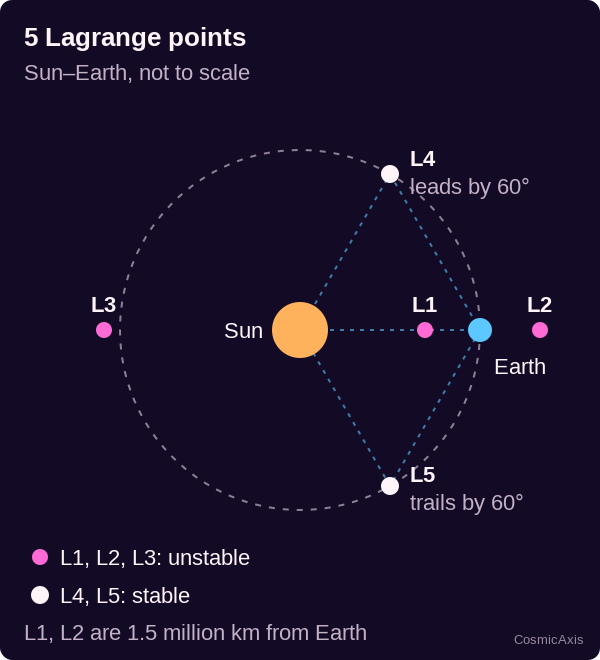
Lagrange points are 5 positions in a two-body system where the pull of both bodies keeps a small object circling in step with them (NASA). For the Sun and Earth, L1 and L2 lie 1.5 million km from Earth (ESA); L1–L3 are unstable, while L4 and L5 are stable because the mass ratio exceeds 24.96 (NASA).
01Knowledge
What is a Lagrange point?
A Lagrange point is a position in a system of two large bodies where the pull of both equals the centripetal force a small object needs to circle in step with them (NASA). Every such system has exactly five, L1 to L5.
Joseph-Louis Lagrange found the five points in his prize-winning 1772 essay on the three-body problem (NASA). He solved the restricted version: the third object is so light that it does not disturb the two large ones, like a spacecraft beside the Sun and Earth (Gordon, NASA 1992).
In the frame rotating around the shared center of mass, a Lagrange point is where the two gravitational pulls and the centrifugal force cancel.
In orbital mechanics, Lagrange points seem to bend the third of Kepler’s laws: an object farther from the Sun than Earth should move slower. Earth’s extra pull makes an object at L2 move faster than the circular orbital velocity √(GM/r) of the Sun alone at that distance, just fast enough to complete one lap per year alongside Earth (ESA).
Where are the five Lagrange points L1–L5?
L1, L2 and L3 lie on the line joining the two bodies, while L4 and L5 sit at the apexes of two equilateral triangles whose other two corners are the bodies (NASA). For the Sun–Earth system:
- L1 lies between the Sun and Earth, 1.5 million km from Earth; the solar wind passes L1 about 1 hour before reaching Earth (ESA).
- L2 lies behind Earth as seen from the Sun, also 1.5 million km away, about 4 times the Moon’s greatest distance (ESA).
- L3 lies on the far side of the Sun, hidden from Earth (ESA).
- L4 leads Earth by 60° along its orbit and L5 trails it by 60° (ESA).
Earth–Moon and Sun–Jupiter each have their own five points; both Earth sets lie far beyond ordinary satellite orbits, geostationary included.
Why are L1 and L2 about 1.5 million km from Earth?
L1 and L2 lie about 1.5 million km from Earth because their distance from the smaller body is roughly the separation a times the cube root of m divided by 3M: r ≈ a · ∛(m / 3M), where m and M are the small and large masses (Cornish, NASA WMAP 1998).
The force balance is a fifth-degree equation with no closed-form solution, so Cornish keeps the lowest-order term, usually called the Hill sphere radius.
Plugging in numbers: the Sun is 328,901 times as massive as Earth plus Moon (CosmicAxis calculation from NASA JPL GM values), and a = 149,597,870.7 km. The cube root of 1/(3 × 328,901) is 0.01004, so r ≈ 1.50 million km, matching ESA’s figure.
Which Lagrange points are stable?
L1, L2 and L3 are unstable, while L4 and L5 are stable when the larger body is more than 24.96 times as massive as the smaller one, true for both Sun–Earth and Earth–Moon (NASA).
On the potential map of the rotating frame, L1, L2 and L3 are saddle points, so a nudged object drifts away (NASA). Cornish finds that a displacement from Sun–Earth L1 or L2 grows by a factor of e in about 23 days; at L3 the saddle is weaker and the figure is about 150 years.
L4 and L5 are hilltops. An object starts to roll off, but once it has velocity in the rotating frame, the Coriolis acceleration bends its path into a loop around L4 or L5, much as cyclones form (NASA). Coriolis wins only when the mass ratio exceeds 25 · (1 + √(1 − 4/625)) / 2 = 24.96 (Cornish).
So a spacecraft at L1 or L2 must fire its engine periodically for station-keeping, while asteroids gather at L4 and L5 on their own (ESA).
How do halo, Lissajous and NRHO orbits differ?
A halo orbit is a periodic three-dimensional orbit around a Lagrange point, while a Lissajous orbit is only quasi-periodic: its shape changes from loop to loop and it is usually smaller (Gordon, NASA 1992).
Robert Farquhar coined “halo” in the late 1960s for an orbit around the Lagrange point behind the Moon, wide enough that the spacecraft always appears from Earth like a halo (Gordon).
The most elongated halo orbit near the Moon is the near-rectilinear halo orbit (NRHO). NASA’s 2019 reference trajectory for the Gateway station is an NRHO around Earth–Moon L2, southern family: mean period 6.562 days, a 9:2 resonance with the lunar synodic period to avoid Earth’s shadow, mean closest approach 3,366 km from the Moon’s center, and low station-keeping cost. Why Orion picked NRHO over low lunar orbit is covered in trajectory to the Moon.
A halo orbit must be integrated numerically in a many-body model, the job of software such as GMAT, and cannot be solved by hand like a Hohmann transfer orbit.
02Practice
How do you calculate L1 and L2 in Python?
You calculate L1 and L2 in Python by finding the root of “net acceleration on the axis joining the two bodies equals zero” in the rotating frame, which scipy’s brentq does once you give it an interval where the function changes sign.
Source
NASA JPL, NASA NSSDCA; CosmicAxis calculation
The problem is normalized: the bodies are 1 apart, and μ is the small body’s share of the total mass.
import math
from scipy.optimize import brentq

GM_SUN, GM_EARTH, GM_MOON = 1.32712440041279419e11, 398600.435507, 4902.800118  # km³/s², NASA JPL
AU, R_MOON = 149_597_870.7, 384_400  # km: IAU 2012; Moon's orbit, NASA NSSDCA

def accel_x(x, mu):
    # net acceleration on the axis through both bodies, normalized rotating frame (R = 1, ω = 1)
    d1, d2 = x + mu, x - 1 + mu
    return x - (1 - mu) * d1 / abs(d1)**3 - mu * d2 / abs(d2)**3

for name, M, m, R in [("Sun–Earth", GM_SUN, GM_EARTH + GM_MOON, AU),
                      ("Earth–Moon", GM_EARTH, GM_MOON, R_MOON)]:
    mu, e = m / (M + m), 1e-9
    L1 = brentq(accel_x, -mu + e, 1 - mu - e, args=(mu,))  # between the two bodies
    L2 = brentq(accel_x, 1 - mu + e, 2, args=(mu,))        # beyond the smaller body
    r1, r2 = (1 - mu - L1) * R, (L2 - 1 + mu) * R
    hill = (mu / 3) ** (1 / 3) * R
    print(f"{name}: L1 {r1:,.0f} km, L2 {r2:,.0f} km, Hill {hill:,.0f} km "
          f"({100 * (r1 / hill - 1):+.1f} % / {100 * (r2 / hill - 1):+.1f} %)")

threshold = 25 * (1 + math.sqrt(1 - 4 / 625)) / 2   # L4/L5 stable when M/m exceeds this (Cornish)
tau = 365.25636 / (2 * math.pi * math.sqrt(1 + 2 * math.sqrt(7)))  # days for L1/L2 drift to grow e-fold
print(f"L4/L5 threshold: {threshold:.2f}; Sun/Earth {GM_SUN / (GM_EARTH + GM_MOON):,.0f}; "
      f"Earth/Moon {GM_EARTH / GM_MOON:.1f}; τ = {tau:.1f} days")
Output on CosmicAxis’s machine (Python 3.14, scipy 1.18):
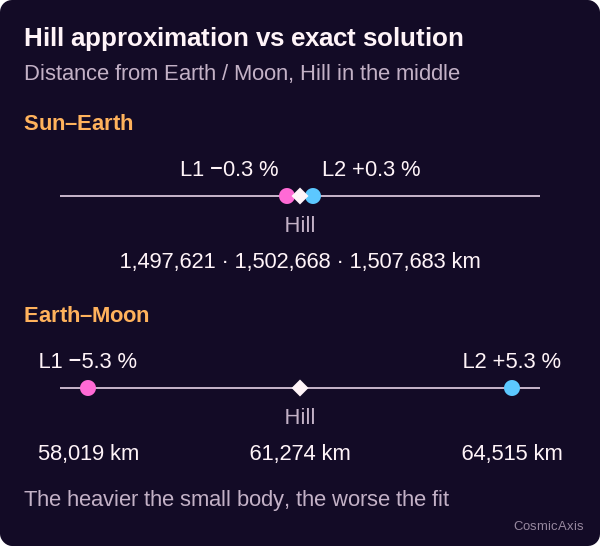
Sun–Earth: L1 1,497,621 km, L2 1,507,683 km, Hill 1,502,668 km (-0.3 % / +0.3 %)
Earth–Moon: L1 58,019 km, L2 64,515 km, Hill 61,274 km (-5.3 % / +5.3 %)
L4/L5 threshold: 24.96; Sun/Earth 328,901; Earth/Moon 81.3; τ = 23.2 days
Sun–Earth L1 and L2 lie 1.50 and 1.51 million km from Earth, matching ESA, and the Hill approximation is 0.3% off. For Earth–Moon it is 5.3% off because the Moon is 1/81.3 of Earth’s mass, so real designs must solve the equation exactly. The last line recomputes NASA’s 23-day figure.
03Reality
Where is the James Webb Space Telescope and how does it orbit L2?
The James Webb Space Telescope (JWST) flies a halo orbit around the Sun–Earth L2 point, 1.5 million km from Earth, with each loop around L2 taking about 6 months; it launched on 25 December 2021 and entered its L2 orbit on 24 January 2022 (NASA).
JWST passed the Moon’s orbital distance after 3 days but needed about 30 days to reach L2. Three correction burns total only about 24 m/s (CosmicAxis sum of NASA figures): 20 m/s right after launch, 2.8 m/s on 27 December 2021, and 1.6 m/s in a 297-second burn on 24 January 2022.
L2 suits an infrared telescope because the Sun, Earth and Moon always lie on the same side, so one sunshield blocks all three.
L2 is unstable, so JWST corrects its orbit every 21 days, a typical burn being about 12 cm/s. The NASA Goddard team (Dichmann et al., 2014) put the station-keeping delta-v budget at 25.5 m/s for 10.5 years, or 2.43 m/s per year, about 2.4 times the usual L1 and L2 level, because sunlight pressure on the sunshield changes whenever the telescope turns. NASA judged that the telescope has fuel for well over 10 years of science.
Which spacecraft and asteroids sit at Lagrange points?
Sun–Earth L1 hosts solar observers such as SOHO and DSCOVR (NOAA), L2 hosts telescopes such as JWST and Gaia, and L4 and L5 are where Trojan asteroids gather by themselves (NASA, ESA).
| Spacecraft or body | Point | Key milestone | Source, accessed |
|---|---|---|---|
| ISEE-3 | Sun–Earth L1 | Entered halo orbit 20 November 1978, the first spacecraft around a Lagrange point | NASA Science, 2026-10-03 |
| SOHO | Sun–Earth L1 | Launched 2 December 1995, entered Lissajous orbit 14 February 1996, turned 30 in December 2025 | NASA Science, 2026-10-03 |
| Gaia | Sun–Earth L2 | Launched 2013, left L2 for a retirement orbit 27 March 2025 | ESA, 2026-10-03 |
| CAPSTONE | Earth–Moon NRHO | Launched 28 June 2022, entered NRHO 13 November 2022, the first spacecraft in this orbit | NASA, 2026-10-03 |
| 2010 TK7 | Sun–Earth L4 | Confirmed by the WISE telescope in 2010, Earth’s first Trojan | NASA Science, 2026-10-03 |
Trojans are most numerous at Sun–Jupiter L4 and L5, named after three asteroids: Agamemnon, Achilles and Hector (NASA). NASA’s Lucy spacecraft will fly past the first Trojan, Eurybates, on 11 August 2027.
NRHO was NASA’s chosen orbit for the Gateway station of the Artemis program. In February 2026 NASA restructured Artemis, dropping Gateway’s role as a staging station in favor of a permanent Moon base, and in April 2026 it ordered a halt to building the HALO module (NASA OIG ML-26-002). The game Kerbal Space Program has no Lagrange points at all, because at any moment a ship in the game feels the pull of only one body.
04Milestone
Milestone: check yourself
If you can do all of these, move on to the next article in this phase.
- Can you explain why an object at L2 orbits in step with Earth even though it is farther from the Sun?
- Can you estimate the Sun–Earth L2 distance by hand with r ≈ a·∛(m/3M)?
- Can you say why L4 and L5 are stable while L1, L2 and L3 are not?
- Can you run the Python code and adapt it to the Sun–Jupiter system?
Frequently asked questions
How far is the James Webb Space Telescope from Earth?
The James Webb Space Telescope orbits the Sun–Earth L2 point, about 1.5 million km from Earth, roughly 4 times the Moon's greatest distance (NASA, ESA).
What is the L2 point?
L2 is the second Lagrange point, on the Sun–Earth line behind Earth as seen from the Sun, 1.5 million km away; an object there orbits the Sun in step with Earth (ESA).
What is the three-body problem?
The three-body problem asks how three mutually attracting objects move. Even the restricted form leads to a fifth-degree equation with no closed-form solution; Lagrange found 5 special solutions in 1772 (NASA, Cornish).
References
- NASA — What is a Lagrange Point? — accessed
- ESA — What are Lagrange points? — accessed
- ESA — L2 — accessed
- Cornish — The Lagrange Points, NASA WMAP, 1998 — accessed
- Gordon — Lissajous and Halo Orbits, NASA, 1992 — accessed
- NASA JPL — Astrodynamic Parameters — accessed
- NASA NSSDCA — Moon Fact Sheet — accessed
- NASA — Webb Orbit — accessed
- NASA — Webb — accessed
- NASA — Webb Arrives at L2, 2022 — accessed
- NASA — Webb's Excess Fuel, 2021 — accessed
- Dichmann et al. — JWST Stationkeeping, NASA, 2014 — accessed
- NASA — ISEE-3 — accessed
- NASA — SOHO — accessed
- NOAA NESDIS — DSCOVR — accessed
- ESA — Farewell Gaia, 2025 — accessed
- NASA — Lucy — accessed
- NASA — Gateway NRHO Reference Trajectory, 2019 — accessed
- NASA — CAPSTONE — accessed
- NASA OIG ML-26-002, 2026 — accessed
Cite this article
CosmicAxis. (2026). Lagrange Points: L1–L5, Halo Orbits and James Webb. https://cosmicaxis.space/en/lagrange-points/