
What is a Hohmann transfer orbit?
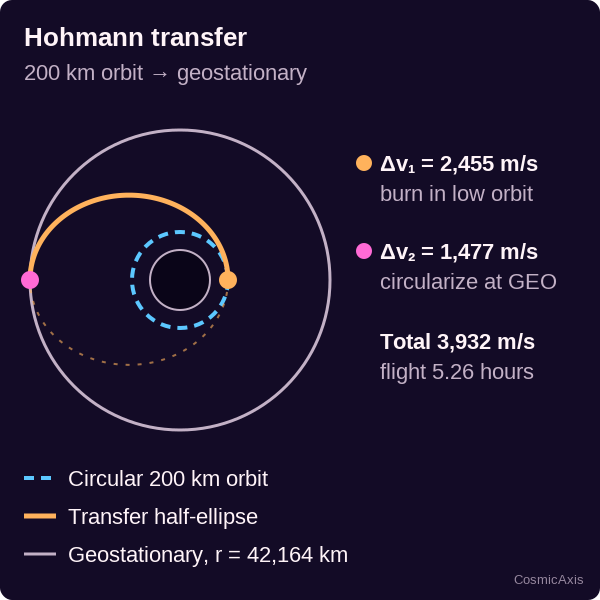
Source
GM constants: NASA JPL; radii: NASA NSSDCA; calculated by CosmicAxis
A Hohmann transfer orbit is a half-ellipse joining two coplanar circular orbits with just two engine burns. From a 200 km orbit to geostationary it takes 3,932 m/s and 5.26 hours; from Earth to Mars it takes 259 days (calculated by CosmicAxis from NASA JPL constants, matching the NASA JPL lesson plan).
01Knowledge
What is a Hohmann transfer orbit?
A Hohmann transfer orbit is a half-ellipse tangent to two coplanar circular orbits, used to move a spacecraft from one orbit to the other with two engine burns. It is named after the German scientist Walter Hohmann, who published it in 1925 (NASA JPL, Doody 2007).
- First burn (Δv₁) in the inner orbit: the spacecraft speeds up, and the circle becomes an ellipse whose farthest point touches the outer orbit.
- Coasting for half an ellipse, with no propellant used.
- Second burn (Δv₂) at the farthest point: the spacecraft speeds up again, and the ellipse becomes the outer circle.
In orbital mechanics, every orbit-changing leg of a delta-v budget is compared against the Hohmann figure. Both burns sit where the ellipse touches a circle, so thrust only changes the speed and no propellant is spent turning the flight direction. The price is a slower flight than routes that burn more propellant.
How does the vis-viva equation give the two Hohmann burns?
The vis-viva equation says that the square of the speed at any point of an orbit equals GM times the difference between twice the inverse distance to the center and the inverse semi-major axis: v² = GM · (2/r − 1/a).
GM is the gravitational constant times the mass of the central body, r is the distance to the center, and a is the semi-major axis. For a circle r = a, so the equation reduces to v = √(GM / r), the first cosmic velocity. The transfer ellipse between radii r₁ and r₂ has a = (r₁ + r₂) / 2, so:
- Δv₁ = speed at the ellipse’s nearest point − inner circular speed = √(GM · (2/r₁ − 1/a)) − √(GM / r₁).
- Δv₂ = outer circular speed − speed at the ellipse’s farthest point = √(GM / r₂) − √(GM · (2/r₂ − 1/a)).
- Transfer time = half the period of the ellipse, from Kepler’s third law: t = π · √(a³ / GM).
The total delta-v depends only on GM and the two radii, not on the mass of the spacecraft.
How much delta-v does a Hohmann transfer from low orbit to geostationary orbit need?
A Hohmann transfer from a 200 km circular orbit to a coplanar geostationary orbit needs 3,932 m/s: a first burn of 2,455 m/s and a second of 1,477 m/s, over a flight of 5.26 hours (calculated by CosmicAxis).
Earth’s GM is 398,600.435507 km³/s² (NASA JPL) and its equatorial radius is 6,378.137 km (NASA NSSDCA), so r₁ = 6,578.137 km. ESA gives the geostationary altitude as 35,786 km, so r₂ = 42,164 km.
| Point on the flight path | Speed (m/s) | Source, date |
|---|---|---|
| Circular orbit at 200 km | 7,784 | Calculated by CosmicAxis from NASA JPL GM, 2026-09-29 |
| Ellipse nearest point, after Δv₁ | 10,239 | Calculated by CosmicAxis, 2026-09-29 |
| Ellipse farthest point, before Δv₂ | 1,597 | Calculated by CosmicAxis, 2026-09-29 |
| Geostationary orbit | 3,075 | Calculated by CosmicAxis; ESA gives about 3 km/s, 2026-09-29 |
The first two rows differ by Δv₁, the last two by Δv₂. Without the second burn, the spacecraft falls back to the ellipse’s nearest point.
When is a bi-elliptic transfer cheaper than a Hohmann transfer?
A bi-elliptic transfer can cost less delta-v than a Hohmann transfer only when the target orbit radius is more than 11.94 times the starting radius, and it always costs less when the ratio exceeds 15.58 (calculated by CosmicAxis with vis-viva).
A bi-elliptic transfer uses three burns: climb into an ellipse reaching beyond the target orbit, raise the nearest point there, then brake at the target orbit. Far out the spacecraft moves slowly, so changing orbit is cheap. CosmicAxis example: from a 200 km orbit to a circular orbit 20 times farther out (131,563 km), a Hohmann transfer costs 4,162 m/s and takes 25 hours, while a bi-elliptic transfer looping out to 263,125 km costs 4,092 m/s but takes 190 hours.
Geostationary orbit (ratio 6.41) and Mars (ratio 1.52) are both below the threshold, so Hohmann is the default for chemical engines. An ion-engine spacecraft thrusts for months and does not coast along a Hohmann arc (NASA). The Moon follows the same logic: the lowest-delta-v path is a Hohmann half-ellipse of about 5 days, and Apollo burned a few tens of m/s harder to arrive two days sooner (see the trajectory to the Moon).
Why does a trip to Mars have to wait for a launch window?
A trip to Mars has to wait for a launch window because a Hohmann flight takes 259 days, so at launch Mars must lead Earth by 44° to be at the meeting point, and that geometry repeats only once per synodic period of 779.94 days (NASA NSSDCA; calculated by CosmicAxis).
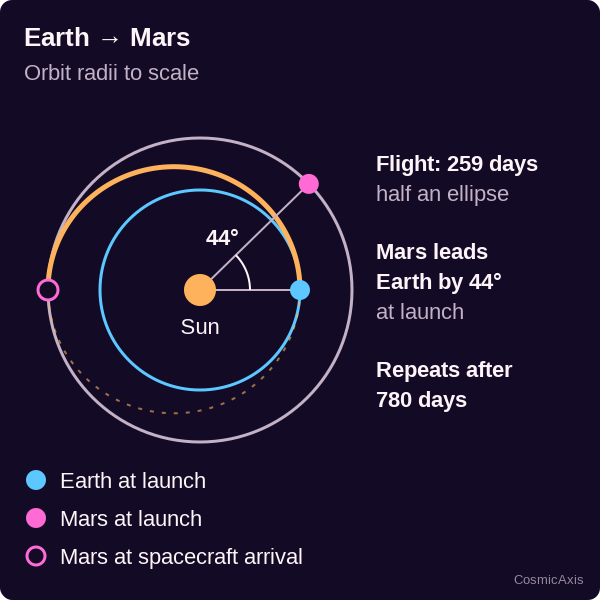
Source
NASA JPL, NASA NSSDCA; calculated by CosmicAxis
Now the central body is the Sun, with GM = 1.32712440041 × 10¹¹ km³/s² (NASA JPL). Earth’s semi-major axis is 149.598 million km and Mars’s is 227.956 million km (NASA NSSDCA). Treating both orbits as circular, vis-viva gives:
- The spacecraft leaves Earth 2.95 km/s faster than Earth moves, and arrives at Mars 2.65 km/s slower than Mars moves.
- The transfer ellipse has a period of 518 days; the spacecraft flies half of it, 259 days.
- In 259 days Mars (period 686.980 days) travels 136°, so at launch it must lead by 180° − 136° = 44°.
The NASA JPL lesson plan “Let’s Go to Mars!” gives the same three numbers: 259 days, 136° and 44°. Earth laps Mars once every 779.94 days; NASA writes that launch opportunities repeat “about every 26 months” (779.94 days is 25.6 months).
02Practice
How do you calculate a Hohmann transfer in Python?
A Hohmann transfer needs only the vis-viva equation and Python’s built-in math library. The code below computes the geostationary transfer, the Mars transfer, the departure burn from a 200 km orbit, and the launch phase angle.
import math

# km³/s², NASA JPL
GM_EARTH = 398600.435507
GM_SUN = 1.32712440041279419e11

def hohmann(gm, r1, r2):
    # two burns (km/s) and transfer time (s) between two circular orbits
    a = (r1 + r2) / 2
    v1, v2 = math.sqrt(gm / r1), math.sqrt(gm / r2)
    # vis-viva: v² = GM · (2/r − 1/a)
    vp = math.sqrt(gm * (2 / r1 - 1 / a))
    va = math.sqrt(gm * (2 / r2 - 1 / a))
    t = math.pi * math.sqrt(a**3 / gm)
    return vp - v1, v2 - va, t

# 200 km orbit → geostationary, km (NASA NSSDCA)
r_leo = 6378.137 + 200
dv1, dv2, t = hohmann(GM_EARTH, r_leo, 42164)
print(f"LEO→GEO: {dv1*1000:.0f} + {dv2*1000:.0f} = {(dv1+dv2)*1000:.0f} m/s, {t/3600:.2f} hours")

# Earth → Mars, semi-major axes (km), NASA NSSDCA
dv1, dv2, t = hohmann(GM_SUN, 149.598e6, 227.956e6)
print(f"Earth→Mars: {dv1:.2f} + {dv2:.2f} km/s, {t/86400:.0f} days")

# departure burn from the 200 km orbit that leaves dv1 to spare after escaping Earth
v_leo = math.sqrt(GM_EARTH / r_leo)
dv_depart = math.sqrt(dv1**2 + 2 * GM_EARTH / r_leo) - v_leo
print(f"Departure burn from 200 km orbit: {dv_depart:.2f} km/s")

# orbital periods (days), NASA NSSDCA
T_EARTH, T_MARS = 365.256, 686.980
synodic = 1 / (1 / T_EARTH - 1 / T_MARS)
phase = 180 - 360 * (t / 86400) / T_MARS
print(f"Synodic period {synodic:.1f} days, Mars leads by {phase:.1f}°")
Output on the CosmicAxis machine (Python 3.14):
LEO→GEO: 2455 + 1477 = 3932 m/s, 5.26 hours
Earth→Mars: 2.95 + 2.65 km/s, 259 days
Departure burn from 200 km orbit: 3.61 km/s
Synodic period 779.9 days, Mars leads by 44.3°
The third line merges the escape from Earth and the spare 2.95 km/s into one 3.61 km/s burn by conservation of energy. For real, inclined orbits use GMAT, NASA’s open-source mission analysis software; the Python library poliastro has been unmaintained since October 2023.
03Reality
How did VINASAT-1 reach geostationary orbit through a transfer orbit?
A communications satellite such as VINASAT-1 reaches geostationary orbit in a near-Hohmann way: the rocket releases it into a geostationary transfer orbit (GTO), and the satellite’s own engine burns at the farthest point, 35,786 km up, to circularize the orbit (ESA).
VINASAT-1 launched at 22:17 UTC on 18 April 2008 on an Ariane 5 ECA, flight V182 from Kourou, the rocket family that broke up in the Ariane 5 flight 501 failure. ESA records the satellite entering the transfer orbit about 30 minutes after liftoff, and calls it the first telecommunications satellite among Vietnam’s satellites.
GTO differs from the ideal Hohmann transfer in its plane: ESA explains that a launch site away from the equator tilts the transfer orbit, and the burn at the farthest point also removes the tilt. CosmicAxis calculated that burn, nearest point at 200 km:
- No tilt: 1,477 m/s.
- Tilt of 5.05°, the latitude of Kourou (5°3′ N, ESA): 1,490 m/s.
- Tilt of 28.5°, the latitude of Kennedy Space Center (NASA TM-2015-218760): 1,836 m/s.
How long does the trip from Earth to Mars take in practice?
Real spacecraft take 203 to 307 days to fly from Earth to Mars, around the ideal Hohmann figure of 259 days, because in each launch year the two planets sit at different points on their elliptical orbits (NASA).
| Flight | Launch → Mars arrival | Flight time (days) | Source, date |
|---|---|---|---|
| Ideal Hohmann | — | 259 | Calculated by CosmicAxis; NASA JPL Education, 2026-09-29 |
| Curiosity | 26 Nov 2011 → 6 Aug 2012 | 254 | NASA Science, 2026-09-29 |
| MAVEN | 18 Nov 2013 → 21 Sep 2014 | 307 | NASA Science, 2026-09-29 |
| Perseverance | 30 Jul 2020 → 18 Feb 2021 | 203 | NASA Science, 2026-09-29 |
CosmicAxis counted the days from NASA’s published launch and arrival dates. NASA calls a path sweeping less than 180° around the Sun Type-I, and 180° or more Type-II; MAVEN swept more than 180° in 10 months, so it flew a Type-II path close to Hohmann, not the ideal half-ellipse. The Perseverance launch window ran from 20 July to 11 August 2020, and the landing date stayed the same whichever day it launched (NASA JPL). Every one of these flights ends in Mars entry, descent and landing, which for Perseverance took about 7 minutes (JPL, 2021).
For crewed vehicles, the launch window sets the length of the entire trip: a crewed mission lasts at least 600 days (Bret Drake, NASA, 2013). Spending that long in weightlessness with no resupply is a life-support problem; Mars-500 tested 520 days of such isolation in a Mars simulation habitat on Earth.
04Milestone
Milestone: check yourself
If you can do all of these, move on to the next article in this phase.
- Can you write the vis-viva equation and recompute the two burns of 2,455 m/s and 1,477 m/s?
- Can you explain why Hohmann transfer time equals half the period of the transfer ellipse?
- Can you calculate the 44° lead angle Mars must have over Earth at launch?
- Can you explain why launching from Kourou to geostationary orbit costs less delta-v than launching from Florida?
Frequently asked questions
What is the synodic period?
The synodic period is the time for two planets to return to the same position relative to the Sun. For Earth and Mars it is 779.94 days (NASA NSSDCA), so Mars launch windows repeat about every 26 months.
How long does it take to get from Earth to Mars?
An ideal Hohmann transfer takes 259 days (calculated by CosmicAxis, matching the NASA JPL lesson plan). Real spacecraft took from 203 days (Perseverance) to 307 days (MAVEN), depending on the launch year (NASA).
Is the Hohmann transfer the cheapest route in delta-v?
It is the cheapest two-burn transfer between coplanar circular orbits. When the target orbit is more than 11.94 times larger than the starting orbit, a bi-elliptic transfer can cost less but takes far longer (calculated by CosmicAxis).
References
- NASA JPL — Astrodynamic Parameters — accessed
- NASA NSSDCA — Earth Fact Sheet — accessed
- NASA NSSDCA — Mars Fact Sheet — accessed
- Doody — Basics of Interplanetary Flight, NASA JPL, 2007 — accessed
- NASA — Basics of Space Flight, Chapter 4 — accessed
- NASA JPL Education — Let's Go to Mars! Calculating Launch Windows — accessed
- NASA — Mars Mission Timeline — accessed
- NASA JPL — Mars 2020 Launch Press Kit, Mission Overview — accessed
- NASA — Mars 2020: Perseverance Rover — accessed
- NASA — MSL Curiosity — accessed
- NASA — MAVEN — accessed
- NASA — Hohmann Transfer Orbit (MAVEN), 2014 — accessed
- Drake — Human Missions to Mars: Key Challenges, NASA, 2013 — accessed
- NASA/TM-2015-218760 — accessed
- ESA — Types of orbits — accessed
- ESA — Ariane 5 V182 (2008) — accessed
- poliastro (GitHub, archived) — accessed
- NASA GMAT (GitHub) — accessed
Cite this article
CosmicAxis. (2026). Hohmann Transfer Orbit: Formula, Delta-v, Earth to Mars. https://cosmicaxis.space/en/hohmann-transfer-orbit/