
Trajectory to the Moon: TLI, free return and NRHO
Source
NASA MSC-00171; NASA Artemis II Press Kit; NASA CAPSTONE
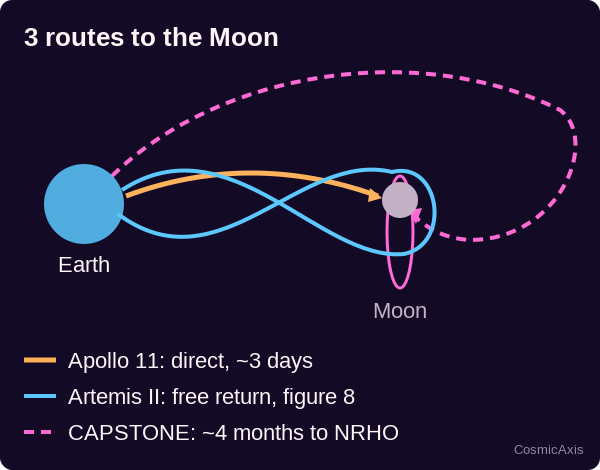
A spacecraft reaches the Moon with a translunar injection (TLI) burn from a parking orbit, coasts about 3 days on a stretched ellipse, then brakes into lunar orbit (LOI). Apollo 11 used a 3,182 m/s TLI and an 889 m/s LOI (NASA MSC-00171); CosmicAxis's patched-conic model gives an 874 m/s LOI. A 4-month route like CAPSTONE's saves propellant.
01Knowledge
What stages does a trip to the Moon go through?
A trip to the Moon has four stages: a parking orbit around Earth, the translunar injection (TLI) burn, about 3 days of free coast, and the lunar orbit insertion (LOI) burn. Apollo 11 flew exactly these four stages in 1969 (NASA MSC-00171):
- Parking orbit: 2.5 hours in a 100.7 × 99.2 nautical mile orbit (186.5 × 183.7 km).
- TLI: the S-IVB stage burned 347.3 seconds for 3,182 m/s of delta-v, turning a near-circular orbit into a stretched ellipse whose far point sits at the Moon’s mean distance of 384,400 km (NSSDCA).
- Coast: 73.0 hours, from TLI cutoff (ground elapsed time 2:50:03) to the LOI burn (75:49:50).
- LOI: the SPS engine braked by 2,917.5 ft/s (889 m/s) into a 169.7 × 60.0 nautical mile orbit (314.3 × 111.1 km).
The spacecraft aims at where the Moon will be: at 1.022 km/s (NSSDCA), the Moon moves about 265,000 km in 72 hours (CosmicAxis calculation). The cheapest path is half of a Hohmann transfer orbit, about 5 days; Apollo burned a few tens of m/s harder to arrive two days sooner.
What are patched conics and the Moon’s sphere of influence?
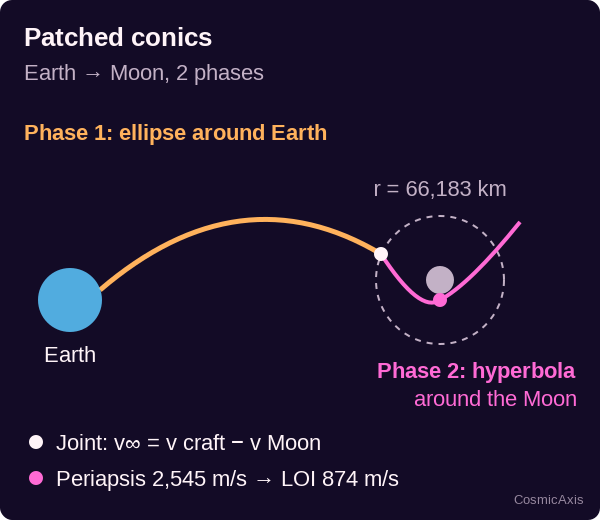
Patched conics is an approximation that splits the flight into conic sections; on each, the spacecraft feels the pull of one body only, and the pieces join at the edge of that body’s sphere of influence. In NASA’s Artemis I timeline, entering the lunar sphere of influence is the moment the Moon replaces Earth as the main pull (Artemis I Mission Timeline).
Source
CosmicAxis calculation from NASA JPL and NSSDCA
The Laplace formula gives the sphere of influence radius as the distance between the bodies times the mass ratio to the power 2/5: r = a · (m/M)^(2/5). With NASA JPL’s GM values and a = 384,400 km, r = 66,183 km, about 17% of the way (CosmicAxis calculation).
- Phase 1: an ellipse around Earth; flight time comes from Kepler’s equation, the basis of Kepler’s laws.
- Joint: the spacecraft velocity minus the Moon’s velocity gives the hyperbolic excess velocity v∞.
- Phase 2: a hyperbola around the Moon, because the spacecraft arrives faster than the Moon’s escape velocity. Periapsis speed is v_p = √(v∞² + 2 · GM / r_p).
Patched conics is least accurate near the boundary, where the two pulls are comparable, but it is good enough to estimate delta-v. The game Kerbal Space Program computes orbits this way.
Why does a free return trajectory make a figure 8?
A free return trajectory makes a figure 8 because the spacecraft swings behind the Moon, the Moon’s pull bends its path, and on the way home it crosses its outbound track. NASA describes Artemis II’s path as a figure 8 stretching more than 230,000 miles (370,149 km) from Earth and returning by gravity alone (Artemis II Press Kit).
The Moon turns the spacecraft like a gravity assist: v∞ keeps its magnitude but changes direction. With the right periapsis, the new direction brings the spacecraft back at a safe angle for atmospheric reentry.
Apollo 11 shows how sensitive this path is (MSC-00171, section 7.4): a 1.6 ft/s (0.5 m/s) error at TLI moved the periapsis from 718.9 to 896.3 nautical miles, and one 20.9 ft/s correction brought it back to 61.5 nautical miles (113.9 km). Table 7-IV records that, without the LOI burn, the spacecraft would still have entered Earth’s atmosphere at ground elapsed time 145:04:32.
The price is that periapsis, orbital plane and arrival time are locked, so few landing sites are reachable. In return, if the main engine fails the spacecraft still has a way home, as in the Apollo 13 oxygen tank explosion.
Which lunar orbit should a spacecraft enter: LLO, NRHO or DRO?
The target orbit is chosen by the delta-v the spacecraft can carry: Orion has about 1,250 m/s, enough to enter and leave a near-rectilinear halo orbit (NRHO) but not a low lunar orbit (LLO), according to NASA’s analysis by Whitley and Martinez (2015).
| Orbit | Period | Orion delta-v in + out (m/s) | Source, accessed |
|---|---|---|---|
| LLO 100 km | ~2 hours | ~900 + ~900 | Whitley, Martinez 2015, 2026-10-04 |
| NRHO | 6–8 days | 840 (stay 10.9 days) | Whitley, Martinez 2015, 2026-10-04 |
| DRO | ~14 days | 957 (stay 6 days) | Whitley, Martinez 2015, 2026-10-04 |
| Orion capability | — | ~1,250 | Whitley, Martinez 2015, 2026-10-04 |
Orion can enter LLO, but without an extra propulsion stage it cannot afford the 900 m/s home. NRHO is a halo orbit around the L2 Lagrange point passing near both lunar poles. A distant retrograde orbit (DRO) is a large loop around the lunar equator, flown against the Moon’s motion. Both exist only in the restricted three-body problem, which has no hand-solvable Kepler ellipse.
NASA chose NRHO for the Gateway station in the Artemis program because holding a spacecraft there takes so little propellant that a large vehicle can park for at least 15 years (NASA, 10 November 2022).
02Practice
How can you simulate the trip to the Moon in Python?
You can simulate the trip to the Moon in Python with the two-phase patched-conic model above, NASA constants and the standard library. The model uses a 185 km parking orbit and a 60.0 × 169.7 nautical mile LOI ellipse like Apollo 11 (CosmicAxis assumption). The function outbound takes the TLI delta-v and returns flight time, v∞, periapsis speed and LOI delta-v; a bisection finds the TLI for exactly 73.0 hours.
from math import sqrt, acos, sin, hypot

MU_E, MU_M = 398600.435507, 4902.800118  # km³/s², NASA JPL DE440
R_E, R_M = 6378.137, 1737.4              # km, NASA NSSDCA
D, V_MOON = 384400.0, 1.022              # km, km/s, NASA NSSDCA
R0 = R_E + 185                           # 185 km parking orbit
RP, RA = R_M + 111.1, R_M + 314.3        # LOI ellipse 60.0 × 169.7 nmi

def outbound(dv):
    v0 = sqrt(MU_E / R0) + dv            # phase 1: ellipse around Earth
    a = 1 / (2 / R0 - v0**2 / MU_E)
    e = 1 - R0 / a
    E = acos((1 - D / a) / e)
    hours = (E - e * sin(E)) * sqrt(a**3 / MU_E) / 3600
    v, vt = sqrt(MU_E * (2 / D - 1 / a)), R0 * v0 / D
    v_inf = hypot(vt - V_MOON, sqrt(v * v - vt * vt))  # phase 2: around the Moon
    vp = sqrt(v_inf**2 + 2 * MU_M / RP)
    loi = vp - sqrt(MU_M * (2 / RP - 2 / (RP + RA)))
    return hours, v_inf * 1000, vp * 1000, loi * 1000

print(f"Sphere of influence: {D * (MU_M / MU_E) ** 0.4:,.0f} km")
for dv in (3.14, 3.16, 3.20):
    hours, vi, vp, loi = outbound(dv)
    print(f"TLI {dv * 1000:.0f} m/s: {hours:5.1f} h, v∞ {vi:4.0f}, LOI {loi:4.0f} m/s")

lo, hi = 3.14, 3.30                      # bisection: TLI that gives 73.0 h like Apollo 11
for _ in range(50):
    mid = (lo + hi) / 2
    lo, hi = (mid, hi) if outbound(mid)[0] > 73.0 else (lo, mid)
hours, vi, vp, loi = outbound(lo)
print(f"73.0 h: TLI {lo * 1000:.0f}, periapsis {vp:.0f}, LOI {loi:.0f} m/s")
print(f"Apollo 11: periapsis {8334 * 0.3048:.0f}, LOI {2917.5 * 0.3048:.0f} m/s")
# Sphere of influence: 66,183 km
# TLI 3140 m/s:  92.1 h, v∞  897, LOI  801 m/s
# TLI 3160 m/s:  70.9 h, v∞ 1114, LOI  888 m/s
# TLI 3200 m/s:  56.2 h, v∞ 1455, LOI 1054 m/s
# 73.0 h: TLI 3157, periapsis 2545, LOI 874 m/s
# Apollo 11: periapsis 2540, LOI 889 m/s
How far does the patched-conic model deviate from Apollo 11?
The patched-conic model matches Apollo 11 within 2%: for the same 73.0 hours of flight, periapsis speed is 2,545 m/s against 2,540 m/s actual (0.2% off), and LOI is 874 m/s against 889 m/s actual (1.7% off) (CosmicAxis calculation; actual values from MSC-00171, tables 7-III and 7-V).
- Arriving faster is paid for twice. Adding 60 m/s at TLI (3,140 to 3,200 m/s) cuts flight time from 92.1 to 56.2 hours, but v∞ rises from 897 to 1,455 m/s, so LOI costs 253 m/s more.
- The model’s TLI is 25 m/s below the report (3,157 against 3,182 m/s) because the model treats the burn as instantaneous; the S-IVB burned 347 seconds, so part of its delta-v went into gravity loss.
- The LOI is 1.7% off because the model ignores the Moon’s pull in phase 1, the eccentricity of the Moon’s orbit (363,300–405,500 km, NSSDCA) and the tilt of its orbital plane.
Exercise: set RA = RP to calculate LOI into a circular orbit, then convert it to propellant mass with the Tsiolkovsky rocket equation and specific impulse. An advanced step is NASA’s GMAT, with real ephemerides, several bodies pulling at once and a Target–Vary–Achieve sequence to find the TLI that reaches a 111 km periapsis.
03Reality
How do the Artemis I and Artemis II trajectories differ?
Uncrewed Artemis I flew into a DRO around the Moon in 2022, while Artemis II carries 4 astronauts on a figure-8 free return trajectory and does not enter lunar orbit (NASA).
Artemis I, 16 November – 11 December 2022 (Artemis I Mission Timeline):
- The ICPS stage burned TLI at flight time 1:29:27. On 21 November, Orion made a powered flyby about 81 miles (130 km) above the surface.
- On flight day 10 Orion entered the DRO; on flight day 13 it was farthest from Earth, 268,563 miles (432,210 km).
- On flight day 16 Orion left the DRO and made a second flyby on 5 December at 80.6 miles (129.7 km), then headed home.
Artemis II (Artemis II Press Kit):
- The ICPS stage lifts Orion to a high orbit of about 44,525 × 115 miles (71,656 × 185 km) to check out the spacecraft close to home.
- On flight day 2, Orion’s service module burns TLI. NASA records that this burn doubles as the departure-from-orbit burn, because gravity then brings the spacecraft home by itself.
- The spacecraft flies about 4 days to the Moon, swings behind it and returns, with 3 small trajectory corrections each way.
How did CAPSTONE reach NRHO in 4 months?
CAPSTONE reached NRHO in 4 months by a ballistic lunar transfer: it took a detour through deep space, let the Sun’s gravity bend its path, then met the Moon at a low relative speed. NASA states that this route sharply cuts the propellant needed to reach the Moon (Release 22-067).
- CAPSTONE is a 12U CubeSat of 55 pounds (25 kg), launched on 28 June 2022 on an Electron rocket; the Lunar Photon stage burned several times over 6 days before releasing it onto the transfer.
- After 5 self-corrections, on 13 November 2022 CAPSTONE burned into NRHO while traveling 3,800 miles per hour (1.70 km/s) (NASA, 10 November 2022).
- On NRHO the spacecraft passes within 1,000 miles (1,609 km) of the north pole and out to 43,500 miles (70,006 km) over the south pole, once every 6.5 days.
Whitley and Martinez (2015) find that with a few months of flight, entering NRHO costs under 100 m/s, while entering LLO still needs at least 628 m/s. The slow route suits only uncrewed spacecraft, because astronauts should not spend 4 months in deep space exposed to space radiation. More articles on mission operations are collected under deep space operations.
04Milestone
Milestone: check yourself
If you can do all of these, move on to the next article in this phase.
- Can you calculate the radius of the Moon's sphere of influence?
- Can you explain why a faster trip to the Moon makes the LOI burn more expensive?
- Can you compare the delta-v to enter and leave LLO, NRHO and DRO with what Orion can supply?
- Can you edit the Python code to calculate the LOI into a circular orbit?
Frequently asked questions
What is the Artemis II trajectory?
Artemis II flies a figure-8 free return trajectory: Orion climbs to a high Earth orbit, fires its own translunar injection, flies about 4 days, swings behind the Moon, and gravity pulls it home (NASA Artemis II Press Kit).
What is TLI?
TLI (translunar injection) is the burn that turns a parking orbit around Earth into an elongated ellipse reaching the Moon's distance. Apollo 11's TLI burned 347.3 seconds for 3,182 m/s of delta-v (NASA MSC-00171).
What is NRHO?
NRHO (near-rectilinear halo orbit) is a long orbit around the Moon. CAPSTONE passes within 1,609 km of the north pole and out to 70,006 km over the south pole, once every 6.5 days (NASA Release 22-067).
References
- NASA MSC-00171 — Apollo 11 Mission Report (1969) — accessed
- NASA JPL — Astrodynamic Parameters — accessed
- NASA NSSDCA — Moon Fact Sheet — accessed
- Whitley, Martinez — Options for Staging Orbits in Cis-Lunar Space (NASA, 2015) — accessed
- NASA — Artemis I Mission Timeline — accessed
- NASA — Artemis I — accessed
- NASA — Artemis II Press Kit (2026) — accessed
- NASA — CAPSTONE — accessed
- NASA Release 22-067 — CAPSTONE launches (28 June 2022) — accessed
- NASA — CAPSTONE will soon reach the Moon's orbit (10 November 2022) — accessed
Cite this article
CosmicAxis. (2026). Trajectory to the Moon: TLI, Free Return and NRHO. https://cosmicaxis.space/en/trajectory-to-the-moon/