
Falcon 9 CRS-7 Failure: Why It Exploded in 2015
Source
NASA IRT, SpaceX CRS-7 Accident Investigation Report Public Summary (12 March 2018), pages 5–7; SpaceX CRS-7 Investigation Update (20 July 2015)
Falcon 9 flight CRS-7 broke up about 139 seconds after launch on 28 June 2015. According to SpaceX, a steel strut holding a helium bottle in the stage 2 liquid oxygen tank failed at 2,000 lbf despite a 10,000 lbf certification. The NASA Independent Review Team (March 2018) called the use of an industrial-grade cast steel part a design flaw.
01Knowledge
What happened to Falcon 9 on the CRS-7 mission?
Falcon 9 flight CRS-7 broke up about 139 seconds after leaving pad LC-40 at Cape Canaveral at 10:21 Eastern time on 28 June 2015, carrying a Dragon cargo capsule to the ISS. It was SpaceX’s seventh cargo mission for NASA, flown on Falcon 9 version 1.1 after 13 successful flights of that version.
According to the NASA Independent Review Team (IRT) public summary (12 March 2018), stage 1 ran normally and the trouble began in the stage 2 liquid oxygen (LOX) tank. Video shows these times in UTC:
| Time (UTC) | Event on video | Source, date viewed |
|---|---|---|
| 14:23:31.062 | Gas begins leaving stage 2 | NASA IRT table 1, 2026-10-03 |
| 14:23:33.759 | Dragon seen separating from the rocket | NASA IRT table 1, 2026-10-03 |
| 14:23:39.339 | Rocket begins to break up completely | NASA IRT table 1, 2026-10-03 |
The decisive part was much faster: SpaceX (20 July 2015) put the time from the first anomaly to loss of telemetry at 0.893 s; the IRT gives 800–900 milliseconds. The case belongs in the structures and reentry phase because the root cause was a structural part, not an engine.
Why did one strut break up the whole Falcon 9 second stage?
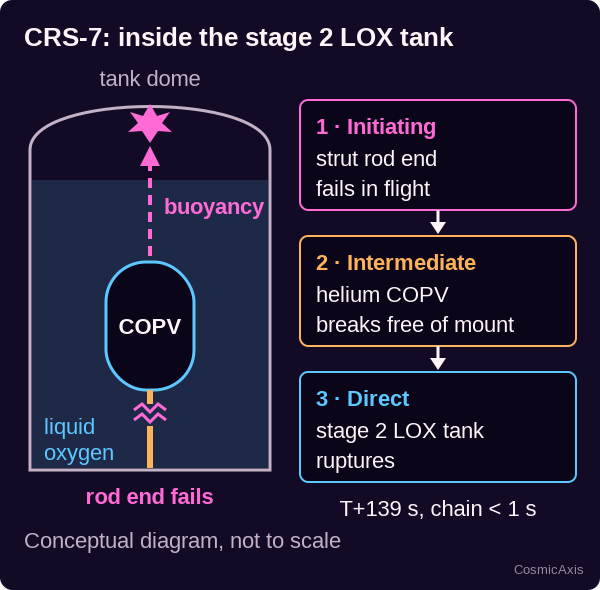
One strut broke up stage 2 because it held a high-pressure helium bottle inside the LOX tank. The IRT split the event into three levels of cause, all rated “credible”:
- Initiating: an axial strut broke, most likely at the rod end, a cast stainless steel eyebolt.
- Intermediate: the composite overwrapped pressure vessel (COPV) holding helium broke free of its mount and ruptured the helium plumbing in the tank.
- Direct: the stage 2 LOX tank ruptured.
The bottle is lighter than the LOX it displaces, so when the rocket accelerates, buoyancy pulls it toward the nose: F = (ρ_LOX · V − m_bottle) · a, with a the acceleration, measured in g-force. Once the strut broke, the IRT wrote, the bottle “accelerated by buoyancy” into the tank dome.
SpaceX said each Falcon 9 carries a few hundred such struts, flown several thousand times in total. One small part became a single point of failure, as on the first flight of Falcon 1, where a corroded aluminum nut leaked fuel and caused a fire. AMOS-6 (September 2016) was different: according to the NASA Inspector General (IG-20-005), it exploded on the pad before a static fire, and SpaceX believed the COPV itself buckled during loading.
Where do SpaceX and NASA disagree on the cause of CRS-7?
SpaceX and NASA agree on the direct and intermediate causes but differ on the initiating cause: SpaceX named a material defect as “most likely”, while the IRT kept five causes equally credible and added a design-flaw finding.
| Question | SpaceX | NASA IRT | Source, date viewed |
|---|---|---|---|
| Strut strength | Certified 10,000 lbf, failed at 2,000 lbf | No force published | SpaceX 20 July 2015, 2026-10-03 |
| Initiating cause | Material defect | Material defect, manufacturing damage, incorrect assembly, secondary damage, another part fractured | IRT p. 7, 2026-10-03 |
| Design flaw | Not stated | Yes (finding TF-1) | IRT p. 8, 2026-10-03 |
The failure force was one fifth of the certified force: about 8.9 versus 44.5 kN (CosmicAxis unit conversion with NIST SP 811). According to the NASA Inspector General (IG-16-025), SpaceX tested struts from the same purchase order and found casting defects, material “out of specification” and wrong heat treatment.
The IRT explained most of 115 telemetry indicators and left 9 unexplained. It could not exclude four of the five causes, so it wrote “credible” rather than “most likely”.
Why did NASA call the CRS-7 strut a design flaw?
NASA called it a design flaw because SpaceX placed an industrial-grade cast 17-4 PH stainless steel part in a critical load path at cryogenic temperature, with no extra screening, no flight-condition load test, and against the manufacturer’s recommended 4:1 safety factor (IRT, finding TF-1). Three layers of protection were skipped:
- Material grade. Industrial grade differs from aerospace grade in the level of screening.
- Manufacturer’s safety factor. A 4:1 recommendation means working load should be a quarter of rated strength (CosmicAxis interpretation), nearly three times the 1.4 factor that NASA-STD-5001B requires for flight metallic structure.
- Load testing. The part was not modeled and tested under flight conditions: immersion in LOX, vibration, acceleration.
A material certificate describes test samples, not each piece in the box.
02Practice
How do you calculate the CRS-7 strut load and safety factor in Python?
Python gives the strut load in a few lines: net buoyant mass times acceleration, then strength divided by force. Bottle size, shell and thread are assumptions; only the 10,000 and 2,000 lbf figures come from SpaceX. The margin of safety follows NASA-STD-5001B: MS = allowable load / (limit load × 1.4) − 1, and MS ≥ 0 passes. The 6 g level is the limit axial load for payloads over 1,800 kg in the Falcon Payload User’s Guide (March 2025, table 5-3), not the real acceleration at second 139.
import math

LBF = 4.448222                  # N per lbf (NIST SP 811)
RHO_LOX, RHO_HE = 1141.3, 108.58  # kg/m³: LOX at 1 atm; helium at 30 MPa, 90 K (NIST)

# ASSUMED helium bottle, not Falcon 9 figures
V_OUT, V_IN = 0.15, 0.14        # m³: displaced volume, helium-filled volume
M_SHELL, D_THREAD = 35.0, 0.009 # kg bottle shell; m thread root diameter

m_net = RHO_LOX * V_OUT - M_SHELL - RHO_HE * V_IN
A = math.pi * D_THREAD**2 / 4
RATED, BROKE = 10_000 * LBF, 2_000 * LBF   # SpaceX: certified, actual failure

print(f"Net buoyant mass: {m_net:.1f} kg")
print(" g | force (lbf) | stress (MPa) | FS rated | FS bad lot | MS")
for n in (2, 4, 6):
    F = m_net * 9.80665 * n               # buoyant force pulling the bottle toward the dome
    ms = BROKE / (F * 1.4) - 1            # NASA-STD-5001B, factor 1.4
    print(f"{n:2d} | {F / LBF:11.0f} | {F / A / 1e6:12.1f} | "
          f"{RATED / F:8.1f} | {BROKE / F:10.2f} | {ms:+.2f}")
print(f"The 4:1 rule allows {10_000 / 4:.0f} lbf > actual failure force 2000 lbf")
Output on Python 3.14.6:
Output on Python 3.14.6:
Net buoyant mass: 121.0 kg
 g | force (lbf) | stress (MPa) | FS rated | FS bad lot | MS
 2 |         533 |         37.3 |     18.7 |       3.75 | +1.68
 4 |        1067 |         74.6 |      9.4 |       1.87 | +0.34
 6 |        1600 |        111.9 |      6.2 |       1.25 | -0.11
The 4:1 rule allows 2500 lbf > actual failure force 2000 lbf
For this assumed bottle (CosmicAxis own calculation), the paper safety factor at 6 g is 6.2, but the actual strut has only 1.25 and a negative margin. The 4:1 rule would not save a lot that is 5 times weaker; only testing parts from the flight lot catches the weak piece.
How do you draw a fault tree for the CRS-7 failure?
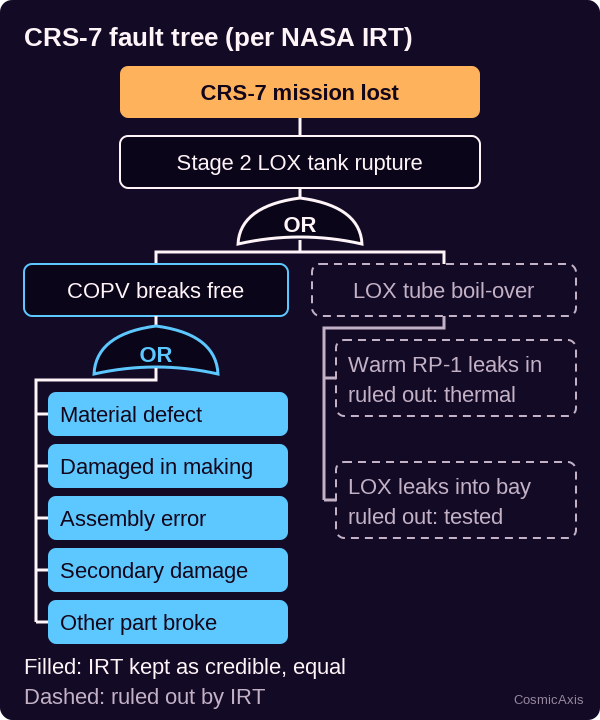
The CRS-7 fault tree can be drawn straight from the IRT report: mission loss at the top, then LOX tank rupture and COPV release, then an OR gate with five initiating causes. Symbols and minimal cut sets are explained in fault tree analysis.
Source
NASA IRT, SpaceX CRS-7 Accident Investigation Report Public Summary (12 March 2018), pages 5–8
- Close innocent branches with evidence. The IRT closed stage 1, engines, avionics, electrical systems and Dragon; only stage 2 stayed open.
- Test the alternative scenarios. Warm RP-1 leaking into the cavity around the LOX line was ruled out by thermal analysis. LOX leaking in was tested at Marshall from 2 to 27 October 2015, in 15 hole configurations: the heat could not boil LOX over in 800–900 milliseconds.
- Keep every cause that cannot be ruled out. Five causes join through an OR gate, each a single point of failure.
Each leaf is a row in an FMEA table: failure mode “rod end breaks”, cause “defective casting lot”, mitigation “aerospace-grade part, test every lot”. For a model rocket, list the commercial off-the-shelf (COTS) parts in the flight computer and test one per lot; the motor stays a certified commercial one under NAR or Tripoli rules.
03Reality
Why was the Dragon capsule lost even though it survived the explosion?
Dragon survived the stage 2 breakup but was still lost because the first-generation Dragon software had no command to deploy its parachutes after a launch failure. The IRT confirmed that Dragon survived the stage 2 event and kept talking to the ground until it dropped below the horizon.
According to Elon Musk, as relayed by NASASpaceflight on 27 July 2015, Dragon was “inert” on the way up, and slightly different software would have brought it home. The article adds that SpaceX put backup parachute software on every cargo Dragon from CRS-8. This is a press account; neither the IRT nor the NASA Inspector General reports mention parachute software. For the crewed Dragon 2, Musk said the launch abort system would push the capsule away from a failing rocket before deploying parachutes: an intact capsule was lost because nobody gave it the job of saving itself.
How did CRS-7 change SpaceX and the Commercial Crew program?
CRS-7 forced SpaceX to drop that strut type and re-examine its hardware certification, and it made NASA look hard at SpaceX’s systems engineering just as Crew Dragon was being designed. The NASA Inspector General (IG-16-025) recorded 118 million USD of NASA cargo lost.
Cargo. Three NASA sources give three figures: the IRT says 1,952 kg; the mission overview (June 2015) says 2,393 kg (2,477 kg with packaging); IG-16-025 says over 1,900 kg pressurized plus 526 kg unpressurized. The most expensive item was the first International Docking Adapter (IDA), 32.4 million USD to develop, needed for Commercial Crew spacecraft to dock at the ISS.
What SpaceX fixed. SpaceX stopped using this strut type, audited hardware against its certificates, and, per IG-16-025, set up three reliability teams for design, manufacturing and flight. The IRT says every credible cause was corrected before Jason-3, the last Falcon 9 v1.1 flight, which succeeded on 17 January 2016.
What NASA tightened. In February 2016 NASA leadership wrote to SpaceX about systems engineering, hardware assembly and telemetry (IG-16-025). IG-16-028 says the cargo program required hazard reports only for cargo and the phase near the ISS, while Commercial Crew has NASA engineers review every hazard, the subject of the human rating phase.
Three lessons carry over: follow the manufacturer’s recommendations on commercial parts (IRT, TR-1); a material certificate does not replace testing; and inspect every lot, because the flaw lay in a casting lot, not in the drawing. As with Ariane 5 flight 501, where a 64-bit to 16-bit conversion overflowed, and the Challenger O-ring failure, where seals in the aft field joint failed, one small element decided the fate of a large system.
04Milestone
Milestone: check yourself
If you can do all of these, move on to the next article in this phase.
- Can you name the initiating, intermediate and direct causes of CRS-7?
- Can you point out where SpaceX and NASA reached different conclusions?
- Can you run the Python code and see the safety factor drop from 6.2 to 1.25 when the strut lot is 5 times weaker?
- Can you draw the CRS-7 fault tree with five initiating causes and two ruled-out scenarios?
Frequently asked questions
Was anyone on board CRS-7?
No. CRS-7 was an uncrewed cargo flight of the first-generation Dragon. NASA stated that the Expedition 44 crew on the ISS still had supplies until at least October 2015.
How do CRS-7 and the 2016 AMOS-6 explosion differ?
CRS-7 broke up in flight on 28 June 2015 after a strut holding the helium bottle failed. AMOS-6 exploded on the pad in September 2016 before a static fire; SpaceX attributed it to the COPV buckling during loading.
How much did CRS-7 cost NASA?
The NASA Inspector General (IG-16-025) recorded 118 million USD of NASA cargo lost, including the first IDA docking adapter, which cost 32.4 million USD to develop.
References
- NASA IRT — SpaceX CRS-7 Accident Investigation Report, Public Summary (12 March 2018) — accessed
- SpaceX — CRS-7 Investigation Update (20 July 2015), Wayback copy — accessed
- NASA OIG IG-16-025 (28 June 2016) — accessed
- NASA OIG IG-20-005 (14 November 2019) — accessed
- NASA OIG IG-16-028 (1 September 2016) — accessed
- NASA — SpaceX CRS-7 Mission Overview (June 2015) — accessed
- NASA — SpaceX CRS-7 Status (28 June 2015) — accessed
- NASASpaceflight — Saving Spaceship Dragon (27 July 2015), Wayback copy — accessed
- NASA-STD-5001B w/Change 3 (24 October 2022) — accessed
- SpaceX — Falcon Payload User's Guide (March 2025) — accessed
- NIST Chemistry WebBook — oxygen, helium — accessed
- NIST SP 811 — Appendix B.9 — accessed
Cite this article
CosmicAxis. (2026). Falcon 9 CRS-7 Failure 2015: Why a Strut Broke. https://cosmicaxis.space/en/falcon-9-crs-7-failure/