
What Is Systems Engineering?
Source
SEBoK v2.14; NASA SP-2016-6105 Rev2
Systems engineering is a multidisciplinary approach to designing, integrating, verifying and operating a complex system, such as a spacecraft, as one unified whole. According to NASA, the design phase spends only about 15% of life-cycle cost but locks in about 75% of it (NASA SP-2016-6105 Rev2).
01Knowledge
What is systems engineering?
Systems engineering is the discipline that makes a whole spacecraft work as one unit, instead of optimizing each part alone. NASA defines systems engineering as a methodical, multidisciplinary approach to the design, realization, technical management, operations and retirement of a system (NASA SP-2016-6105 Rev2, section 2.0). The “system” includes hardware, software, people and processes.
The European standard ECSS-E-ST-10C Rev.1, written jointly by ESA, national space agencies and European industry, gives a close definition: systems engineering is an interdisciplinary approach that governs all technical work needed to turn requirements into a system solution.
A crewed spacecraft needs systems engineering because no single discipline can decide the design alone. Structures, propulsion, power, flight software, life support and the heat shield used during atmospheric reentry all compete for the same budget of mass, electrical power and money. The NASA handbook sums it up: systems engineering is a way of logical thinking that balances every discipline so that none of them dominates the whole vehicle.
This article opens the foundations phase, because every later topic is one piece of the same system.
How is systems engineering different from industrial systems engineering?
Systems engineering in this article is the aerospace discipline, which is different from the university degree called industrial systems engineering.
The two share a name but not a goal. Industrial systems engineering optimizes production, warehousing and supply chains. Aerospace systems engineering takes one complex product, often built only a few times, from idea through flight to disposal. A “systems engineer” in an IT job posting is often a person who runs servers and networks, which is a third meaning.
What does a systems engineer do?
A systems engineer keeps the big picture of the spacecraft within the limits of cost, schedule and risk. According to the NASA handbook, systems engineers lead the writing of the concept of operations (ConOps), build the architecture, define and allocate requirements, run trade studies, define interfaces, and oversee verification and validation. The handbook sums this up in one pair of phrases: not only “doing the design right” but also “choosing the right design to do”.
The daily work is the trade study. For example, the power team wants more battery for safety. The battery makes the spacecraft heavier, so for the same delta-v budget the vehicle needs more propellant, or an engine with a higher specific impulse that costs more. The systems engineer puts the numbers side by side and picks the best option for the whole vehicle. Radio links are the same kind of trade: transmitter power, antenna size and pointing are balanced in a link budget.
NASA groups this work into 17 common technical processes in the document NPR 7123.1: 4 system design processes, 5 product realization processes and 8 technical management processes (requirements, interfaces, risk, configuration, data and others).
What is the V-model in systems engineering?
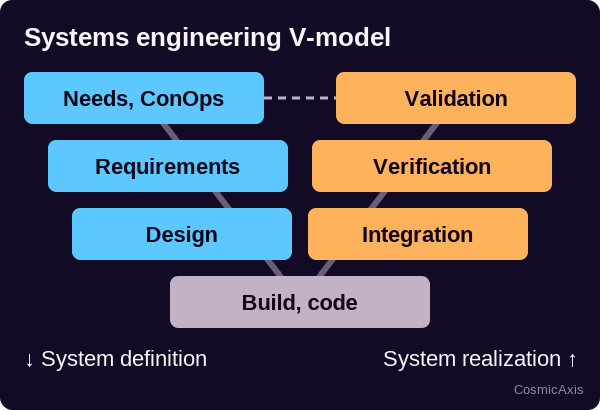
The V-model (also called the Vee) is a diagram of the order in which a system is made. The SEBoK v2.14 body of knowledge calls the descending left branch system definition, and the bottom plus the right branch system realization; time and maturity increase from left to right.
The left branch breaks needs down into system requirements, subsystem requirements and the design of each part. At the bottom, parts are built, bought or coded. The right branch integrates upward and, at each level, verifies the result against the requirements of the matching level on the left. For that reason every requirement must carry its verification method when it is written; a requirement that cannot be verified must be rewritten.
Verification only counts if the test matches flight. In the Challenger O-ring failure, the old solid rocket motors had been test-fired horizontally, not in flight configuration (Rogers Commission, chapter VI).
The two top steps of the right branch, verification and validation, are often confused. Verification answers “was the product built right, meaning to its requirements?”. Validation answers “was the right product built, meaning what the user needs?”, checked against the ConOps in real or simulated conditions (NASA, sections 5.3 and 5.4). The gap between the two is visible in Ariane 5 flight 501: the inertial reference system met its own specification, but the specification did not describe the rocket that would use it. The “V-model” in software testing has the same shape but is narrower, covering software only.
What phases do NASA and ESA spacecraft projects have?
NASA and ESA spaceflight projects both divide into 7 phases, and each phase ends with reviews that decide whether the project may continue (NASA calls these Key Decision Points, KDP).
| NASA phase | ESA phase | Main reviews | Source, date accessed |
|---|---|---|---|
| Pre-A: concept studies | 0: mission analysis | NASA MCR · ESA MDR | NASA SP-2016-6105; ECSS-M-ST-10C, 2026-09-28 |
| A: concept and technology development | A: feasibility | NASA SRR, SDR/MDR · ESA PRR | same |
| B: preliminary design | B: preliminary definition | NASA PDR · ESA SRR, PDR | same |
| C: final design and fabrication | C: detailed definition | NASA CDR, SIR · ESA CDR | same |
| D: integration, test, launch | D: qualification, production | NASA ORR, FRR · ESA QR, AR, ORR | same |
| E: operations | E: utilization | NASA DR · ESA FRR, LRR, CRR, ELR | same |
| F: closeout | F: disposal | NASA DRR · ESA MCR | same |
The phases of the two agencies match roughly, not exactly: ESA places the flight readiness review (FRR) in phase E, while NASA places it in phase D. The two abbreviations seen most often are PDR (preliminary design review) and CDR (critical design review), which also appear often in news about the Artemis program. Before PDR, NASA expects new technology to reach technology readiness level (TRL) 6. According to the NASA handbook, passing CDR means the design is mature enough for full-scale fabrication, assembly, integration and test.
Why does fixing errors late cost more?
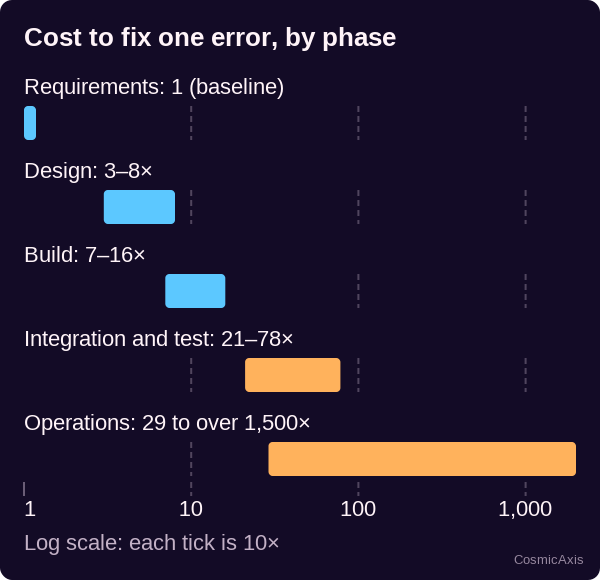
Fixing errors late costs more because a late-found error forces redesign, rebuilding and re-verification of everything made after the mistake.
Source
Stecklein et al., NASA JSC, INCOSE 2004
The NASA handbook (section 2.5) shows that cost is locked in early: during the design phase a project may have spent only about 15% of its cost, yet the design has already determined about 75% of life-cycle cost.
A NASA JSC study (Stecklein et al., INCOSE 2004) measured it more precisely. If fixing a requirement error in the requirements phase costs 1 unit, the same error costs 3–8 units in design, 7–16 in build, 21–78 in integration and test, and 29 to over 1,500 units once the system is operating. That is why systems engineering puts its effort into the left branch of the V: writing requirements carefully and reviewing them carefully at PDR and CDR is far cheaper than fixing hardware that has already flown.
02Practice
How can you practice systems engineering on a small project?
The best practice is to run one full V with real paperwork on a small project: a flight computer for a model rocket, or a 1U CubeSat kit. The model rocket uses commercial motors only and flies under the rules of a certifying body (NAR/Tripoli).
- A 5-sentence ConOps: what the device does, who uses it, where it flies, for how long, and what counts as success.
- 5–10 measurable requirements, each containing the word “shall”. Never write “fast”, “light” or “good”.
- Attach 1 of NASA’s 4 verification methods to each requirement: analysis, demonstration, inspection or test.
- Build an interface table listing sender, receiver and unit. For example, an accelerometer feeds an altitude estimator that uses a Kalman filter, and both sides must agree on m/s² or “g”.
- Hold a self-review: ask a friend to play the PDR board.
The Python snippet below catches an interface unit mismatch and a requirement with no verification method.
# NIST SP 811: 1 lbf = 4.448222 N
LBF_TO_N = 4.448222

# (data item, sender unit, receiver unit)
interfaces = [
    ("small burn impulse", "lbf·s", "N·s"),
    ("battery voltage", "V", "V"),
]
for name, sent, expected in interfaces:
    if sent != expected:
        print("ERROR:", name, sent, "->", expected)

# requirement -> verification methods
requirements = {
    "REQ-1 mass": ["test"],
    "REQ-2 pin has red flag": [],
}
for req, methods in requirements.items():
    if not methods:
        print("NO VERIFICATION METHOD:", req)

print(round(LBF_TO_N, 2))
# 4.45: the error factor if lbf·s is misread as N·s
Output:
ERROR: small burn impulse lbf·s -> N·s
NO VERIFICATION METHOD: REQ-2 pin has red flag
4.45
The NASA handbook and the ECSS standards are free to download. Detailed design data of real spacecraft is often export-controlled under ITAR, so CosmicAxis uses public documents only.
03Reality
What systems engineering error destroyed Mars Climate Orbiter?
NASA’s Mars Climate Orbiter was lost on 23 September 1999 because a data file passed between two teams gave impulse in pound-force seconds (lbf·s), while the interface specification required newton-seconds (N·s). The mishap investigation board named this the root cause (Phase I report, 10 November 1999).
The navigation software treated the numbers as N·s, so it underestimated by a factor of 4.45 the effect on the trajectory of each momentum-desaturation burn accumulated in the reaction wheels, and the spacecraft entered Mars’s atmosphere lower than it could survive.
Mars Climate Orbiter is a systems engineering lesson, not only a coding error. Among 8 contributing causes, the board listed systems engineering processes not transferred fully to operations, poor communication between teams, and interface control and end-to-end verification left incomplete. It then recommended a verification matrix for every requirement and every interface control document (ICD). FMEA asks systematically “what if this part fails”; interfaces between teams need to be asked the same question.
04Milestone
Milestone: check yourself
If you can do all of these, move on to the next article in this phase.
- Can you explain how systems engineering differs from industrial systems engineering?
- Can you redraw the V-model and match each level on the left to its verification activity on the right?
- Can you write 5 measurable requirements for a small project, each tied to one of NASA's 4 verification methods?
- Can you explain why the Mars Climate Orbiter unit error was an interface and process failure, not only a coding error?
Frequently asked questions
What is systems engineering in simple terms?
Systems engineering is the discipline that makes a whole product work as one unit instead of as separate parts. A systems engineer writes the concept of operations, allocates requirements, runs trade studies, manages interfaces and oversees verification (NASA SP-2016-6105 Rev2, section 2.0).
How is systems engineering different from industrial systems engineering?
Systems engineering takes one complex product, often built only a few times, from idea to flight and disposal. Industrial systems engineering is a different degree that optimizes production, warehousing and supply chains.
What is the difference between verification and validation?
Verification asks whether the product was built right, meaning to its requirements. Validation asks whether the right product was built, meaning what the user actually needs.
Where should a beginner start with systems engineering?
A beginner should read chapters 2 and 3 of the NASA Systems Engineering Handbook (SP-2016-6105 Rev2, free to download), then apply them to a small project: write requirements, attach a verification method to each, and build an interface table with units.
References
- NASA Systems Engineering Handbook, NASA/SP-2016-6105 Rev2, sections 2.0, 2.1, 2.5, 3.0, 5.3, 5.4 — accessed
- ECSS-E-ST-10C Rev.1 — Space engineering: System engineering general requirements (15/2/2017), sections 3.2.3, 4.1 — accessed
- ECSS-M-ST-10C Rev.1 — Project planning and implementation (6/3/2009), section 4.4 — accessed
- SEBoK v2.14 — Sequential Development Approach (Vee model) — accessed
- Stecklein et al. — Error Cost Escalation Through the Project Life Cycle, NASA JSC, INCOSE 2004 — accessed
- Mars Climate Orbiter Mishap Investigation Board — Phase I Report (10/11/1999) — accessed
- NIST SP 811 — Guide to the SI, Appendix B.9 (pound-force to newton) — accessed
Cite this article
CosmicAxis. (2026). What Is Systems Engineering? V-Model, Phases, Costs. https://cosmicaxis.space/en/what-is-systems-engineering/