
What is g-force? How much g-force do astronauts experience
Source
NASA HIDH (NASA/SP-2010-3407/REV1), table 6.5-1; NASA-STD-3001 Vol. 2 Rev F, tables 6.5-1 to 6.5-3
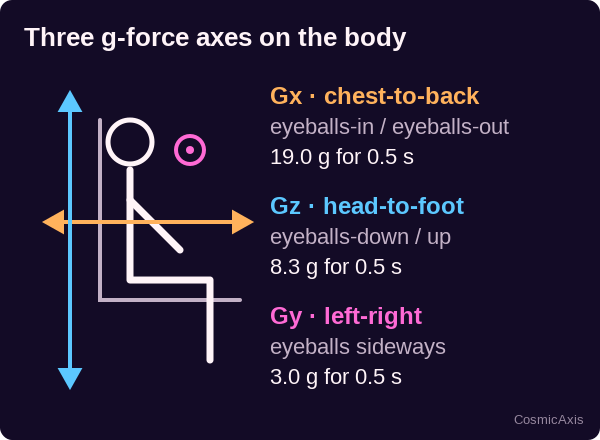
g-force is acceleration expressed in multiples of g₀ = 9.80665 m/s² (NIST). Under NASA-STD-3001 Vol. 2, a seated astronaut may take 7.5 g chest-to-back for 5 minutes but only 4 g head-to-foot for 20 minutes, which is why crews launch lying on their backs.
01Knowledge
What is g-force and how many m/s² is 1 g?
g-force is acceleration measured in multiples of standard gravity g₀ = 9.80665 m/s², a defined value with no uncertainty (NIST CODATA 2022). An acceleration of 39.2 m/s² is 39.2 / 9.80665 = 4.0 g.
The word “force” is loose: g is a unit of acceleration, and what a person feels is the seat pushing on their back. g-force joins two limits of the structures, materials and reentry phase: what the structure can take and what the crew can take.
What is load factor?
Load factor (n) is the non-gravitational force on an object divided by its weight, expressed in g. For a rocket in vacuum, n = F / (m · g₀), where F is thrust.
Load factor differs from true acceleration. A rocket on the pad has zero acceleration but n = 1 g. The ISS at 400 km falls freely at 8.69 m/s² (calculated by CosmicAxis) yet has n = 0, which is weightlessness. An accelerometer measures exactly n, called specific force. SpaceX’s Falcon User’s Guide (March 2025) gives a maximum axial load factor of 6.0 g for payloads above 1,800 kg.
What are the Gx, Gy and Gz axes: eyeballs-in, eyeballs-out and head-to-foot?
NASA names g-force along three body axes: Gx chest-to-back, Gy left-right, Gz head-to-foot (HIDH, table 6.5-1). The informal names describe which way the eyeballs are pushed as the body accelerates.
| Body accelerates toward | Symbol | Informal name | Source (accessed 2026-10-02) |
|---|---|---|---|
| Front / back | +Gx / −Gx | Eyeballs-in / eyeballs-out | HIDH, table 6.5-1 |
| Up / down | +Gz / −Gz | Eyeballs-down / eyeballs-up | HIDH, table 6.5-1 |
| Right / left | +Gy / −Gy | Eyeballs-left / eyeballs-right | HIDH, table 6.5-1 |
NASA-STD-3001 Vol. 2 Rev F (14 July 2026) sets separate limits for sustained acceleration (longer than 0.5 s) and transient acceleration.
How many g can humans withstand?
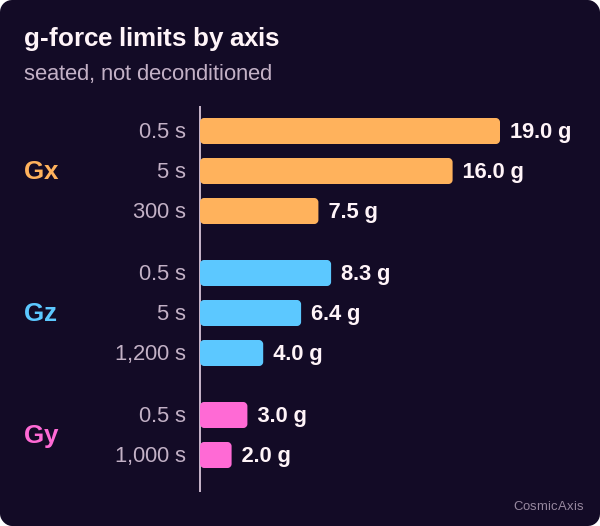
The g-force a human can withstand depends on axis and duration: under NASA-STD-3001 Vol. 2 Rev F (requirement [V2 6064]), a seated astronaut may take 16.0 g chest-to-back for 5 seconds but only 6.4 g head-to-foot for 5 seconds (converted from m/s² by CosmicAxis).
Source
calculated by CosmicAxis from NASA-STD-3001 Vol. 2 Rev F, tables 6.5-1 to 6.5-3
| Axis, condition (seated) | Duration (s) | Limit (m/s²) | Converted (g) | Source (accessed 2026-10-02) |
|---|---|---|---|---|
| +Gx, nominal | 5 / 300 | 157 / 73.5 | 16.0 / 7.5 | Vol. 2 Rev F, table 6.5-1 |
| +Gx, contingency (launch abort) | 120 / 1,200 | 86.3 / 49.0 | 8.8 / 5.0 | Vol. 2 Rev F, table 6.5-1 |
| +Gz, nominal | 5 / 1,200 | 62.8 / 39.2 | 6.4 / 4.0 | Vol. 2 Rev F, table 6.5-3 |
| +Gz, after > 30 days in flight | 0.5 / ≥ 170 | 19.6 / 4.90 | 2.0 / 0.5 | Vol. 2 Rev F, table 6.5-3 |
A person who has flown more than 30 days counts as deconditioned. All limits assume the person is strapped in tightly.
The head-to-foot limit is low because blood is pulled out of the brain. Per HIDH (table 6.5-5), an unprotected person at +3 to +4 g greys out after 3–4 seconds; at +4 to +6 g vision fails after about 5 seconds, then consciousness (G-LOC). By contrast, +Gx at 4 g is tolerable for at least 60 minutes; at 9 g a person cannot lift their head.
Why do astronauts lie on their backs at launch?
Astronauts lie on their backs at launch so that acceleration acts along the chest-to-back axis (+Gx), the axis the body tolerates best, because blood is not pulled out of the brain.
HIDH describes the crew as semi-supine, with g-force pressing the back into the seat. NASA’s brief OCHMO-TB-024 (2023) adds that in a landing impact people tolerate more than twice as much +Gx as other directions, so seats are placed to take the impact along +Gx and +Gz. Long lying causes back pain, so requirement [V2 6113] limits the launch posture to 3 hours 15 minutes.
The Space Shuttle was an exception: the crew sat upright during atmospheric reentry and took head-to-foot load. Per HIDH, it reached only 1.5 g but lasted up to 17 minutes, with hearts already weak after days of weightlessness (orthostatic intolerance).
How strong is the vibration astronauts feel at launch?
Vibration reaching astronauts is limited to 6 m/s² weighted RMS (0.6 g) by requirement [V2 6090]; it is one part of the launch loads, with quasi-static load, acoustics and stage-separation shock. Per HIDH, the Gemini program’s Titan II vibrated lengthwise at 11 Hz, exactly the astronauts’ chest-to-back axis. Saturn V test flights (Apollo 4 and 6) showed pogo oscillation at 5–7 Hz, forcing NASA to fix the liquid-oxygen feed line before a crewed flight. For structures, engineers multiply a part’s mass by a load factor such as 6.0 g and by a safety factor, then solve with the finite element method.
02Practice
How do you calculate g-force on a rocket in Python?
g-force on a rocket rises as the engine burns, because thrust F stays nearly constant while mass m falls: the crew feels F / (m · g₀).
The code simulates a hypothetical CosmicAxis stage: 300 tonnes, 180 tonnes of propellant, thrust 5,000 kN, specific impulse 300 s. The first run uses full thrust (cap 99 g, effectively none); the second throttles down to stay under 3 g, as the Space Shuttle did.
G0 = 9.80665                # m/s², standard gravity (NIST)
F_MAX, ISP = 5_000e3, 300   # ASSUMED: thrust (N), Isp (s)
M0, M_DRY = 300e3, 120e3    # kg: at liftoff, at burnout

def fly(g_cap, dt=0.01):    # vertical flight, drag ignored
    t, m, v, n_max = 0.0, M0, 0.0, 0.0
    while m > M_DRY:
        F = min(F_MAX, g_cap * m * G0)     # throttle down at the cap
        n_max = max(n_max, F / (m * G0))   # g-load the crew feels
        v += (F / m - G0) * dt             # true acceleration = F/m − g
        m -= F / (ISP * G0) * dt           # mass flow = F / (Isp · g0)
        t += dt
    return t, v, n_max, F / F_MAX

print(f"liftoff: {F_MAX / (M0 * G0):.2f} g")
for cap in (99, 3):
    t, v, n, thr = fly(cap)
    print(f"cap {cap} g: burn {t:.0f} s, v = {v:,.0f} m/s, "
          f"peak {n:.2f} g, final throttle {thr:.0%}")
# liftoff: 1.70 g
# cap 99 g: burn 106 s, v = 1,657 m/s, peak 4.25 g, final throttle 100%
# cap 3 g: burn 111 s, v = 1,604 m/s, peak 3.00 g, final throttle 71%
Results from Python 3.14 (calculated by CosmicAxis):
- g-force rises 2.5 times at constant thrust: from 1.70 g at liftoff to 4.25 g at burnout, exactly the mass ratio 300 / 120. Each stage’s g peak therefore comes at engine cutoff.
- A 3 g cap forces throttling to 71% at the end of the stage, and the burn lasts 5 seconds longer.
- Throttling costs velocity: 5 more seconds fighting gravity leave the stage 53 m/s slower, a gravity loss in the delta-v budget.
How do you measure g-force with a phone and phyphox?
The free phyphox app (RWTH Aachen University) reads the phone’s accelerometer: its “Acceleration with g” experiment does not subtract gravity, so a phone at rest reads about 9.81 m/s², which is 1 g.
Lay the phone flat on an elevator floor, start the run, ride up a few floors, export the CSV, then divide the Absolute acceleration (m/s^2) column by 9.80665: the peak above 1 g is the upward acceleration. Never take measurements while driving.
03Reality
How many g did Apollo 11 pull from launch to return?
The Apollo 11 crew pulled a maximum of 3.94 g at launch, when the first stage S-IC shut down at 161.71 seconds, and 6.56 g on return, per “Apollo by the Numbers” (NASA SP-2000-4029).
| Apollo 11 flight phase (1969) | Time after liftoff | Peak g-force | Source (accessed 2026-10-02) |
|---|---|---|---|
| Stage 1 S-IC engine cutoff | 2 min 41.71 s | 3.94 g | SP-2000-4029 |
| Stage 2 S-II center engine cutoff | 7 min 40.70 s | 1.82 g | SP-2000-4029 |
| Stage 3 S-IVB, burn 1 | 11 min 39.41 s | 0.69 g | SP-2000-4029 |
| Reentry | 8 days | 6.56 g | SP-2000-4029 |
g-force rises as each stage lightens and peaks at cutoff, matching the Python result. The return was heaviest because the capsule brakes from 11 km/s in the atmosphere.
The Space Shuttle flattened its g peak on purpose: NASA reports the RS-25 engines were throttled between 65% and 109% thrust to keep acceleration under 3 g late in ascent.
How many g do Soyuz ballistic reentries and the Soyuz MS-10 abort produce?
A normal Soyuz reentry pulls 4–5 g (ESA); in ballistic mode the capsule flies like a sphere, descends more steeply, and g-force climbs to about 8 g.
- Soyuz TMA-1 (May 2003): the Expedition 6 crew reentered ballistically, took about 8 g, and landed about 440 km short (ESA).
- Soyuz MS-10 (11 October 2018): the booster failed just after launch and the launch abort system ended the flight; the descent module came down ballistically, and Nick Hague and Alexey Ovchinin were in good condition (NASA). Spaceflight Now reports 6.7 g.
- Soyuz-18A (1975): the crew took 20.6 g during the fall and suffered internal injuries (HIDH).
NASA-STD-3001 therefore has separate, higher limits for launch aborts and emergency reentry.
How did John Stapp survive 46.2 g on a rocket sled?
On 10 December 1954, US Air Force physician John Stapp rode the Sonic Wind I rocket sled to 632 mph (1,017 km/h, converted by CosmicAxis), braked hard, and took 46.2 g, per the Smithsonian National Air and Space Museum (NASM). He was bruised and dazed but suffered no lasting injury.
According to NASM, Stapp’s research stands behind car seat belts and pilot ejection seats. The 46.2 g exceeds the highest bar in the chart above (19.0 g for 0.5 seconds) without contradiction: NASA-STD-3001 limits are what astronauts may be exposed to, not what a human can survive, as the Soyuz-18A crew survived 20.6 g.
04Milestone
Milestone: check yourself
If you can do all of these, move on to the next article in this phase.
- Can you convert 39.2 m/s² to g and explain why an accelerometer at rest reads 1 g?
- Can you explain why NASA allows more g on the Gx axis than on the Gz axis, and why astronauts launch lying on their backs?
- Can you calculate how g-force rises as a rocket gets lighter, and the cost of throttling down to hold a 3 g cap?
- Can you tell sustained load, vibration and shock apart during launch?
Frequently asked questions
How many kg is a g-force?
g-force is not measured in kg; it is a multiple of the acceleration g₀ = 9.80665 m/s². A 60 kg person under 3 g presses into the seat like a 180 kg object (calculated by CosmicAxis).
What is a pilot's g-force?
Pilot g-force is head-to-foot acceleration (+Gz) in hard turns. Per NASA HIDH, an unprotected person greys out at 3–4 g and loses vision after about 5 seconds at 4–6 g.
What is G-LOC?
G-LOC (gravity-induced loss of consciousness) is blackout caused by g-force draining blood from the brain. Per NASA HIDH, tunnel vision and grey-out usually come first.
References
- NIST CODATA 2022 — g_n — accessed
- NASA-STD-3001 Vol. 2 Rev F (14 July 2026) — accessed
- NASA OCHMO-TB-024 Rev B (June 2023) — accessed
- NASA HIDH, SP-2010-3407/REV1 (June 2014) — accessed
- NASA — The Space Shuttle — accessed
- NASA SP-2000-4029 — Apollo by the Numbers — accessed
- SpaceX — Falcon User's Guide (March 2025) — accessed
- ESA — The return home — accessed
- ESA — A hard but safe landing — accessed
- Spaceflight Now (16 October 2018) — accessed
- NASA — Soyuz MS-10 (11 October 2018) — accessed
- Smithsonian NASM — John Stapp (August 2018) — accessed
- phyphox — Acceleration with g — accessed
Cite this article
CosmicAxis. (2026). G-Force Astronauts Feel: How Many g at Launch and Reentry. https://cosmicaxis.space/en/g-force-astronauts/