
Apollo 13 oxygen tank explosion: what happened?
Source
Report of Apollo 13 Review Board (1970), chapters 4 and 5
The Apollo 13 oxygen tank explosion was the rupture of oxygen tank 2 in the service module at ground elapsed time 55:54:53 on 13 April 1970, which cancelled the lunar landing. The three astronauts used the lander Aquarius as a lifeboat and splashed down safely on 17 April 1970 (Apollo 13 Review Board, NASA MSC-02680).
01Knowledge
When and where did the Apollo 13 accident happen?
The Apollo 13 accident happened at ground elapsed time (GET) 55:54:53, which was 10:08 p.m. Eastern time on 13 April 1970, when oxygen tank 2 in the service module ruptured on the way to the Moon. NASA recorded the spacecraft at about 200,000 miles (about 322,000 km) from Earth.
Apollo 13 launched on 11 April 1970 with commander James Lovell, command module pilot John Swigert and lunar module pilot Fred Haise (NASA MSC-02680). The spacecraft had three parts: the command module Odyssey, the service module holding the main engine and gas tanks, and the lunar module Aquarius.
Oxygen in the service module was not only for breathing. The fuel cells burned oxygen and hydrogen to make electricity and water for the whole spacecraft, so losing an oxygen tank meant losing most of the power, water and breathable gas at once. This article analyses the accident as part of the life support phase.
According to telemetry in the report of the Apollo 13 Review Board, everything happened in under two minutes:
- 55:53:20: the tank 2 stirring fan was switched on at the request of ground control; moments later electrical noise appeared from a short circuit with arcing.
- 55:54:45: tank pressure peaked at 1,008.3 psia (6.95 MPa, CosmicAxis conversion).
- 55:54:53: accelerometers recorded vibration on all three axes, and telemetry dropped out for about 1.8 seconds.
- 55:55:20: Swigert called “Houston, we’ve had a problem here” (Apollo Flight Journal).
Why did oxygen tank 2 on Apollo 13 explode?
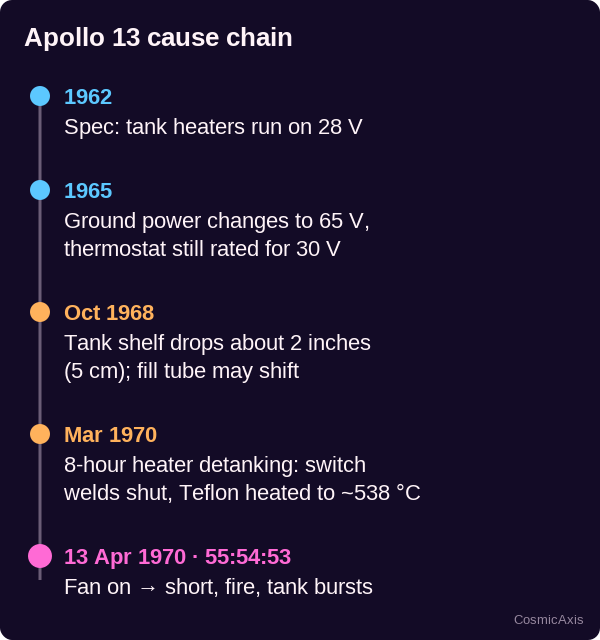
Oxygen tank 2 exploded because the Teflon insulation on the fan wiring had been scorched before launch, then ignited in high-pressure oxygen when the fan was switched on. The Review Board concluded that the accident was not a random failure but a chain of mistakes meeting a design with too little safety margin (report of 15 June 1970, chapter 5).
The cause chain has four links, and no single link was enough to cause the accident:
- A thermostat with the wrong voltage rating (1962–1965). The 1962 specification said the heaters inside the tank would run on the spacecraft’s 28 V direct current. In 1965 the prime contractor, North American Rockwell, let ground equipment use 65 V to fill the tank faster, but the subcontractor Beech did not change the thermostat switch, which stayed rated for 30 V. No test forced the switch to open under load.
- A dropped tank shelf (21 October 1968). While removing the shelf from another service module, a technician missed one bolt; the shelf was lifted about 2 inches (5.08 cm) and dropped. The loosely fitted fill tube inside the tank may have been displaced at that moment.
- Detanking with the heaters (27 March 1970). After a countdown rehearsal, tank 2 would not empty the normal way because gas leaked past the displaced fill tube. Technicians switched on the 65 V heaters to boil off the liquid oxygen for about 8 hours. The thermostat set to open at 80 °F (26.7 °C) was welded shut by arcing, and parts of the heater tube reached about 1,000 °F (538 °C), enough to damage the Teflon badly.
- Switching on the fan in flight (13 April 1970). The bare wires shorted, the arc ignited the Teflon, heat weakened the tank neck, and high-pressure oxygen blew out the panel covering bay 4 of the service module.
According to the board, many of the people who approved the detanking procedure did not know the heaters had run for 8 hours straight, and those who did know did not think of the overheating risk. A gap between several parties like this is exactly what systems engineering exists to catch.
How did the lander Aquarius work as a lifeboat?
The lunar module Aquarius became a lifeboat when the crew powered it up before ground elapsed time 58:40 and then shut down the command module completely to save its batteries for reentry. Oxygen tank 1 leaked as well, and about 1 hour 30 minutes after the explosion it was clear that the leak could not be stopped (Apollo 13 Review Board).
The lander was designed to support 2 people for 48 hours after separation from the mother ship, but on Apollo 13 it supported 3 people for about 83 hours (NASA MSC-02680). CosmicAxis computes this in person-hours: design 2 × 48 = 96, actual 3 × 83 = 249, a factor of 2.6. NASA’s technical brief OCHMO-TB-022 counts in person-days and says “triple”.
| Lander resource (unit) | At loading or activation | Left at lander separation | Source, date accessed |
|---|---|---|---|
| Battery power (Ah) | 2,179 | 410 | MSC-02680 section 7.2.5, 2026-09-29 |
| Water (kg) | 153.3 | 22.7 | MSC-02680 section 7.2.4, 2026-09-29 |
| Oxygen (kg) | 24.5 | 14.7 | MSC-02680 section 7.2.3, 2026-09-29 |
CosmicAxis converted from pounds: 1 lb = 0.45359237 kg.
Water was the scarcest resource, because it cooled the electronics by evaporating overboard. The crew cut power to about 900 W, then to 360 W after the second burn, and the cabin fell to 54–60 °F (12–16 °C). At lander separation at ground elapsed time 141:30, the reserves were 4.5 hours of power, 5.5 hours of water and 124 hours of oxygen (Apollo 13 Review Board).
Carbon dioxide was the third danger: the lander’s lithium hydroxide (LiOH) canisters could last only 53 hours when 85 hours were needed. The crew solved it by adapting the command module’s square canisters to the lander’s round sockets, using materials found aboard.
What trajectory brought Apollo 13 back to Earth?
Apollo 13 returned to Earth on a free-return trajectory: the spacecraft swung around the far side of the Moon and gravity pulled it back toward Earth without a large engine burn, the same bending principle as a gravity assist. The ship had left this trajectory at ground elapsed time 30:40 to adjust its arrival time at the Moon, so after the explosion it had to burn again (Apollo 13 Review Board).
Flight controllers did not use the service module’s main engine, because it drew a lot of power and might have been damaged. Every large burn used the lander’s descent propulsion system (DPS), according to NASA MSC-02680. Each burn is one line in a delta-v budget, the sum of the velocity changes a mission needs, and these were small:
- MCC-4, ground elapsed time 61:29:43: a 34.2-second burn of 37.8 ft/s (11.5 m/s) that put the spacecraft back on a free-return trajectory, with splashdown planned in the Indian Ocean.
- PC+2, two hours after closest approach to the Moon: a 263.8-second burn of 860.5 ft/s (262.3 m/s) that shortened the trip home by about 9 hours and moved the splashdown point to the South Pacific.
- MCC-5, ground elapsed time 105:18: a 15-second burn at 10% thrust that corrected the entry angle to −6.52°.
A free-return trajectory works because the spacecraft leaves Earth slightly below escape velocity, so Earth’s gravity still pulls it back after the lunar flyby. The command module began atmospheric reentry at ground elapsed time 142:40:47 and splashed down at 142:54:41, within sight of the recovery ship Iwo Jima.
02Practice
How can you calculate the CO₂ buildup in the lander without scrubbing?
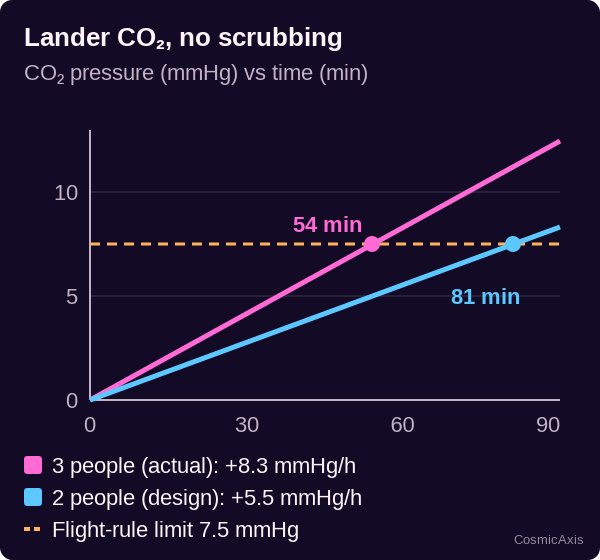
CO₂ in the lander rises by about 8.3 mmHg per hour when 3 people breathe without scrubbing, so it reaches the flight-rule limit of 7.5 mmHg after only 54 minutes (CosmicAxis calculation). The method uses the ideal gas law: partial pressure equals moles times the gas constant times temperature, divided by volume, p = n · R · T / V.
The inputs of the Python code below are: each person exhales 1.085 kg of CO₂ per day (NASA BVAD 2022, table 3-31); CO₂ weighs 44.009 g/mol (IUPAC CIAAW); R = 8.314462618 J/(mol·K) (NIST CODATA 2022). The lander has a pressurized volume of 6.65 m³ and a habitable volume of 4.53 m³ (NASA OCHMO-TB-022). The temperature is taken from the middle of the 54–60 °F range: 57 °F, about 287 K.
R = 8.314462618    # J/(mol·K)
M_CO2 = 44.009     # g/mol
CO2_PER_DAY = 1.085  # kg per person per day
MMHG = 133.322     # Pa per mmHg

def rise_mmhg_per_hour(people, v_m3, t_k):
    mol_per_hour = people * CO2_PER_DAY * 1000 / M_CO2 / 24
    return mol_per_hour * R * t_k / v_m3 / MMHG

rate = rise_mmhg_per_hour(3, 6.65, 287)
print(round(rate, 1))
# 8.3
print(round(7.5 / rate * 60))
# 54
print(round(7.5 / rise_mmhg_per_hour(2, 6.65, 287) * 60))
# 81
Source
CosmicAxis calculation from NASA BVAD 2022 and NASA OCHMO-TB-022
The calculation deliberately takes the worst case: it ignores the gas in the command module and every canister. The result shows why the LiOH canisters were a life-or-death resource: without scrubbing, the crew had less than one hour. As an exercise, change the volume to 4.53 m³ and recalculate.
03Reality
What lessons did the Apollo 13 Review Board draw?
The review board, chaired by Edgar Cortright, made 9 recommendations, headed by keeping all bare wiring and motors out of contact with the oxygen in the tank and minimizing Teflon, aluminum and other flammable material around oxygen. Recommendation 6 requires that when critical equipment shows an anomaly close to launch, every earlier anomaly of that same equipment must be presented too: the 1968 shelf drop was never mentioned when the 1970 detanking was approved.
Three lessons are still valid:
- Test the ground modes too. The switch met requirements at the spacecraft’s 28 V but failed at the ground equipment’s 65 V; a failure modes and effects analysis (FMEA) must list test and maintenance conditions as well.
- Failures rarely have a single cause. Four independent links had to line up, the kind of combination that fault tree analysis (FTA) draws out before flight.
- Redundancy must be usable in practice. The crew survived thanks to an emergency power-down checklist that already existed and a CO₂ canister adapter built from material aboard.
Sixteen years later, the Rogers Commission investigated the Challenger O-ring failure, where the launch took place at 36 °F after Thiokol had first recommended not launching below 53 °F. The pattern of a familiar anomaly being explained away returned again 33 years after Apollo 13 in the Columbia disaster. Apollo 13’s record for the farthest flight from Earth stood until 6 April 2026, when the Artemis II crew passed it (NASA Release 26-028).
04Milestone
Milestone: check yourself
If you can do all of these, move on to the next article in this phase.
- Can you list the four links in the chain that led to the Apollo 13 explosion, in order?
- Can you explain why the thermostat could carry 65 V when closing but welded shut when it had to open?
- Can you run the Python code that finds when CO₂ reaches 7.5 mmHg in the lander?
- Can you tell the MCC-4 burn apart from the PC+2 burn?
Frequently asked questions
Did anyone die on Apollo 13?
Nobody died on Apollo 13. The spacecraft launched on 11 April 1970; Lovell, Swigert and Haise splashed down in the South Pacific on 17 April 1970, after 142 hours 54 minutes of flight (NASA MSC-02680).
Was Apollo 13 a success?
Apollo 13 never landed on the Moon but returned all three astronauts safely, so NASA called the flight a successful failure.
Did anyone really say "Houston, we have a problem"?
The real line was "Houston, we've had a problem": Swigert said it at 55:55:20 and Lovell repeated it at 55:55:35. The 1995 film changed it to "we have a problem" (Apollo Flight Journal).
References
- Report of Apollo 13 Review Board (Cortright), NASA, 15 June 1970 — accessed
- Apollo 13 Mission Report, MSC-02680, NASA, September 1970 — accessed
- Apollo Flight Journal — Apollo 13, Day 3, part 2 — accessed
- NASA — Apollo 13 mission page — accessed
- NASA Release 26-028 — Artemis II crew eclipses record for farthest human spaceflight — accessed
- NASA OCHMO-TB-022 Rev B — Apollo Lunar Lander (28 November 2023) — accessed
- NASA BVAD 2022 (NASA/TP-2015-218570/REV2), table 3-31 — accessed
- NIST CODATA 2022 — Molar gas constant (R) — accessed
- IUPAC CIAAW — Abridged Standard Atomic Weights — accessed
Cite this article
CosmicAxis. (2026). Apollo 13 oxygen tank explosion: cause and survival. https://cosmicaxis.space/en/apollo-13-oxygen-tank-explosion/