
Atmospheric Reentry: How Spacecraft Return to Earth
Source
NASA TN D-6725, SP-2000-4029
Spacecraft return to Earth through atmospheric reentry: they plunge into the air from the 122 km entry interface and use drag to slow down. Apollo 11 entered at 11,032 m/s at −6.48° and peaked at 6.56 g (NASA SP-2000-4029). A heat shield keeps the capsule from melting.
01Knowledge
Where does atmospheric reentry start, and how fast is the vehicle going?
Atmospheric reentry begins at the entry interface, an altitude of 400,000 ft (121.92 km) where NASA defines the vehicle as starting to feel the atmosphere (Columbia Accident Investigation Board, CAIB, section 2.6). ESA gives about 120 km for the Soyuz capsule. Reentry dictates the shape, materials and structure of the whole capsule, which makes it the central topic of the structures and reentry phase.
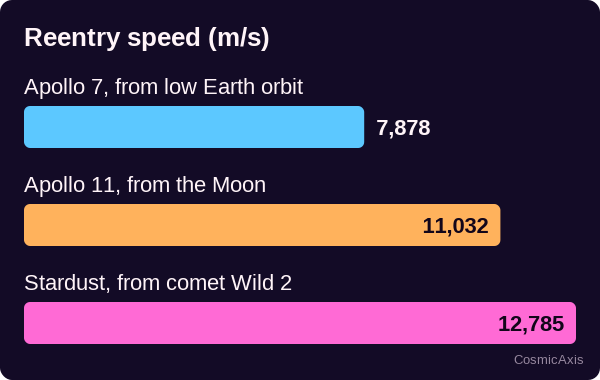
Vehicles hit the atmosphere at roughly orbital speed or faster. Soyuz begins reentry at 28,800 km/h, or 8,000 m/s (ESA). According to NASA’s “Apollo by the Numbers”, Apollo 7 returned from Earth orbit at 7,878 m/s, while Apollo 11 returned from the Moon at 11,032 m/s.
Source
NASA SP-2000-4029, NASA Spinoff 2013
Spacecraft use the atmosphere as a brake because braking with engines would take about as much delta-v budget as the launch did, which means carrying a huge amount of propellant. The CAIB report describes the Space Shuttle using the atmosphere to slow from orbital speed to 220 mph at landing, dissipating all the energy gained on the way up. Engines burn only briefly to lower the orbit into the air: Columbia’s deorbit burn lasted 2 minutes 38 seconds. The propellant for that burn depends on the specific impulse of the engine.
Mars shows the opposite limit. Its surface air is only about 0.016 kg/m³, or 1.3% of Earth’s (NASA NSSDC), so a lander slows far lower in the atmosphere than a capsule returning to Earth. The article on Mars entry, descent and landing covers that case.
Why does a spacecraft heat up during reentry?
A spacecraft heats up during reentry mainly because the air in front of it is compressed violently, not because of friction. NASA TN D-2732 states that drag converts most of the kinetic energy into heat, mostly through compression of the air directly ahead of the nose and only partly through friction at the surface.
The energy to dissipate grows with the square of speed. Each kilogram of Apollo 7 carried 31.0 MJ of kinetic energy at entry; each kilogram of Apollo 11 carried 60.9 MJ, 1.96 times as much although the speed was only 1.4 times higher (CosmicAxis calculation from NASA SP-2000-4029).
Vehicle shape decides how much of that heat reaches the structure. In 1951, H. Julian Allen at the Ames center proposed the blunt body: a blunt face pushes the shock wave away from the vehicle, so most of the heat flows around it instead of into the surface (NASA Ames). That is why the Apollo capsule entered base first rather than nose first. Even so, Apollo 11 saw a peak heat flux of 286 BTU/ft²/s, about 3,250 kW/m² (NASA SP-2000-4029, CosmicAxis conversion).
What is the entry corridor, and why does the entry angle matter?
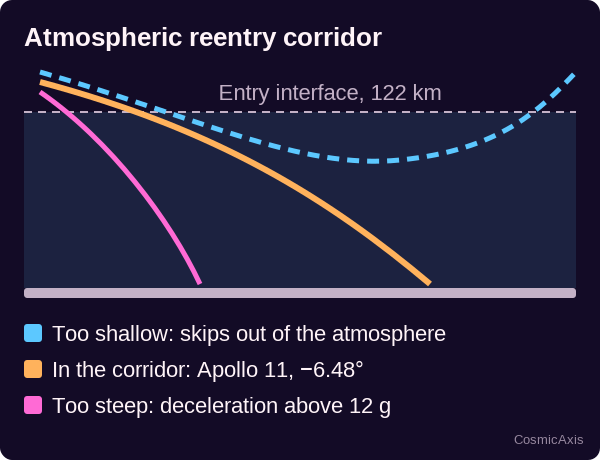
The entry corridor is the narrow range of entry angles in which the atmosphere captures the vehicle while deceleration and heating stay within the limits of the crew and the capsule. NASA TN D-6725 on Apollo entry defines its boundaries:
- Too shallow: the atmosphere does not capture the vehicle, and it skips back out into space at high speed.
- Too steep: the vehicle plunges into dense air too fast. Apollo’s steepest boundary was chosen so that deceleration stays under 12 g.
- Heating limit: the bond line between the heat shield and the structure must not exceed 600 °F (316 °C).
Apollo 11 entered at −6.48° below the horizontal and peaked at 6.56 g; Apollo 7, returning from low Earth orbit, entered at −2.07° and peaked at only 3.33 g (NASA SP-2000-4029). After the Apollo 13 oxygen tank explosion, flight controllers trimmed the entry angle to −6.52° with a 15-second burn at 10% thrust (NASA MSC-02680).
The Apollo capsule could steer inside the atmosphere because its center of gravity was offset from the axis (NASA TN D-2732), giving a lift-to-drag ratio of 0.3: the guidance system rolled the capsule to point the lift up or down. A narrow corridor demands precise guidance, and estimating the vehicle’s position from noisy sensors is the job of a Kalman filter.
How do ablative and reusable heat shields differ?
An ablative heat shield chars and erodes to carry heat away and is used once, while a reusable shield blocks heat with insulating material and flies many times. Choosing between them is a trade-off in systems engineering: mass, maintenance between flights, entry speed and resistance to impact.
Orion uses ablative Avcoat on a shield 16.5 ft (5.03 m) wide (NASA, 2018). Stardust returned on January 15, 2006 at 28,600 mph (12,785 m/s) with a PICA shield (NASA Spinoff 2013). The Space Shuttle used reusable tiles, insulating blankets and reinforced carbon-carbon (RCC) panels (CAIB). Desai and Qualls (2008) reconstruct Stardust entering the atmosphere at an inertial speed of 12.9 km/s; this article uses the Spinoff figure of 12,785 m/s for every calculation.
| Location / material | Design or tolerated temperature (°C) | Type | Source, date accessed |
|---|---|---|---|
| Space Shuttle tile, low grade | 649 | Reusable | CAIB Vol. I, 2026-09-28 |
| Space Shuttle tile, high grade | 1,260 | Reusable | CAIB Vol. I, 2026-09-28 |
| Space Shuttle nose and wing leading edge (RCC) | 1,538–1,649 | Reusable | CAIB Vol. I, 2026-09-28 |
| PICA-X tested in an arc jet | 1,927 | Ablative | NASA Spinoff 2013, 2026-09-28 |
| Orion Avcoat shield | 2,760 | Ablative | NASA 2018, 2026-09-28 |
CosmicAxis converted from °F with °C = (°F − 32) / 1.8.
Why does a spacecraft lose radio contact during reentry?
A spacecraft loses radio contact during reentry because the ionized gas around it conducts electricity well, which weakens or completely blocks radio waves (NASA TN D-2732). Faster vehicles lose contact more severely: that report predicted a worse blackout for Apollo (35,000 ft/s) than for Mercury (24,000 ft/s). Measured flight data:
- Apollo 7, from low Earth orbit: 4 minutes 48 seconds (NASA SP-2000-4029).
- Apollo 8, from the Moon: 5 minutes 5 seconds (NASA SP-2000-4029).
- Orion on Artemis II in 2026: about 6 minutes expected (NASA).
Blackout can coincide with the moment the vehicle is steering inside the atmosphere, so the ground can offer almost no help (NASA TN D-2732).
02Practice
How can you estimate reentry energy yourself in Python?
Estimating reentry energy needs only the kinetic energy per kilogram: specific kinetic energy equals half the speed squared, e = v² / 2. The Python code below uses the Apollo 7 and Apollo 11 speeds from NASA SP-2000-4029.
# ft to m, exact definition
FT = 0.3048
# BTU/ft²/s to kW/m²
BTU_FT2_S = 1055.056 / 0.09290304 / 1000

def specific_energy(v_ms):
    # kinetic energy per kg, in MJ/kg
    return v_ms ** 2 / 2 / 1e6

def f_to_c(f):
    return (f - 32) / 1.8

a7 = 25846.4 * FT
a11 = 36194.4 * FT
print(round(specific_energy(a7), 1), round(specific_energy(a11), 1))
# 31.0 60.9 MJ/kg
print(round(286 * BTU_FT2_S))
# 3248 kW/m²
print(round(f_to_c(5000)))
# 2760 °C
Exercise: compute the specific kinetic energy of Stardust at 12,785 m/s and compare it with Apollo 11. The result explains why vehicles returning from beyond Earth orbit use ablative shields: the energy per kilogram is nearly double that of a return from low Earth orbit.
03Reality
Why did the Space Shuttle Columbia break up during reentry in 2003?
Columbia broke up during reentry on February 1, 2003 because its left wing leading edge had been breached since launch, letting superheated air into the wing. The CAIB concluded that the physical cause was a piece of insulating foam that fell from the external tank.
- At launch, January 16, 2003: at 81.9 seconds, the foam struck the left wing leading edge near RCC panel 8 at a relative speed of about 545 mph.
- In orbit, 16 days: the mission met every objective. Some engineers asked for imagery of the wing, but mission management did not pursue the request.
- At reentry, February 1, 2003: the vehicle crossed the entry interface at 8:44:09 a.m. Eastern time. Air probably hotter than 5,000 °F entered behind the RCC panel and melted an aluminum spar in the wing. The last signal was received at 8:59:32; ground video shows the vehicle breaking up over Texas at 9:00:18.
The board verified the cause experimentally: foam fired at an RCC panel at 777 ft/s punched a hole about 16 × 17 inches (41 × 43 cm). To rule out other causes, it built a fault tree with more than 3,000 elements, a tool from the same family as FMEA.
The CAIB concluded that NASA’s organizational culture contributed to the accident as much as the foam: foam had struck the vehicle on many earlier flights, and managers gradually rationalized the hazard. Recommendation R3.3-2 required improving the impact resistance of RCC panels and tiles.
What did Artemis I and Artemis II teach about the Avcoat heat shield?
Artemis I and Artemis II showed that both the material and the reentry trajectory decide whether a heat shield is safe. On the uncrewed Artemis I test, Orion entered the atmosphere at nearly 25,000 mph and endured nearly 5,000 °F; afterward, engineers found that more charred Avcoat had broken away than expected.
On December 5, 2024, after more than 100 tests, NASA announced the cause: the shield did not let enough of the gas generated inside the Avcoat escape, so the material cracked and spalled. The effect is tied to the skip entry, in which the vehicle dips into the air and bounces back up before entering fully, the approach NASA considers necessary for returns from the Moon. NASA kept the shield already installed on the Artemis II capsule but changed the reentry trajectory.
Artemis II carried four astronauts and splashed down off San Diego on April 10, 2026. As planned, the crew experienced at most 3.9 g and the shield endured about 3,000 °F. Initial assessments on April 20, 2026 reported that charred-material spalling had dropped markedly in both number and size (NASA).
04Milestone
Milestone: check yourself
If you can do all of these, move on to the next article in this phase.
- Can you explain why a spacecraft heats up mainly because the air in front of it is compressed, not because of friction?
- Can you calculate the kinetic energy per kilogram of a vehicle reentering from low Earth orbit and from the Moon?
- Can you say what happens when a vehicle enters the atmosphere too shallow or too steep?
- Can you compare an ablative heat shield with the reusable tiles of the Space Shuttle?
- Can you retell the sequence of events of the 2003 Columbia accident according to the CAIB report?
Frequently asked questions
Why don't spacecraft burn up when they return to Earth?
Spacecraft survive because the forward-facing side carries a heat shield. Orion's Avcoat chars and erodes to carry heat away; Space Shuttle tiles are 90% air and 10% silica, so they conduct heat very poorly (NASA, CAIB).
What is atmospheric reentry?
Atmospheric reentry is the phase in which a spacecraft travels from space into the atmosphere to land. NASA defines this phase as starting at an altitude of 400,000 ft (121.92 km).
How long does a spacecraft lose radio contact during reentry?
Apollo 7 from low Earth orbit lost contact for 4 minutes 48 seconds and Apollo 8 from the Moon for 5 minutes 5 seconds (NASA SP-2000-4029); Orion on Artemis II in 2026 was expected to lose contact for about 6 minutes (NASA).
How hot does a spacecraft get during reentry?
Temperature depends on speed and location on the vehicle: Space Shuttle nose and wing leading edges 1,538–1,649 °C (CAIB), Soyuz heat shield 1,600 °C (ESA), Orion's shield returning from the Moon nearly 2,760 °C (NASA).
References
- Columbia Accident Investigation Board — Report Volume I (2003) — accessed
- NASA TN D-6725 — Mission Planning for Apollo Entry (1972) — accessed
- NASA TN D-2732 — Plasma Effects on Apollo Re-entry Communication (1965) — accessed
- NASA SP-2000-4029 — Apollo by the Numbers — accessed
- NASA Ames — There and Back Again (2019) — accessed
- NASA Spinoff 2013 — Heat Shield (PICA, PICA-X) — accessed
- Desai & Qualls — Stardust Entry Reconstruction (2008) — accessed
- NASA — Orion Heat Shield Install (2018) — accessed
- NASA — Orion Heat Shield Findings (December 5, 2024) — accessed
- NASA — Artemis II Flight Day 10: Final Burn, Splashdown — accessed
- NASA — Artemis II Flight Day 10: Live Re-Entry Updates — accessed
- NASA — Initial Artemis II Assessments (April 20, 2026) — accessed
- ESA — The return home — accessed
Cite this article
CosmicAxis. (2026). Atmospheric Reentry: How Spacecraft Return to Earth. https://cosmicaxis.space/en/atmospheric-reentry/