
What is a gravity assist?
Source
MIT OCW 16.07 Lecture L16; NASA Basics of Space Flight; concept diagram by CosmicAxis
A gravity assist (gravitational slingshot) is a flyby in which a planet's gravity bends a spacecraft's path and changes its speed around the Sun without burning propellant. Venus gave Cassini 7 km/s (NASA JPL); Voyager 2 reached Neptune after 12 years instead of 30 (NASA).
01Knowledge
What is a gravity assist?
A gravity assist is a flyby in which a spacecraft passes close to a planet and the planet’s gravity bends its path, changing its speed around the Sun without burning propellant. The planets hold most of the Solar System’s angular momentum, and a spacecraft can “borrow” a tiny part of it (NASA Basics of Space Flight, chapter 4).
In orbital mechanics, every km/s bought with an engine is paid for in propellant from the delta-v budget. A gravity assist is delta-v that is almost free: only a few small course corrections are needed to aim at the flyby point.
NASA credits Michael Minovitch (UCLA, on a summer job at JPL) with promoting the technique in the early 1960s. The name “gravitational slingshot” is only an image: no cord is stretched, and the spacecraft just falls into and out of the planet’s gravity well.
Why does a flyby make the spacecraft faster?
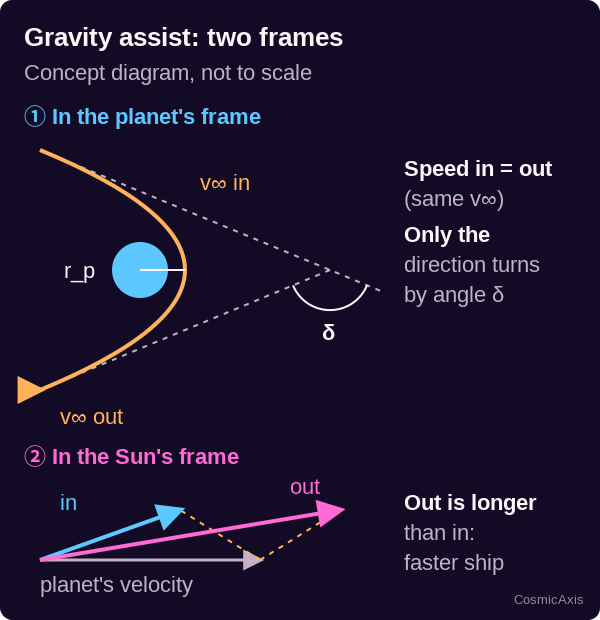
A flyby makes the spacecraft faster because its speed stays constant only in the planet’s frame; in the Sun’s frame the planet’s velocity adds to the spacecraft’s, and the new direction changes the total (MIT OCW 16.07, lecture L16).
In the planet’s frame, the spacecraft arrives with hyperbolic excess velocity v∞, the speed left over after escaping the planet’s gravity. Orbital energy is unchanged, so the exit speed equals the entry speed; the planet only turns the direction of v∞.
In the Sun’s inertial frame, the spacecraft’s velocity is the planet’s velocity plus v∞. Jupiter moves at 13.06 km/s around the Sun (NASA NSSDCA). If the entry v∞ points against Jupiter’s motion and the exit v∞ has turned to nearly the same direction, the sum grows considerably. This is vector addition and rotation, basic linear algebra.
Energy is still conserved overall: NASA writes that the spacecraft pulls back on Jupiter, which loses orbital energy too small to measure.
How are the turning angle δ and Δv of a flyby calculated?
The turning angle δ satisfies sin(δ/2) = 1 / (1 + r_p · v∞² / μ), where r_p is the closest distance to the planet’s center and μ is the planet’s gravitational parameter (GM); the spacecraft’s velocity change is Δv = 2 · v∞ · sin(δ/2) (MIT OCW 16.07; Δv derived by CosmicAxis).
Both formulas come from the hyperbolic orbit:
- Eccentricity in terms of periapsis distance: e = 1 + r_p · v∞² / μ (equation 14 of the MIT lecture).
- Turning angle is the angle v∞ rotates between entry and exit: δ = 2 · arcsin(1/e).
- Δv is the base of an isosceles triangle whose two equal sides have length v∞ and whose apex angle is δ.
A closer pass and a heavier planet give a larger δ; a faster arrival is harder to bend. CosmicAxis derived that, for a fixed r_p, Δv is largest when v∞² = μ / r_p, and equals the circular orbital speed at r_p. Skimming Jupiter’s cloud tops gives at most 42.1 km/s, and skimming Venus’s surface only 7.33 km/s (NASA NSSDCA data), which is why Jupiter is the strongest slingshot among the planets.
Does the spacecraft speed up or slow down when it passes ahead of or behind the planet?
A spacecraft speeds up when it passes behind the planet, trailing it in its orbit around the Sun, and slows down when it crosses in front of the planet (NASA Basics of Space Flight, chapter 4).
Passing behind, the path is pulled around toward the planet’s motion, so the exit v∞ points nearly along the planet’s velocity and the total grows. Passing in front, v∞ turns against it and the total shrinks.
Slowing down is useful too: Galileo flew close to the moon Io before entering Jupiter orbit, saving 90 kg of propellant on the orbit-insertion burn (NASA).
Each planet gives only a limited Δv, so a spacecraft going far chains several flybys and picks a launch date when the planets line up.
02Practice
How do you calculate a gravity assist at Jupiter and Venus in Python?
One gravity assist needs only the turning-angle formula, the vis-viva equation and Python’s built-in math library. The patched-conics model assumes:
- Circular, coplanar orbits for Earth, Venus and Jupiter (2D); GM, radii and semi-major axes from NASA NSSDCA.
- The spacecraft arrives on a Hohmann transfer from Earth, so v∞ lies along the planet’s motion.
- Jupiter: Voyager 2’s closest approach, 10.11 radii with 1 radius = 71,398 km (NASA NSSDCA), plus a skimming case at 2 radii.
- Venus: a flyby at 300 km altitude.
import math

GM_SUN = 1.32712440041279419e11  # km³/s², NASA JPL
A_EARTH = 149.598e6              # km, NASA NSSDCA

def flyby(gm, a, r_p):
    # arrival on a Hohmann transfer from Earth, circular coplanar orbits
    v_sc = math.sqrt(GM_SUN * (2 / a - 2 / (A_EARTH + a)))
    v_pl = math.sqrt(GM_SUN / a)
    v_inf = v_sc - v_pl
    sin_half = 1 / (1 + r_p * v_inf**2 / gm)
    delta = 2 * math.asin(sin_half)
    # v∞ is rotated by δ, then added back to the planet's velocity
    v_out = math.hypot(v_pl + v_inf * math.cos(delta), v_inf * math.sin(delta))
    print(f"r_p {r_p:,.0f} km: v∞ {abs(v_inf):.2f} km/s, δ {math.degrees(delta):.1f}°, "
          f"Δv {2 * abs(v_inf) * sin_half:.2f} km/s, around the Sun {v_sc:.2f} → {v_out:.2f} km/s")
    return 2 * abs(v_inf) * sin_half

# NASA NSSDCA: GM (km³/s²), semi-major axis (km), radius (km)
JUPITER = (126.687e6, 778.479e6, 71492)
VENUS = (0.32486e6, 108.210e6, 6051.8)

dv = flyby(JUPITER[0], JUPITER[1], 10.11 * 71398)   # Voyager 2 distance
flyby(JUPITER[0], JUPITER[1], 2 * JUPITER[2])       # skimming at 2 radii
print(f"Solar escape speed at Jupiter's orbit: {math.sqrt(2 * GM_SUN / JUPITER[1]):.2f} km/s")
flyby(VENUS[0], VENUS[1], VENUS[2] + 300)           # Venus, 300 km altitude
print(f"Maximum Δv: Jupiter {math.sqrt(JUPITER[0] / JUPITER[2]):.1f}, Venus {math.sqrt(VENUS[0] / VENUS[2]):.2f} km/s")
# momentum conservation: Voyager 2 is 721.9 kg, Jupiter 1.89813e27 kg
print(f"Jupiter's velocity change: {721.9 * dv * 1000 / 1.89813e27:.1e} m/s")
Output on the CosmicAxis machine (Python 3.14):
r_p 721,834 km: v∞ 5.64 km/s, δ 115.6°, Δv 9.55 km/s, around the Sun 7.41 → 16.31 km/s
r_p 142,984 km: v∞ 5.64 km/s, δ 149.7°, Δv 10.89 km/s, around the Sun 7.41 → 18.15 km/s
Solar escape speed at Jupiter's orbit: 18.46 km/s
r_p 6,352 km: v∞ 2.71 km/s, δ 122.0°, Δv 4.73 km/s, around the Sun 37.73 → 33.66 km/s
Maximum Δv: Jupiter 42.1, Venus 7.33 km/s
Jupiter's velocity change: 3.6e-21 m/s
How much speed does Jupiter give the spacecraft in the Python result?
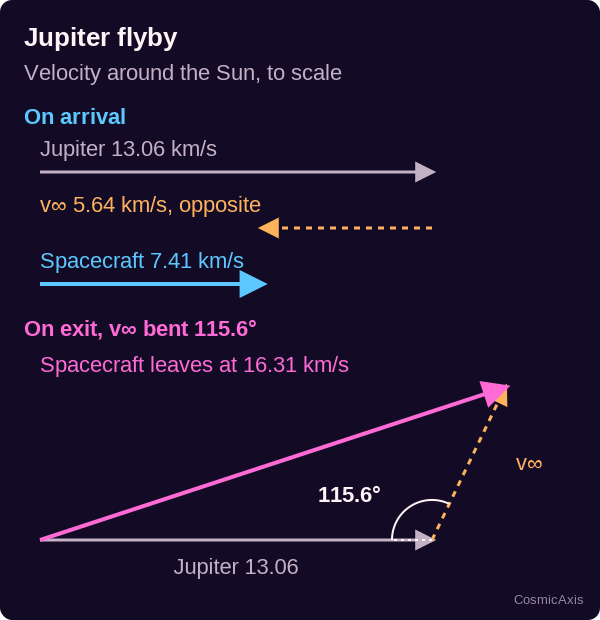
In the CosmicAxis 2D model, one pass at Voyager 2’s distance raises the spacecraft’s speed around the Sun from 7.41 km/s to 16.31 km/s, a gain of 8.90 km/s with no propellant burned (calculated by CosmicAxis from NASA NSSDCA constants).
Source
NASA NSSDCA; calculated by CosmicAxis
- Jupiter, Voyager 2 distance: the spacecraft arrives slower than Jupiter, so v∞ points against the planet’s motion; bent by 115.6°, v∞ nearly reverses and adds to Jupiter’s velocity. Δv is 9.55 km/s but the speed rises only 8.90 km/s, because Δv measures the change of the whole vector.
- Skimming at 2 radii: the exit speed is 18.15 km/s, still below 18.46 km/s, the solar escape speed at Jupiter’s distance, so one flyby with so small a v∞ does not leave the Solar System.
- Venus: the spacecraft arrives faster than Venus, v∞ points along the planet’s motion, and the 122° bend cuts the speed from 37.73 to 33.66 km/s.
The model puts v∞ along the planet’s motion; in reality v∞ arrives at an angle, the side of the flyby decides speed-up or slow-down, and Voyager 2’s real numbers differ from the model. To see it yourself, fly past the moon Mun in Kerbal Space Program, once after Mun and once ahead of it, and watch the orbit around Kerbin grow or shrink.
03Reality
How did Mariner 10 and Voyager 2 use gravity assists?
Mariner 10 was the first spacecraft to use one planet’s gravity to reach another: it flew past Venus on 5 February 1974 at a closest distance of 5,768 km and went on to Mercury (NASA NSSDCA). Voyager 2 later chained Jupiter, Saturn and Uranus to reach Neptune in 1989.
| Spacecraft | Flyby (planet, date) | Result | Source, date |
|---|---|---|---|
| Mariner 10 | Venus, 5 Feb 1974 | Reached Mercury on 29 Mar 1974 | NASA NSSDCA, 2026-10-03 |
| Voyager 2 | Jupiter, 9 Jul 1979 (10.11 radii) | Continued to Saturn | NASA NSSDCA, 2026-10-03 |
| Voyager 2 | Saturn, 26 Aug 1981 | Continued to Uranus | NASA NSSDCA, 2026-10-03 |
| Voyager 2 | Uranus, 24 Jan 1986 | Continued to Neptune | NASA Science, 2026-10-03 |
| Voyager 2 | Neptune, 25 Aug 1989 (1.18 radii) | First spacecraft to fly past Neptune | NASA NSSDCA; NASA, 2026-10-03 |
NASA writes that an alignment allowing a hop from Jupiter to Neptune without a large engine occurs only about once every 175 years, and that gravity assists cut the flight time to Neptune from 30 years to 12. The original Grand Tour plan was cut back to two spacecraft aimed only at Jupiter and Saturn (NASA NSSDCA).
Why did Cassini and Parker Solar Probe swing by Venus?
Cassini swung by Venus to gain speed on the way to Saturn, while Parker Solar Probe swung by Venus to shed speed and fall close to the Sun (NASA JPL; NASA).
Cassini weighed 5,300 kg, more than half of it propellant, and NASA JPL writes that the rockets of the day could not send it straight to Saturn. By the Tsiolkovsky rocket equation, propellant grows exponentially with delta-v, so it flew the VVEJGA route (Venus, Venus, Earth, Jupiter): launch 15 October 1997; Venus on 26 April 1998, changing velocity by 7 km/s; a large deep space maneuver on 3 December 1998; Venus again on 24 June 1999; Earth on 18 August 1999; Jupiter on 30 December 2000; Saturn on 1 July 2004 (NASA JPL).
Parker Solar Probe has the opposite problem: anything launched from Earth carries a sideways velocity of 67,000 miles per hour (about 107,800 km/h), so reaching the Sun takes 55 times the energy of reaching Mars (NASA). The fifth Venus flyby, on 16 October 2021, reduced the spacecraft’s orbital speed by about 9,720 km/h (NASA). After seven flybys, the last on 6 November 2024, the spacecraft came within about 6.1 million km of the Sun’s surface on 24 December 2024, at 692,018 km/h (JHU APL).
How do Apollo 13 and Artemis II use the Moon’s gravity?
Apollo 13 and Artemis II use the bending effect of a gravity assist to turn back toward Earth, not to gain speed: the spacecraft loops behind the Moon on a free-return trajectory, and the gravity of the Moon and Earth bring it home without a large engine burn (see the trajectory to the Moon).
In the Apollo 13 oxygen tank explosion of 1970, after the oxygen tank failed, the crew burned the lunar module engine at mission time 61:29:43 to return to a free-return trajectory (NASA MSC-02680). In 2026, Artemis II looped behind the Moon on the same kind of trajectory, which NASA describes as using the Earth–Moon gravity field to pull the Orion spacecraft home.
04Milestone
Milestone: check yourself
If you can do all of these, move on to the next article in this phase.
- Can you explain why the spacecraft's speed is the same in and out in the planet's frame, yet higher in the Sun's frame?
- Can you recompute the turning angle of 115.6° and the Δv of 9.55 km/s for the Jupiter flyby at 10.11 radii?
- Can you say when a flyby speeds a spacecraft up and when it slows it down, and give Parker Solar Probe as an example?
Frequently asked questions
What is the gravitational slingshot effect?
The gravitational slingshot is the popular name for a gravity assist: a spacecraft passes close to a planet and leaves with a different speed around the Sun, like a stone leaving a sling. Venus changed Cassini's velocity by 7 km/s on 26 April 1998 (NASA JPL).
Does the planet slow down when it lends velocity to a spacecraft?
The planet does slow down, but by an unmeasurable amount (NASA). By conservation of momentum, when the 721.9 kg Voyager 2 gains 9.55 km/s, Jupiter changes velocity by about 3.6 × 10⁻²¹ m/s (calculated by CosmicAxis).
Can you try a gravity assist in Kerbal Space Program?
Yes. Kerbal Space Program computes orbits with patched conics, the same model as the Python exercise here: passing behind the moon Mun speeds the ship up, passing in front slows it down.
References
- Peraire, Widnall — MIT OCW 16.07 Dynamics, Lecture L16: Central Force Motion: Orbits — accessed
- NASA — Basics of Space Flight, Chapter 4: Trajectories — accessed
- NASA NSSDCA — Jupiter Fact Sheet — accessed
- NASA NSSDCA — Venus Fact Sheet — accessed
- NASA NSSDCA — Earth Fact Sheet — accessed
- NASA JPL — Astrodynamic Parameters — accessed
- NASA NSSDCA — Mariner 10 (1973-085A) — accessed
- NASA Science — Voyager: Planetary Voyage — accessed
- NASA NSSDCA — Voyager 1/2 Closest Approach Distances/Times — accessed
- NASA NSSDCA — Voyager 2 (1977-076A) — accessed
- NASA — 30 Years Ago: Voyager 2 Explores Neptune — accessed
- NASA JPL — Cassini VVEJGA Trajectory (JPL 400-856D, 1999) — accessed
- NASA — 10 Things to Know About Parker Solar Probe — accessed
- NASA — Parker Solar Probe Completes Its Fifth Venus Flyby (2021) — accessed
- JHU APL — Parker Solar Probe Swings Through Final Venus Flyby (2024) — accessed
- NASA — Artemis II Press Kit — accessed
Cite this article
CosmicAxis. (2026). Gravity Assist: How the Slingshot Maneuver Works, Voyager. https://cosmicaxis.space/en/gravity-assist/