
Mars Entry, Descent and Landing (EDL)
Source
JPL, Mars 2020 Perseverance Landing Press Kit (2/2021)
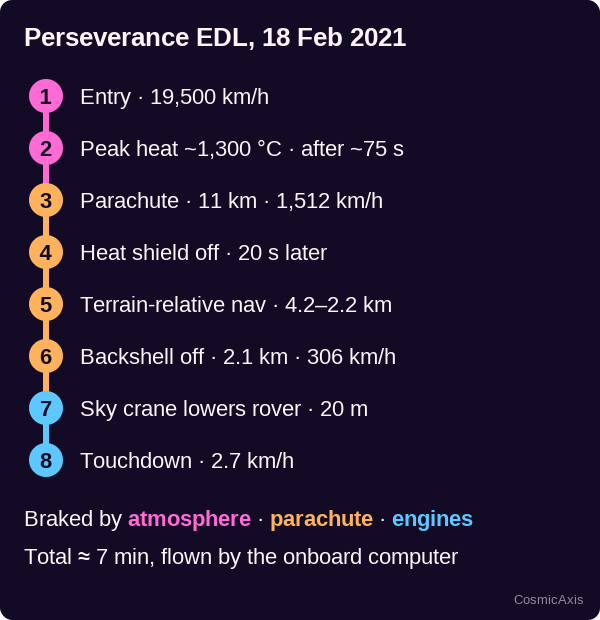
A Mars lander reaches the ground through entry, descent and landing (EDL), about 7 minutes long: a heat shield slows it from 19,500 km/h, a parachute opens at 11 km, and engines finish the job (JPL, Perseverance 2021). Mars's air is only 1.3% as dense as Earth's, so braking is hard.
01Knowledge
Why is landing on Mars harder than returning to Earth?
Landing on Mars is hard because the air at the surface has a density of only about 0.016 kg/m³, or 1.3% of Earth’s (NASA NSSDC): thick enough to heat a spacecraft, but too thin to slow it to touchdown speed. Braun and Manning (JPL, 2006) list three consequences:
- Late braking. The vehicle slows at a much lower altitude than in atmospheric reentry at Earth. Only a vehicle with a ballistic coefficient below about 50 kg/m² gets below the speed of sound, and only below about 10 km.
- Parachutes are not enough. A vehicle under a parachute still falls at 55–90 m/s in the last kilometer, so engines or airbags must finish the job.
- Limited landing sites. Every successful landing up to 2006 was below −1.4 km relative to the MOLA elevation datum; about half of Mars’s surface is out of reach.
Entry, descent and landing (EDL) cannot be fully tested on Earth either, so it is verified by simulations anchored to real test data. EDL is a central topic of the deep-space operations phase. Before EDL begins, a spacecraft must first get to Mars: the 6.5-month flight of the MarCO CubeSats was a Hohmann transfer, an orbit sized by its delta-v budget (JPL DESCANSO 18).
What steps does Mars EDL take in 7 minutes?
The EDL of the Perseverance rover on 18 February 2021 lasted about 7 minutes, from the top of the atmosphere to the rover at rest (JPL, 2021). A signal takes 11 minutes 22 seconds to reach Earth, so the onboard computer performs every step on its own. For InSight on 26 November 2018, the CubeSat pair MarCO relayed data in real time over an 8 kbps X-band downlink; its link budget left only 2.4 dB above the 3 dB margin (JPL DESCANSO 18).
- Entry at about 19,500 km/h; the heat shield reaches about 1,300 °C after about 75 seconds.
- Supersonic parachute 21.5 m wide opens at about 11 km, with the vehicle still at about 1,512 km/h.
- Heat shield jettison 20 seconds later; the radar starts measuring the ground.
- Terrain-relative navigation at 4.2–2.2 km, then backshell separation together with the parachute at about 2.1 km.
- Powered descent: at 20 m, the descent stage lowers the rover on 7.6 m cables (the sky crane), and the rover touches down at 2.7 km/h.
For the MSL vehicle carrying Curiosity, more than nine tenths of the braking came from the atmosphere before the parachute opened (JPL, 2012). Unlike a parachute landing on Earth, a Mars parachute does not bring the vehicle to touchdown speed.
What is the ballistic coefficient, and why did Viking-era technology stop at about 1 tonne?
The ballistic coefficient is a vehicle’s mass divided by the product of its drag coefficient and cross-section area: β = m / (C_D · A), in kg/m². The larger β is, the more slowly the vehicle decelerates and the lower it must fall before a parachute can open (Braun and Manning, 2006).
Every US lander since 1976 has used the technology set built for Viking: a 70° cone aeroshell, a supersonic parachute and braking engines for the final stage.
- Viking (1976) had β of 64 kg/m², Mars Pathfinder 63, and Spirit and Opportunity 94 (Braun and Manning, 2006).
- MSL (2012) had β of 145 kg/m² and weighed about 3.7 t at entry, with a payload of about 1 t; Braun (2017) called MSL the Viking-era technology stretched “as far as it can go”.
- The ceiling for a 4.6 m aeroshell is β of about 153 kg/m²; a vehicle with β of 153 must open its parachute 7.3 km lower than one with β of 63.
A 100 t crewed vehicle with a 15 m aeroshell would still have β of about 400 kg/m², so plans for humans on Mars need new technology, such as inflatable decelerators or supersonic retropropulsion.
Do Mars landers touch down on legs, airbags or a sky crane?
Mars landers have touched down in three ways: standing on legs with braking engines, bouncing in airbags, or being lowered on cables from an engine-powered stage (the sky crane).
| Vehicle (year) | Touchdown method | Touchdown speed (m/s) | Source, date accessed |
|---|---|---|---|
| Viking 1, 2 (1976) | Legs, engines | 2.4 | Braun, Manning; 2026-10-04 |
| Mars Pathfinder (1997) | Airbags | 12.5 | Braun, Manning; 2026-10-04 |
| Spirit, Opportunity (2004) | Airbags | 8 and 5.5 | Braun, Manning; 2026-10-04 |
| Phoenix (2008) | Legs, engines | 2.4 | JPL 2007; 2026-10-04 |
| Curiosity (2012), Perseverance (2021) | Sky crane | 0.75 | JPL 2012, 2021; 2026-10-04 |
- Legs are light, but the ground is only 20–30 cm away, and engines cannot stay near the surface for more than a few hundred milliseconds or they dig trenches and throw rocks (Braun and Manning, 2006).
- Airbags absorb hard impacts but suit only vehicles up to about 0.6 t.
- The sky crane keeps the engines 7.5–7.6 m above the rover, and the rover’s wheels double as landing gear (JPL, 2012, 2021); this made it possible to land the 899 kg Curiosity, five times the mass of the 175 kg Spirit (Braun, 2017).
How do landers avoid rocks and cliffs on the way down?
Newer landers avoid rocks and cliffs by looking at the ground as they fall and steering to a safe spot. The planned landing ellipse of Spirit and Opportunity was 80 km long; Curiosity’s shrank to 20 km because the vehicle guided itself with lift during entry (JPL, 2012).
- Perseverance (2021) landed in Jezero crater, a place with steep cliffs, dunes and boulder fields. Its lander vision system matches images taken during the fall against a map to find its position, with an error of about 40 m in under 10 seconds, then picks the safest landing spot (JPL, 2021). This terrain-relative navigation is part of guidance, navigation and control (GNC).
- Tianwen-1 (carrying the Zhurong rover) landed on Utopia Planitia on 15 May 2021 after an EDL of about 9 minutes; the lander hovered at about 100 m to choose a spot clear of obstacles, according to CNSA via Global Times.
02Practice
How do you simulate Mars entry by ballistic coefficient in Python?
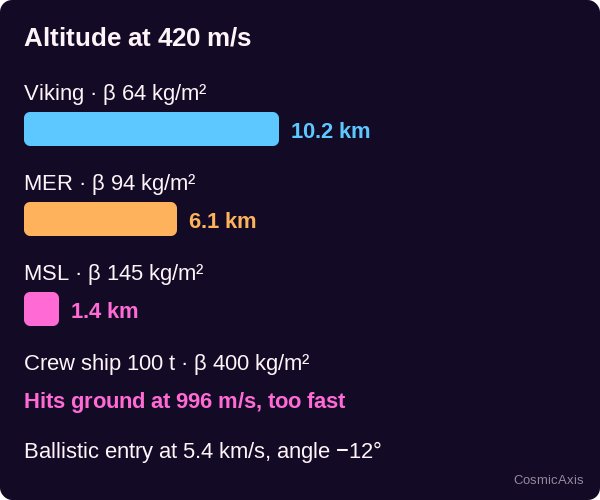
The Python code below integrates a 2D, lift-free entry trajectory through an exponential Martian atmosphere (NASA NSSDC), then finds the altitude where the vehicle has slowed to 420 m/s, the speed at which Perseverance opened its parachute. The vehicle enters at 5.4 km/s; the −12° entry angle is CosmicAxis’s choice, close to the angles of MER and Phoenix (Braun and Manning, 2006).
import math
RHO0, H, G0, R = 0.016, 11_000, 3.73, 3_389_500  # NASA NSSDC: kg/m³, m, m/s², m
V_CHUTE = 420  # m/s, Perseverance parachute deployment (JPL 2021)

def entry(beta, v=5_400, gamma=-12, h=125_000, dt=0.05):  # beta = m/(Cd·A), kg/m²
    gam, t, g_max = math.radians(gamma), 0, 0
    while h > 0:
        g = G0 * (R / (R + h)) ** 2
        a = RHO0 * math.exp(-h / H) * v * v / (2 * beta)  # drag deceleration
        g_max = max(g_max, a / 9.81)
        if v <= V_CHUTE:
            return t, h, v, g_max
        v += (-a - g * math.sin(gam)) * dt
        gam += (v / (R + h) - g / v) * math.cos(gam) * dt
        h += v * math.sin(gam) * dt
        t += dt
    return t, 0, v, g_max

for name, beta in [("Viking", 64), ("MER", 94), ("MSL", 145), ("Crew 100 t", 400)]:
    t, h, v, g_max = entry(beta)
    res = f"{V_CHUTE} m/s at {h / 1000:4.1f} km" if h > 0 else f"hits ground at {v:.0f} m/s"
    print(f"{name:<10} β {beta:3d}: {res}, after {t:3.0f} s, peak drag {g_max:.1f} g")
# Viking     β  64: 420 m/s at 10.2 km, after 206 s, peak drag 6.9 g
# MER        β  94: 420 m/s at  6.1 km, after 215 s, peak drag 6.6 g
# MSL        β 145: 420 m/s at  1.4 km, after 226 s, peak drag 6.4 g
# Crew 100 t β 400: hits ground at 996 m/s, after 207 s, peak drag 5.6 g
Source
CosmicAxis simulation; atmosphere from NASA NSSDC, β from Braun and Manning (2006)
CosmicAxis ran the code on 4 October 2026 (Python 3.14):
- More than doubling β costs almost 9 km: a Viking-class vehicle has 10.2 km left to open its parachute, while an MSL-class vehicle flying ballistically has only 1.4 km.
- Lift saved MSL: the real vehicle opened its parachute at about 11 km by offsetting its center of mass to generate lift and steer (JPL, 2012).
- A 100 t vehicle hits the ground at nearly 1 km/s if it relies on drag alone.
The model ignores lift, wind, dust and terrain, and serves only to compare values of β. Exercise: add lift with the MSL lift-to-drag ratio of 0.22 (Braun and Manning).
03Reality
Why did Mars Polar Lander crash in 1999?
NASA’s Mars Polar Lander was lost on 3 December 1999, most likely because its descent engines shut down at 40 m when software treated a false signal from a leg sensor as “touchdown.” That was the conclusion of the JPL special review board chaired by John Casani (report JPL D-18709, 22 March 2000). The sister spacecraft of the same program had been lost on 23 September 1999 in the Mars Climate Orbiter failure, a lesson in systems engineering.
- At about 1,500 m, with the vehicle still under its parachute, the three legs deployed; the Hall-effect magnetic sensor on a leg produced a false signal lasting 5–33 milliseconds in tests.
- The software read the sensor 100 times per second, and two consecutive “touchdown” readings set a touchdown flag that was never cleared.
- At 40 m, the radar enabled the function that used the flag; the stale flag made the software shut off the engines at once.
- The vehicle, falling at about 13 m/s, hit the ground at about 22 m/s instead of the designed 2.4 m/s.
The fault slipped through three gaps in verification and validation:
- A dropped requirement: the system documents forbade using sensor data before a specified altitude, but the software specification lacked that line, so no test covered it.
- No retest: in the leg deployment test on 4 June 1998, the sensor was wired wrongly; after the wiring was fixed, the team did not rerun the test.
- No telemetry during EDL: the board could only infer the cause, and its top recommendation for later spacecraft was to add telemetry for EDL.
In 2016, the Schiaparelli failure repeated this kind of fault: software held a momentary signal at parachute deployment for too long. Ariane 5 flight 501 had taught the same lesson in 1996: software that ran to its specification still lost the vehicle when a sensor value fell outside the range the specification had foreseen.
How did Phoenix and Curiosity land safely after Mars Polar Lander?
Phoenix and Curiosity landed safely by fixing the weak points that the Mars Polar Lander report identified and by testing more thoroughly. EDL lasts only 5–8 minutes, so most equipment runs as a single string, with no redundancy (Braun and Manning, 2006).
- Phoenix (2008) used the spacecraft built for the cancelled 2001 lander program. JPL wrote that the Phoenix team had addressed every weakness identified in the Mars Polar Lander reviews (JPL, 2007); the 2001 spacecraft software already had a line of code clearing the touchdown flag (JPL D-18709).
- Curiosity (2012) went through 6 configurations and fired 76 pyrotechnic devices in about 7 minutes (JPL, 2012).
04Milestone
Milestone: check yourself
If you can do all of these, move on to the next article in this phase.
- Can you list the Perseverance EDL steps in order, with altitude and speed?
- Can you explain why a high ballistic coefficient forces the parachute to open lower?
- Can you run the Python Mars entry code and change the ballistic coefficient to see a 100 t vehicle hit the ground before its parachute can open?
- Can you explain how one false signal from a landing leg made Mars Polar Lander shut down its engines at 40 m?
Frequently asked questions
What are the seven minutes of terror?
The seven minutes of terror is the nickname for Mars EDL: the vehicle goes from the top of the atmosphere to rest in about 7 minutes, fully automatically, because a signal takes over 11 minutes to reach Earth (JPL, 2021).
Why can't a Mars lander land on a parachute alone, as on Earth?
Mars's air is only 1.3% as dense as Earth's, so a vehicle under a parachute still falls at 55–90 m/s and needs engines or airbags for the last kilometer (Braun and Manning, 2006).
How fast do Mars landers touch down?
Viking and Phoenix touched down at 2.4 m/s, Curiosity and Perseverance at 0.75 m/s, and Mars Pathfinder bounced in its airbags at 12.5 m/s (Braun and Manning, 2006; JPL).
References
- NASA NSSDC, Mars Fact Sheet — accessed
- NASA NSSDC, Earth Fact Sheet — accessed
- Braun, Manning (IEEE, 2006) — accessed
- Braun (National Academies, 2 May 2017) — accessed
- JPL, Perseverance Landing Press Kit (Feb 2021) — accessed
- JPL, MSL Landing Press Kit (Jul 2012) — accessed
- JPL, Phoenix Launch Press Kit (Aug 2007) — accessed
- JPL D-18709 (22 Mar 2000) — accessed
- JPL DESCANSO 18, MarCO Telecom (Sep 2021) — accessed
- Global Times (15 May 2021) — accessed
Cite this article
CosmicAxis. (2026). Mars Entry, Descent and Landing: Why It Is So Hard. https://cosmicaxis.space/en/mars-entry-descent-landing/