
Link Budget: How to Calculate It for a Satellite
Source
CosmicAxis calculation using ITU-R P.525; parameters from NASA SoA, PULSE-A, JPL DESCANSO
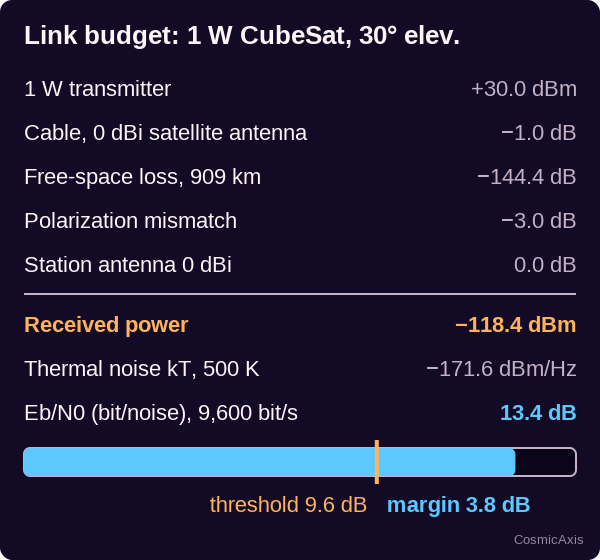
A link budget is a decibel ledger of transmit power, antenna gains, losses and noise that shows how much signal remains above the decoding threshold. CosmicAxis calculates that a 1 W CubeSat at 437 MHz, 909 km from the station, loses 144.4 dB (ITU-R P.525) and keeps a 3.8 dB margin.
01Knowledge
What is a link budget?
A link budget is a decibel ledger of everything that strengthens or weakens a radio signal on its way from transmitter to receiver, showing how much signal arrives above the decoding threshold. The surplus is called the link margin.
Decibels turn multiplication into addition: doubling the power is +3 dB, and 1 W = 30 dBm = 0 dBW. A downlink is calculated in three lines:
- Received power = transmit power − cable loss + transmit antenna gain − path loss − other losses + receive antenna gain.
- C/N0 = received power − noise density N0.
- Margin = received Eb/N0 − Eb/N0 required for decoding.
According to NASA’s State-of-the-Art of Small Spacecraft Technology report (Communications chapter, 18 May 2026), the margin of each link budget option expresses the reliability of the system. For small satellites and CubeSats, choosing the transmit power means choosing the battery size.
What is the free-space path loss formula?
Free-space path loss (FSPL) equals L = 20·log10(4πd/λ) dB, where d is the distance and λ is the wavelength, according to ITU-R P.525-5 (11/2024). In terms of frequency f (MHz) and distance d (km), ITU rounds this to L = 32.4 + 20·log10(f) + 20·log10(d).
The formula comes from the Friis transmission equation: power spreads over a sphere of radius d, and an isotropic receiving antenna intercepts only an area of λ²/4π (ITU-R P.525). The energy is not absorbed; it simply spreads too widely.
- Doubling the distance or the frequency costs another 6 dB. At 437 MHz, CosmicAxis calculates 139.2 dB when the satellite is 500 km directly overhead, 144.4 dB at 30° elevation (909 km) and 149.8 dB at 10° (1,695 km).
- Distance depends on elevation: d = √((R + h)² − (R·cos e)²) − R·sin e, with R = 6,371 km (NASA NSSDCA), h the altitude and e the elevation angle.
What are EIRP, G/T and thermal noise kTB?
EIRP (equivalent isotropically radiated power) is the transmitter power minus cable loss plus the transmit antenna gain (dBi), the input to every power-density formula in ITU-R P.525.
On the receive side, thermal noise is the floor under every signal: N = k·T·B, with the Boltzmann constant k = 1.380649 × 10⁻²³ J/K (NIST), or −228.6 dBW/K/Hz. A system temperature of 500 K gives a noise density N0 = −171.6 dBm/Hz.
- System temperature combines the noise of the low-noise amplifier (LNA), the cable and the sky. MarCO’s UHF link budget lists an LNA noise figure of 3.5 dB, equivalent to 359.2 K (JPL DESCANSO 18, table 5-5).
- G/T is the receive antenna gain divided by the system temperature (dB/K), the sensitivity of a station. A 70 m Deep Space Network dish has 74.3 dBi and 24.8 K in X-band, so G/T ≈ 60.4 dB/K (CosmicAxis calculation from table 5-4).
Putting it together: C/N0 = EIRP − path loss + G/T − k.
How do Eb/N0 and margin decide whether a link lives or dies?
Eb/N0 is the energy per bit divided by the noise density, equal to C/N0 minus 10·log10 of the bit rate; the link lives when the received Eb/N0 exceeds the decoding threshold plus the margin. Uncoded BPSK needs 9.6 dB for a bit error rate of 10⁻⁵, which CosmicAxis calculates from the theoretical formula BER = ½·erfc(√(Eb/N0)).
Error-correcting codes lower that threshold: according to CCSDS 130.1-G-3 (6/2020), the standard convolutional code gains about 5.5 dB at a BER of 10⁻⁵, and adding a Reed–Solomon code gains another 2.0 dB. Plain AX.25 frames carry no error-correcting code, so they get none of this gain.
The secondary losses are each a few tenths of a dB to a few dB:
- Polarization mismatch: a linearly polarized satellite antenna with a circularly polarized station antenna loses 3 dB, the level the PULSE-A CubeSat group accepts to keep contact in every attitude (SSC25).
- Ionosphere: at 0.5 GHz and about 30° elevation, the plane of polarization can rotate by 1.2 turns (Faraday rotation); above 10 GHz the ionospheric effects are negligible (ITU-R P.618-14, table 1).
- Atmosphere and pointing: MarCO reserves 0.15 dB for the atmosphere and 2.8 dB for antenna pointing loss in X-band.
A minimum margin of 3 dB is the level MarCO used for every link, a buffer for what the spreadsheet does not know.
02Practice
How do you calculate a 437 MHz UHF CubeSat link budget to a SatNOGS station in Python?
The link budget of a UHF CubeSat can be calculated in a few dozen lines of standard-library Python, for two kinds of SatNOGS ground station: a fixed antenna and a Yagi that tracks the satellite.
- Satellite: a CubeSat flying at 500 km, transmitting 1 W at 437 MHz (the 435–438 MHz amateur band, IARU), like the 30 dBm GomSpace NanoCom AX100 transceiver in NASA SoA 2026; the 1 dB cable and 0 dBi antenna are assumptions.
- Station: 3 dB polarization mismatch (PULSE-A); 500 K is an assumption, made of 359 K for a 3.5 dB LNA (DESCANSO 18) plus sky and cable noise; a 17 dBi Yagi as at the MinXSS station.
- Data: 9,600 bit/s, with the uncoded BPSK threshold at a BER of 10⁻⁵.
import math

C, K = 299_792_458, 1.380649e-23   # m/s, J/K (NIST)
R_E = 6371.0                       # km (NASA NSSDCA)
db = lambda x: 10 * math.log10(x)

def fspl(d_km, f_hz):              # ITU-R P.525, dB
    return 20 * math.log10(4 * math.pi * d_km * 1e3 * f_hz / C)

def slant_range(h_km, elev):       # km, spherical Earth
    e = math.radians(elev)
    return math.sqrt((R_E + h_km) ** 2 - (R_E * math.cos(e)) ** 2) - R_E * math.sin(e)

def bpsk_threshold(ber):           # Eb/N0 (dB) for BER = ½·erfc(√(Eb/N0)), by bisection
    lo, hi = 0.0, 20.0
    for _ in range(60):
        mid = (lo + hi) / 2
        lo, hi = (mid, hi) if 0.5 * math.erfc(math.sqrt(10 ** (mid / 10))) > ber else (lo, mid)
    return mid

F = 437e6                  # Hz
EIRP = 30.0 - 1.0 + 0.0    # dBm: 1 W, 1 dB cable, 0 dBi antenna
L_POL = 3.0                # dB, linear-to-circular (PULSE-A)
T_SYS = 500.0              # K, assumed
R_BIT = 9600               # bit/s
N0 = db(K * T_SYS) + 30    # dBm/Hz
THRESHOLD = bpsk_threshold(1e-5)
print(f"N0 = {N0:.1f} dBm/Hz, threshold = {THRESHOLD:.1f} dB")

for name, g_station in [("Fixed 0 dBi antenna", 0.0), ("17 dBi Yagi", 17.0)]:
    print(name)
    for elev in (10, 30, 60, 90):
        d = slant_range(500, elev)
        p_rx = EIRP - fspl(d, F) - L_POL + g_station
        eb_n0 = p_rx - N0 - db(R_BIT)
        print(f"  {elev:2d}°: {d:5.0f} km, FSPL {fspl(d, F):5.1f} dB, "
              f"rx {p_rx:6.1f} dBm, margin {eb_n0 - THRESHOLD:+5.1f} dB")

print(f"VINASAT-1, Hanoi, 12 GHz: FSPL {fspl(36_981, 12e9):.1f} dB")
Output:
N0 = -171.6 dBm/Hz, threshold = 9.6 dB
Fixed 0 dBi antenna
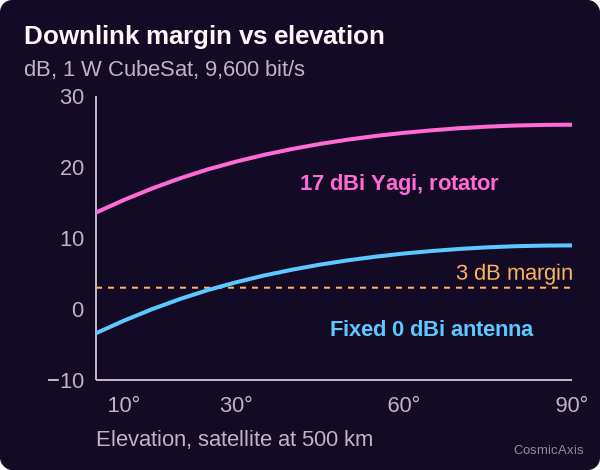
  10°:  1695 km, FSPL 149.8 dB, rx -123.8 dBm, margin  -1.6 dB
  30°:   909 km, FSPL 144.4 dB, rx -118.4 dBm, margin  +3.8 dB
  60°:   571 km, FSPL 140.4 dB, rx -114.4 dBm, margin  +7.8 dB
  90°:   500 km, FSPL 139.2 dB, rx -113.2 dBm, margin  +9.0 dB
17 dBi Yagi
  10°:  1695 km, FSPL 149.8 dB, rx -106.8 dBm, margin +15.4 dB
  30°:   909 km, FSPL 144.4 dB, rx -101.4 dBm, margin +20.8 dB
  60°:   571 km, FSPL 140.4 dB, rx  -97.4 dBm, margin +24.8 dB
  90°:   500 km, FSPL 139.2 dB, rx  -96.2 dBm, margin +26.0 dB
VINASAT-1, Hanoi, 12 GHz: FSPL 205.4 dB
CosmicAxis ran the code on 29 September 2026 (Python 3.14.6). The fixed station receives −118.4 dBm at 30° elevation with a margin of +3.8 dB; at 10° the margin is −1.6 dB, meaning the signal is lost. The 17 dBi Yagi station keeps +15.4 dB even at 10°.
Source
CosmicAxis calculation using ITU-R P.525; parameters from NASA SoA, PULSE-A, JPL DESCANSO
A fixed station can therefore decode reliably only the middle of a pass: CosmicAxis calculates that the 0 dBi station exceeds the 3 dB margin only when the satellite is above about 26.5°. Lowering 9,600 to 1,200 bit/s gains 9 dB, equal to three doublings of transmit power; change R_BIT and T_SYS to try it yourself.
Why does a geostationary satellite like VINASAT need a receiving dish?
A geostationary satellite needs a dish because the downlink is longer and the frequency is higher: CosmicAxis calculates the free-space path loss from Hanoi to VINASAT-1 at 12 GHz as 205.4 dB, more than 66 dB (about 4 million times) above a 437 MHz CubeSat directly overhead at 500 km. The 36,981 km distance comes from the dish-pointing calculation in the VINASAT article; 12 GHz is the lower edge of the Ku band, 12–18 GHz, according to ESA.
A geostationary link makes up the difference at both ends: a communications satellite has a high EIRP and the receiving station uses a high-gain dish. Dish gain equals efficiency times (πD/λ)²; a 0.6 m dish at 12 GHz, with an assumed efficiency of 60%, gives 35.3 dBi (CosmicAxis calculation). CosmicAxis has not found an official VNPT EIRP table for VINASAT, so this article does not build a full link budget for that path.
The Ku band pays for this by fearing rain: according to ESA, the higher the band, the more it suffers rain fade, so a geostationary link budget in the tropics always has a rain-loss line calculated under ITU-R P.618.
03Reality
What link budget let MarCO send 8 kbps from Mars to Earth?
MarCO is a pair of 6U CubeSats from JPL that relayed the landing of the InSight lander in real time on 26 November 2018, when Mars was more than 160 million km (1.07 AU) from Earth; the 8 kbps X-band downlink to a 70 m dish in Madrid kept only 2.4 dB above its 3 dB margin level (JPL DESCANSO 18, 9/2021, table 5-4).
The relay served the Mars entry, descent and landing phase, which lasts about 7 minutes and runs fully automatically because a signal from Perseverance took 11 minutes 22 seconds to reach Earth in 2021 (JPL).
| Line, X-band 8,414 MHz | Value | Source, date accessed |
|---|---|---|
| RF transmit power (dBm) | 36.6 | DESCANSO 18, 2026-09-29 |
| Reflectarray antenna gain (dBi) | 29.2 | DESCANSO 18, 2026-09-29 |
| EIRP after circuit and pointing losses (dBm) | 61.7 | DESCANSO 18, 2026-09-29 |
| Free-space path loss (dB) | −275.0 | DESCANSO 18, 2026-09-29 |
| DSN 70 m dish gain (dBi) | 74.3 | DESCANSO 18, 2026-09-29 |
| Received power (dBm) | −139.5 | DESCANSO 18, 2026-09-29 |
| Margin above the 3 dB threshold (dB) | 2.4 | DESCANSO 18, 2026-09-29 |
CosmicAxis rechecked the path loss with ITU-R P.525: 8,414 MHz over 160 million km gives 275.0 dB, matching the table. Three choices kept the link alive:
- A large dish on the ground: going from a 34 m dish (68.3 dBi) to 70 m (74.3 dBi) gains 6 dB, and the system temperature drops from 30.5 K to 24.8 K.
- A directional antenna on the satellite: the reflectarray has a 3.5° beam, so Blue Canyon’s XACT attitude controller must hold the pointing to ±0.003° (1σ) on two axes.
- A rate-1/6 Turbo code: the threshold is −0.10 dB instead of the 9.6 dB of uncoded BPSK.
At the end of December 2018, as the distance grew, the two satellites could transmit only 1 kbps (DESCANSO 18). The 6.5-month flight to Mars is a Hohmann-transfer problem, sized in the delta-v budget; the link budget decides how much the spacecraft can say once it arrives.
What antennas and cable does a real university CubeSat ground station use?
The ground station of the MinXSS CubeSat (3U, University of Colorado Boulder) uses two crossed M2 436CP42 Yagi antennas, about 17 dBdc each with a 21° beam, turned by a rotator and connected to the receiver through about 60 m of low-loss cable that costs 5.4 dB (Mason et al., arXiv 1508.05354).
The satellite uses an AstroDev Lithium-1 transceiver at 437 MHz (9.6 kbps, 0.25–4 W according to NASA SoA 2026). The MinXSS team estimated a download of 449 kB/day from the measured radiation pattern and 600 kB/day from the model, both above the requirement of 360 kB/day.
- Long cable eats the margin: the 5.4 dB of 60 m of cable is larger than the 3.8 dB margin of the fixed station calculated above; an LNA mounted on the mast, next to the antenna, amplifies the signal before it enters the cable.
- Measurement differs from the model: the two estimates differ by 25%, a reason to keep a margin.
Mass matters as well. In the analysis of rocket launch cost, SpaceX rideshare seats in 2026 cost 7,000 USD/kg with a 50 kg minimum, or 350,000 USD, so a bigger battery bought for more transmit power is paid for per kilogram.
In Vietnam, the Hoa Lac station could not receive the UHF telemetry of NanoDragon (2021), and VNSC had to ask the SatNOGS network to detect the signal. When a satellite falls silent, the operator walks back through the link budget line by line. Balancing power, antennas and attitude from the start of the project is the job of systems engineering.
04Milestone
Milestone: check yourself
If you can do all of these, move on to the next article in this phase.
- Can you calculate the free-space path loss at 437 MHz over 909 km?
- Can you convert a 500 K system temperature into a noise density in dBm/Hz?
- Can you explain why a fixed-antenna station loses its 3 dB margin when the satellite is below about 26 degrees?
- Can you read each line of MarCO's X-band link budget table?
Frequently asked questions
What is EIRP?
EIRP (equivalent isotropically radiated power) is transmitter power minus cable loss plus transmit antenna gain, expressed in dBW or dBm. MarCO has an EIRP of 61.7 dBm (JPL DESCANSO 18).
What is the free-space path loss formula?
Free-space path loss equals 20·log10(4πd/λ) dB, or 32.4 + 20·log10(f) + 20·log10(d) with f in MHz and d in km (ITU-R P.525-5). Doubling the distance or the frequency adds 6 dB of loss.
What is Eb/N0?
Eb/N0 is energy per bit divided by noise density, equal to C/N0 minus 10·log10 of the bit rate. Uncoded BPSK needs 9.6 dB for a bit error rate of 10⁻⁵ (calculated by CosmicAxis).
How much link margin is enough?
JPL's MarCO used a minimum margin of 3 dB above the decoding threshold (DESCANSO 18). With less margin, rain, a mispointed antenna or a damp cable can be enough to lose the link.
References
- ITU-R P.525-5 (11/2024) — accessed
- ITU-R P.618-14 (8/2023) — accessed
- NASA SoA 2026 — Communications — accessed
- JPL DESCANSO 18 — MarCO Telecom (9/2021) — accessed
- Mason et al. — MinXSS (arXiv 1508.05354) — accessed
- PULSE-A — SSC25 (arXiv 2506.20014) — accessed
- CCSDS 130.1-G-3 (6/2020) — accessed
- ESA — Satellite frequency bands — accessed
- NIST — Boltzmann constant — accessed
- NIST — speed of light — accessed
- NASA NSSDCA — Earth Fact Sheet — accessed
Cite this article
CosmicAxis. (2026). Link Budget Explained: Path Loss, EIRP and Eb/N0. https://cosmicaxis.space/en/link-budget/