
Apollo 1 fire (1967): what happened and why?
Source
Report of Apollo 204 Review Board (NASA, 1967), Part IV–VI
The Apollo 1 fire occurred on 27 January 1967 during a launch-pad test: the command module, filled with pure oxygen at 16.7 psia, caught fire, cabin pressure pressed the inward-opening hatch shut, the module ruptured about 15 seconds after the fire report, and Grissom, White and Chaffee died of asphyxia from toxic gas (Apollo 204 Review Board, 1967).
01Knowledge
What was the Apollo 1 fire, and when did it happen?
The Apollo 1 fire was a fire inside the command module of the first crewed Apollo spacecraft on the afternoon of 27 January 1967, during a test on launch pad 34 (LC-34) at Cape Kennedy; three astronauts died and the spacecraft never flew (NASA).
The flight, designated AS-204, was planned for 21 February 1967 as the first crewed Apollo mission. The crew were commander Virgil “Gus” Grissom, Edward White, the first American to walk in space, and Roger Chaffee (NASA History Office, 2006).
The test was a plugs-out test: a simulated countdown with ground cables disconnected, so the spacecraft ran on its own power, with the hatch closed and the cabin full of pure oxygen. Nobody classed it as hazardous because the rocket carried no propellant (Apollo 204 Review Board, Part IV). This article belongs to the life support phase.
How many seconds did the Apollo 1 fire last?
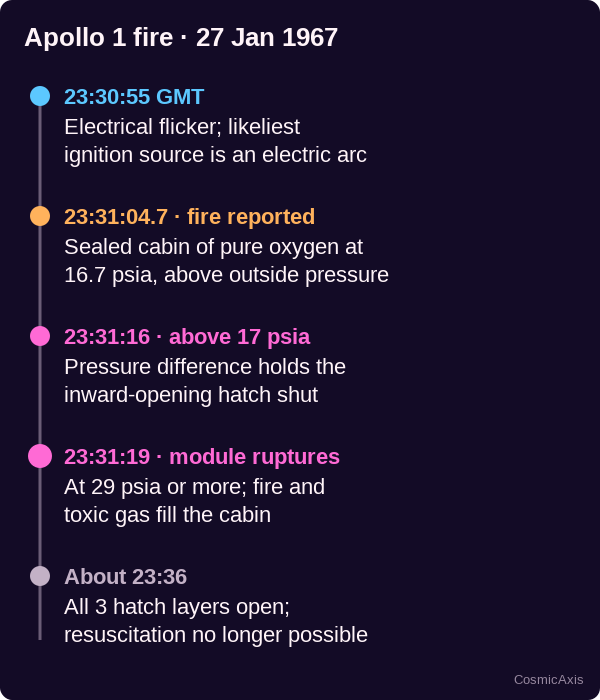
The fire went from the first report of fire to rupture of the module in about 15 seconds, and all signals from the spacecraft ended after 18 seconds (Apollo 204 Review Board, Parts IV–V).
The countdown was holding at T minus 10 minutes because of a communications problem. Timeline from the report (GMT; local time was 5 hours behind):
| Time (GMT) | Event | Source, date accessed |
|---|---|---|
| 23:30:54.8 | AC bus 2 voltage spikes | Review Board Part IV, 2026-10-02 |
| 23:31:04.7 | Crew reports fire | Review Board Part IV, 2026-10-02 |
| 23:31:16 | Cabin pressure passes 17 psia, the sensor limit | Review Board Part V, 2026-10-02 |
| 23:31:19 | Module ruptures at 29 psia or more | Review Board Part V, 2026-10-02 |
| about 23:36 | Ground crew finishes opening all three hatch layers | Review Board Part IV, 2026-10-02 |
The module was designed for a pressure difference of only about 13 psi (90 kPa); when it ruptured, flame spread onto the outside work platform (Part V).
Why was pure oxygen at 16.7 psia so dangerous in the Apollo 1 cabin?
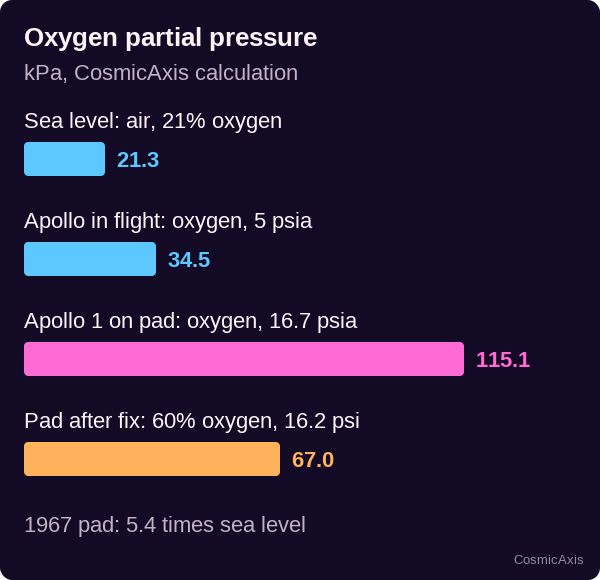
Pure oxygen at 16.7 psia (115 kPa) gives an oxygen partial pressure 5.4 times that of sea-level air (CosmicAxis calculation), so cabin materials ignite more easily and burn much faster; the Review Board called the test conditions extremely hazardous (Apollo 204 Review Board, finding 2).
Apollo flew on pure oxygen at 5 psia (34.5 kPa); on the pad the cabin was pressurized above ambient to check for leaks, according to engineer Max Faget (Chariots for Apollo, ch. 10). The report gave three pieces of evidence:
- Sparks travel far: in oxygen at 16.5 psia, a spark from an electric arc ignited material several inches away (Part V).
- Plenty of flammable material: nylon netting and Velcro strips lay near where the fire began; nylon melted into burning drops that started fires elsewhere (Part V).
- No means of fighting fire: the cabin had no fire extinguisher (Panel 13).
The cabin had been filled with pure oxygen above 14.7 psia four times in an altitude chamber, a test type classed as hazardous; the pad test with the same atmosphere was not (Part IV).
Why could the Apollo 1 crew not open the hatch?
The crew could not open the hatch because the inner hatch opened inward, was 1,200 in² (0.774 m²) in area, and was pressed against its frame whenever cabin pressure exceeded outside pressure (Apollo 204 Review Board, finding 4; Panel 13).
The exit had three layers: the boost protective cover, an ablative hatch, and the inner sealing hatch, which weighed about 55 lb (25 kg) and was held by 6 latches. Opening it took about 220° of wrench rotation, after cabin pressure had first been reduced to nearly the outside level (Panel 13). The relief valve, with a 1.5 in² (9.7 cm²) opening, needed about 18 seconds to drop from 16.4 to 14.8 psia even without a fire; with the fire pushing pressure up, opening it would have delayed the rupture by less than 1 second (Panel 13; Part V).
Ed White followed procedure and reached for the hatch handle. The board concluded the crew died of asphyxia from inhaling toxic gas (finding 3).
What did the Apollo 204 Review Board conclude caused the fire?
The board could not identify the ignition source with certainty, but concluded that the most probable one was an electric arc in wiring near the floor of the left-hand equipment bay, coinciding with the electrical flicker at 23:30:55 GMT (Apollo 204 Review Board, finding 1).
The board, chaired by Floyd L. Thompson, reported on 5 April 1967 (Chariots for Apollo, ch. 9). Six conditions together led to the disaster (Part V):
- A sealed cabin filled with pressurized oxygen.
- Flammable material spread throughout the cabin.
- Vulnerable wiring carrying power.
- Coolant tubing that was both combustible and corrosive.
- No provision for the crew to escape on their own.
- No provision for rescue and medical response.
The root error was risk classification: a test counted as hazardous only if it involved propellant, cryogenic liquids, high-pressure bottles or explosives, so no fire or medical crews stood by (finding 5). Failure modes and effects analysis (FMEA), a core systems engineering method, catches risks outside a familiar list like that.
02Practice
How can you calculate the hatch force and oxygen partial pressure in Python?
A 2 psi pressure difference across a 1,200 in² hatch produces 10.7 kN pressing the hatch against its frame, more than 40 times the hatch’s own weight; at the rupture pressure of 29 psia the force reaches 76.3 kN (CosmicAxis calculation in Python from the Apollo 204 Review Board).
Force equals area times pressure difference: F = A · (p_inside − p_outside). Oxygen partial pressure equals total pressure times oxygen fraction: p_O₂ = p · x_O₂. The 60/40 atmosphere is from Chariots for Apollo; units follow NIST SP 811.
PSI_PA = 6894.757            # Pa per psi (NIST SP 811)
HATCH_AREA = 1200 * 0.0254**2     # m², inner hatch 1,200 in² (Review Board, Panel 13)
P_OUTSIDE = 14.7               # psia, assumed pad ambient pressure

def force_kn(p_inside):  # kN
    return HATCH_AREA * (p_inside - P_OUTSIDE) * PSI_PA / 1000

def ppo2_kpa(p_psia, x_o2):  # kPa
    return p_psia * x_o2 * PSI_PA / 1000

print(f"55 lb hatch = {55 * 4.448222 / 1000:.2f} kN")
for p in (16.7, 29.0):
    print(f"{p} psia: {force_kn(p):.1f} kN")
ground = ppo2_kpa(14.7, 0.21)
for label, p, x in [("sea level", 14.7, 0.21), ("in flight", 5.0, 1.0),
                    ("pad 1967", 16.7, 1.0), ("pad 60/40", 16.2, 0.60)]:
    print(f"{label}: {ppo2_kpa(p, x):.1f} kPa, {ppo2_kpa(p, x) / ground:.1f}x")
# 55 lb hatch = 0.24 kN
# 16.7 psia: 10.7 kN
# 29.0 psia: 76.3 kN
# sea level: 21.3 kPa, 1.0x
# in flight: 34.5 kPa, 1.6x
# pad 1967: 115.1 kPa, 5.4x
# pad 60/40: 67.0 kPa, 3.1x
Source
CosmicAxis calculation from Apollo 204 Review Board (1967) and NASA SP-4205
A force of 10.7 kN equals the weight of about 1.1 tonnes (CosmicAxis calculation). On the pad the oxygen partial pressure was 3.3 times the in-flight value; Faget’s group found that at in-flight pressure, about one third of the pad pressure, fire did not spread so fast (Chariots for Apollo, ch. 10). The 60/40 atmosphere still holds 67.0 kPa of oxygen, but the report says a large fraction of diluent gas reduces fire risk considerably (Part V).
On paper only: never burn materials in oxygen or fill a sealed container with it at home; in concentrated oxygen even ordinary materials burn violently.
03Reality
What changed on the Apollo spacecraft after the fire?
After the fire NASA replaced the inward-opening hatches with a single hatch that opens outward in 5 seconds, switched the pad atmosphere to 60% oxygen and 40% nitrogen, and replaced flammable materials in the cabin (Chariots for Apollo, ch. 9–10):
- Unified hatch: two layers merged into one, opening outward in 5 seconds, releasable by hand from inside or outside, even at higher cabin pressure.
- Pad atmosphere: 60% oxygen and 40% nitrogen at 16.2 psi, accepted on 7 March 1968; in flight the cabin still used pure oxygen.
- Materials: nylon cloth replaced by Beta fiber, Teflon or fiberglass, after more than 3,000 tests on more than 500 materials.
- Plumbing: aluminum oxygen lines changed to stainless steel; emergency masks added.
Apollo 7, the first crewed Apollo flight, launched on 11 October 1968 from the same pad 34, 623 days after the fire (CosmicAxis calculation), with the backup crew of Apollo 1 (NASA).
Which NASA standard still carries the lesson of Apollo 1?
The lesson of Apollo 1 still lives in NASA-STD-6001B, the flammability test standard for crewed spacecraft: Test 1 burns samples in the worst-case atmosphere the material may meet and rejects a material if flame spreads more than 15 cm (NASA-STD-6001B w/Change 3, 2025).
The lineage starts with Apollo: Houston issued nonmetallic materials requirements on 9 February 1968, with numbered tests; in November 1971 NASA collected them into handbook NHB 8060.1, now NASA-STD-6001 (Greene, McClure, NTRS 20120003312).
The upward flame propagation test hangs 5 samples of 30 × 6.5 cm vertically and ignites them from below. A material passes when no sample burns beyond 15 cm and no burning piece falls and ignites paper underneath, the Apollo 1 problem of burning nylon drops. The report also warns that small-sample tests can mislead, while a full-scale mockup reproduced the fire (Part V). System-level testing is at the heart of human rating.
The lesson was not fully learned: in 1970 fire in oxygen returned inside a tank in the Apollo 13 oxygen tank explosion. Risks accepted as normal came back again in the Challenger O-ring failure of 28 January 1986, which killed 7 astronauts 73 seconds after launch, and in the Columbia disaster of 1 February 2003, which killed 7 on reentry.
04Milestone
Milestone: check yourself
If you can do all of these, move on to the next article in this phase.
- Can you retell the fire, from the electrical flicker to the rupture of the module, in under 25 seconds?
- Can you calculate the force that a 2 psi pressure difference puts on a 1,200 in² hatch?
- Can you explain why pure oxygen at 16.7 psia on the pad is more dangerous than 5 psia in flight?
- Can you name three changes made to the Apollo spacecraft after the fire and the flammability test standard still used today?
Frequently asked questions
Did the Apollo 1 crew die of burns or asphyxia?
The Apollo 1 crew died of asphyxia from inhaling toxic gases produced by the fire. The board found they lost consciousness quickly and death followed soon after (Apollo 204 Review Board, finding 3).
Does oxygen burn?
Oxygen is not a fuel but it sustains combustion: in pure oxygen at 16.5 psia an electric spark ignited material several inches away (Apollo 204 Review Board). The Apollo 1 cabin had 115 kPa of oxygen partial pressure, 5.4 times sea-level air (CosmicAxis calculation).
Why is it called Apollo 1?
The official designation was AS-204. In spring 1967 NASA announced that the flight of Grissom, White and Chaffee would be called Apollo 1; no flight was ever named Apollo 2 or 3 (NASA).
References
- NASA — Report of Apollo 204 Review Board (5 April 1967) — accessed
- NASA — Apollo 204 Review Board, Appendix D, Panel 13: Ground Emergency Provisions — accessed
- Brooks, Grimwood, Swenson — Chariots for Apollo, NASA SP-4205 (1979), chapters 9–10 — accessed
- NASA History Office — Biographies of the Apollo 1 Crew (2006) — accessed
- NASA — Apollo 1 (mission page) — accessed
- NASA-STD-6001B w/Change 3 (6 September 2025) — accessed
- Greene, McClure — NASA standard materials testing, NTRS 20120003312 — accessed
- NIST SP 811, appendix B.8 — accessed
Cite this article
CosmicAxis. (2026). Apollo 1 fire: cause, timeline and lessons (1967). https://cosmicaxis.space/en/apollo-1-fire/