
Mars Climate Orbiter failure
Source
NASA MCO Mishap Investigation Board, Phase I Report (10 November 1999), sections 2, 4, 5
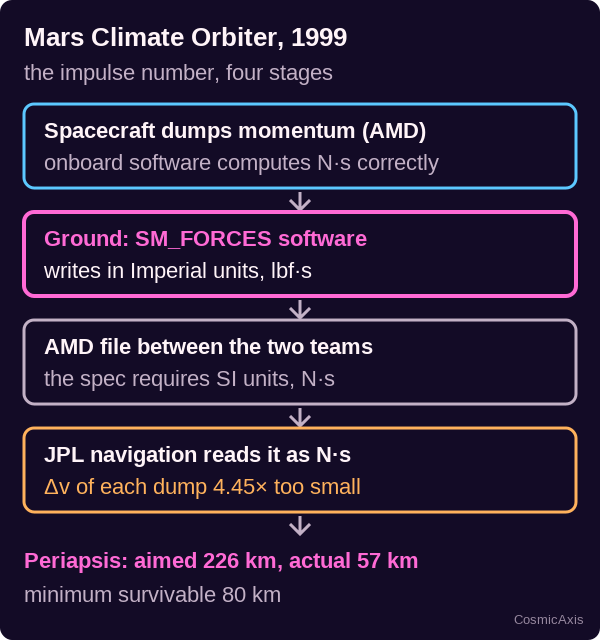
NASA's Mars Climate Orbiter was lost on 23 September 1999 as it entered Mars orbit. The ground software SM_FORCES wrote the impulse of momentum dumps in pound-force seconds although the specification required newton seconds, so navigators underestimated each burn 4.45 times: true periapsis 57 km instead of 226 km (NASA Mishap Investigation Board, 10 November 1999).
01Knowledge
What happened to Mars Climate Orbiter?
Mars Climate Orbiter, NASA’s first interplanetary weather satellite, lost contact at 09:04:52 UTC on 23 September 1999, minutes after its main engine burn to enter Mars orbit. It launched on 11 December 1998 and had flown 286 days (CosmicAxis own count). The Board, chaired by Arthur Stephenson, published its Phase I report on 10 November 1999:
| Time (UTC) | Event | Source, date viewed |
|---|---|---|
| 8 Sep 1999 | TCM-4 correction computed, aiming at a periapsis of 226 km | Report section 2, 2026-10-03 |
| 23 Sep, about 1 hour before MOI | Periapsis recomputed to 110 km | Report section 2, 2026-10-03 |
| 23 Sep, 09:00:46 → 09:04:52 | Main engine starts; signal lost behind Mars, 49 s early | Report section 2, 2026-10-03 |
| 29 Sep 1999 | Discovery that the Δv of the small burns was underestimated 4.45 times | Report section 2, 2026-10-03 |
Recomputed with corrected data, the first periapsis was only 57 km.
Which trajectory did Mars Climate Orbiter fly to Mars?
Mars Climate Orbiter flew a transfer around the Sun for 286 days, then fired its main engine for 16 minutes to enter an elliptical orbit of 13–14 hours around Mars (report, figure 1). The flight time was close to the ideal 259 days of a Hohmann transfer orbit.
In orbital mechanics, the trip spends delta-v in three places: the Delta II launch in late 1998 (629 kg spacecraft, 291 kg of it propellant, per NSSDCA); the trajectory correction maneuvers (TCM) with hydrazine thrusters; and the Mars orbit insertion (MOI), the only burn of the main engine.
After MOI the spacecraft planned aerobraking, dipping its 5.5 m solar array into the upper atmosphere to slow down. So periapsis, the lowest point of the ellipse, is the number that matters: TCM-4 aimed at 226 km, and the Board states the spacecraft could survive down to 80 km.
Why did Mars Climate Orbiter need to dump reaction wheel momentum?
Mars Climate Orbiter had to dump momentum because it held its attitude with reaction wheels, and sunlight torques kept adding momentum to them. When a wheel neared its limit, small thrusters shed it, a procedure NASA calls Angular Momentum Desaturation (AMD).
The Board named two features specific to this spacecraft:
- A one-sided solar array. An 11 m² array on one side of the body (NSSDCA), unlike the symmetric Mars Global Surveyor, gave a large solar radiation pressure torque; AMD events were 10–14 times more frequent than predicted.
- A dropped flip mode. The first plan rolled the spacecraft 180° daily so torques cancelled (barbecue mode). A trade study removed it, but navigation was not told.
Each AMD also changes the spacecraft’s velocity slightly. That Δv is computed from the impulse bit and burn time both onboard and on the ground; the onboard version was right, the ground one wrong.
How did the SM_FORCES software get the units wrong?
The ground software SM_FORCES (“small forces”) wrote the impulse of each AMD into the AMD file in pound-force seconds (lbf·s), while the Software Interface Specification (SIS) required newton seconds (N·s). The Board calls this the single root cause (report section 4): the first event in the chain that the process should have controlled.
The file was the handover from the operations team in Colorado to the navigation team in California (NASA release 99-113), and the navigation software read the numbers as N·s, as the SIS says. One pound-force is 4.448 222 N (NIST SP 811), so every Δv was read 4.45 times too small: navigation saw only 22.5% and missed 77.5% of the true Δv (CosmicAxis own calculation).
The error could have surfaced early. For four months the AMD file had the wrong format and quaternions (numbers that describe attitude), so it was unusable; it worked from April 1999, and within a week the data showed the effect of AMD was underestimated.
Why did Doppler tracking not reveal the error?
Doppler tracking did not reveal the error because radio waves measure only the velocity along the Earth–spacecraft line of sight, while the main thrust of each AMD was perpendicular to it. The missing Δv was almost invisible, yet it pulled the trajectory lower than estimated near Mars (report, contributing cause 1).
Navigators determined the orbit from range and Doppler shift measured through the Deep Space Network. Report section 2 records two warning signs set aside: Doppler residuals around AMD events, noticed in spring and summer 1999 but reported only informally; and near Mars, a Doppler-only solution that always put the trajectory closer to the planet than the solution with range, never resolved.
The predicted periapsis fell from 226 km to 150–170 km in the week before MOI; the real trajectory was about 170 km lower than planned. At 57 km, NSSDCA says the spacecraft was destroyed by atmospheric stress and friction, the load a vehicle in atmospheric reentry is built to survive.
02Practice
How do you simulate the accumulation of a unit error in Python?
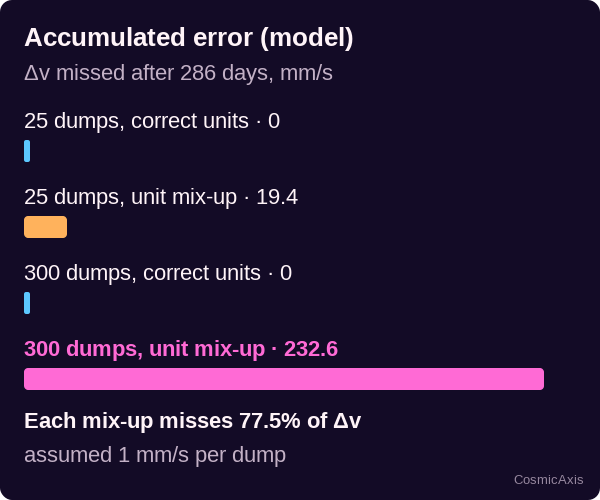
A unit error can be simulated in a few lines of Python: each AMD misses 77.5% of its Δv, the missed part drifts until Mars arrival, so the drift grows with the number of dumps. The model (Python 3.14.6) shows only the trend, not the real trajectory.
Source
CosmicAxis own calculation; factor 4.45: NASA MCO MIB Phase I, 1999
Assumptions: each AMD gives a Δv of 1 mm/s, dumps are evenly spaced, the missed part drifts in a straight line, gravity is ignored. The report does not publish the Δv of each dump or the number of dumps. The two cases, 25 and 300 dumps, differ by 12 times, inside the 10–14 times range the Board gives.
LBF_TO_N = 4.4482216152605   # newtons in 1 lbf, NIST SP 811
FLIGHT = 286                 # days, 11 Dec 1998 → 23 Sep 1999
DV = 1.0                     # mm/s per AMD: ASSUMPTION

def error(dumps, factor):
    # the missed part of each delta-v drifts straight on to Mars arrival
    missed = DV * (1 - 1 / factor)
    drift = sum(missed * FLIGHT * (1 - (i + 0.5) / dumps) for i in range(dumps))
    return dumps * missed, drift

_, base = error(25, LBF_TO_N)
for n, k in [(25, 1), (25, LBF_TO_N), (300, 1), (300, LBF_TO_N)]:
    dv, drift = error(n, k)
    print(f"{n:3d} dumps, factor {k:.2f}: missed {dv:5.1f} mm/s, drift x{drift / base:4.1f}")
 25 dumps, factor 1.00: missed   0.0 mm/s, drift x 0.0
 25 dumps, factor 4.45: missed  19.4 mm/s, drift x 1.0
300 dumps, factor 1.00: missed   0.0 mm/s, drift x 0.0
300 dumps, factor 4.45: missed 232.6 mm/s, drift x12.0
With correct units, even 300 dumps cause no drift; with a unit mix-up the drift grows with the number of dumps and always points the same way, so it does not cancel like random noise.
How do you catch a unit error at run time with astropy.units?
A unit error is caught at run time if every number carries its unit: astropy.units converts lbf·s to N·s and rejects bare numbers and wrong dimensions. The code (astropy 8.0.1) rebuilds the AMD file boundary with one assumed data line.
from astropy import units as u
from astropy.units import imperial

imperial.enable()                # allow reading "lbf" from a string
MASS = 600 * u.kg                # ASSUMPTION; the launch mass was 629 kg (NSSDCA)

@u.quantity_input(impulse=u.N * u.s)
def delta_v(impulse):
    return (impulse / MASS).to(u.mm / u.s)

number, unit = "0.135 lbf s".split(maxsplit=1)   # the file line declares its own unit
impulse = float(number) * u.Unit(unit)
print(impulse, "=", impulse.to(u.N * u.s).round(3), "→ Δv", delta_v(impulse).round(3))
print("Misread as N·s → Δv", delta_v(0.135 * u.N * u.s).round(3))

for bad in [0.135, 0.135 * imperial.lbf]:
    try:
        delta_v(bad)
    except (TypeError, u.UnitsError) as err:
        print("Blocked:", type(err).__name__)
0.135 lbf s = 0.601 N s → Δv 1.001 mm / s
Misread as N·s → Δv 0.225 mm / s
Blocked: TypeError
Blocked: UnitsError
Both units share a dimension, so the library converts instead of raising an error; the misread gives only 0.225 mm/s, the ratio 1/4.45. @u.quantity_input raises TypeError for a bare number and UnitsError for lbf (a force) instead of lbf·s.
Between two teams, the file must state the unit inside the data, and an end-to-end test must compare the ground Δv with the spacecraft’s own.
03Reality
Why did nobody stop the unit error before the spacecraft was lost?
Nobody stopped it because the process had many holes: the Board lists 8 contributing causes, mostly organizational or about verification, not source code (report section 5).
- The wrong Δv model went undetected, because of the Doppler geometry above.
- The navigation team did not know the spacecraft: they joined just before launch and never tried the ground software.
- TCM-5 was not performed: the backup correction was discussed only just before MOI.
- Systems engineering did not carry into operations, as with the dropped flip mode.
- Poor communication: email instead of the ISA (Incident, Surprise, Anomaly) process.
- Too few people: operations ran three missions at once; before MOI, navigation had only the team chief and one person.
- Training was insufficient, including on following the SIS.
- Verification did not cover the ground software: no end-to-end test was seen.
This is the central lesson of systems engineering: each piece of software was correct by its own team’s understanding, and the failure sat at the interface. The Board recommended a verification matrix for every requirement, including the interface control document (ICD).
How does Mars Climate Orbiter differ from Ariane 501, and what did NASA change?
Mars Climate Orbiter differs from the Ariane 5 flight 501 failure in that its error sat on the ground and stayed silent for months: Ariane 501 broke up 39 seconds after liftoff on an onboard overflow, while the Orbiter’s error accumulated all the way. Both are numbers that crossed a software boundary without anyone checking their assumptions. Coding rules such as NASA’s Power of 10 target Ariane-type overflow, not a mismatch between two teams.
The Phase I report mainly advised Mars Polar Lander, due to land on 3 December 1999: check unit consistency and audit every SIS data exchange; revalidate the small-forces model; prepare TCM-5; assign systems engineers; and build a fault tree analysis, since the Board saw no “what could fail” analysis beforehand. JPL also set up an independent peer review (NASA release 99-134). Even so, Mars Polar Lander went silent just before atmospheric entry on 3 December 1999, most probably because its descent engines shut down early (JPL D-18709); see Mars entry, descent and landing.
The lesson at any scale: treat every file exchanged between two teams as a part that can fail, with units in the data and an end-to-end test.
04Milestone
Milestone: check yourself
If you can do all of these, move on to the next article in this phase.
- Can you point to the stage where lbf·s turned into N·s?
- Can you explain why Doppler tracking did not see most of the thrust of the AMD burns?
- Can you run the error-accumulation model in Python?
- Can you write a function that accepts only impulse with units and rejects bare numbers and wrong dimensions?
Frequently asked questions
How much did Mars Climate Orbiter cost?
NSSDCA lists no separate price. The Mars Surveyor '98 program, with Mars Climate Orbiter and Mars Polar Lander, cost USD 193.1 million for development, 91.7 million for launch and 42.8 million for operations, USD 327.6 million in total (NSSDCA; CosmicAxis sum).
Did Mars Climate Orbiter burn up or fly away from Mars?
Nobody knows for sure, because the signal was lost behind Mars. The Board wrote that it was either destroyed in the atmosphere or exited into orbit around the Sun; NASA's mission page says it burned up.
Was Mars Polar Lander lost to the same unit error?
No. Mars Polar Lander was lost on 3 December 1999, most probably because the descent engines shut down early on a spurious signal from the leg sensors (JPL D-18709, 22 March 2000).
References
- Mars Climate Orbiter Mishap Investigation Board — Phase I Report (Stephenson), NASA, 10 November 1999 — accessed
- NASA Release 99-113 — Mars Climate Orbiter Team Finds Likely Cause of Loss, 30 September 1999 — accessed
- NASA Release 99-134 — Mars Climate Orbiter Failure Board Releases Report, 10 November 1999 — accessed
- NASA NSSDCA — Mars Climate Orbiter (1998-073A) — accessed
- NASA NSSDCA — Mars Polar Lander (1999-001A) — accessed
- NASA Science — Mars Climate Orbiter — accessed
- NIST SP 811, appendix B.9 — conversion factors — accessed
- Astropy — Units and Quantities (astropy.units) — accessed
Cite this article
CosmicAxis. (2026). Mars Climate Orbiter failure: how a unit mistake lost it. https://cosmicaxis.space/en/mars-climate-orbiter-failure/