
Reusable Rockets: How Falcon 9 Lands
Source
SpaceX, Transporter-18 mission page (1 October 2026); SpaceX, X Marks the Spot (16 December 2014)
A reusable rocket has a booster that flies back, is inspected and launches again instead of falling into the sea. A Falcon 9 first stage returns with three engine relights (boostback, entry, landing) and four grid fins; by 3 October 2026 it had landed 643 times and reflown 609 times (SpaceX).
01Knowledge
What is a reusable rocket?
A reusable rocket is a launch vehicle whose expensive part, usually the booster stage with its engines, returns intact to be inspected and flown again. SpaceX compared it to airliners: a large jet costs about as much as a Falcon 9, yet nobody throws the jet away after one flight (SpaceX, 25 June 2015).
Reusability comes in three levels:
- Partial, recovered at sea: the Space Shuttle (NASA).
- Partial, landed under engine power: Falcon 9 recovers stage 1 and the fairing; stage 2 is deorbited under control (Falcon User’s Guide, March 2025).
- Full: every stage returns, the goal of Starship.
Reusability sits in the rocket propulsion phase because it depends on restarting engines in flight and throttling them down to a fraction of full thrust.
What sequence does a Falcon 9 landing follow?
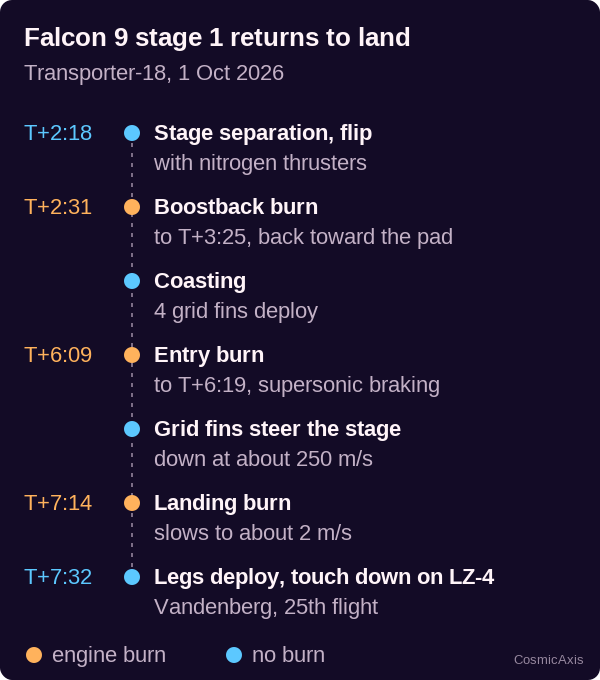
A Falcon 9 first stage lands in six steps after stage separation: flip, boostback burn, entry burn, grid fin steering, landing burn and leg deployment. The three burns are three engine restarts in mid-flight, something liquid-propellant engines can do and solid motors cannot.
Times from the Transporter-18 mission of 1 October 2026, with stage 1 returning to landing zone LZ-4 (SpaceX):
- Stage separation (T+2:18): cold nitrogen thrusters flip stage 1 around.
- Boostback burn (T+2:31 to 3:25): three engines push the stage back toward the landing site (SpaceX, 2015). The Starlink 15-27 mission of 19 September 2026 landed on a ship at sea and skipped this step.
- Entry burn (T+6:09 to 6:19): together with air drag, this burn slows the stage from about 1,300 m/s to about 250 m/s (SpaceX, 16 December 2014).
- Grid fins: four lattice fins in an X pattern near the top of the stage, each rotating independently, steer the stage to its target.
- Landing burn (T+7:14): slows the stage to about 2 m/s while shifting sideways to the center of the pad.
- Touchdown (T+7:32): four carbon fiber legs deploy just before contact.
The entry burn is supersonic retropropulsion. SpaceX first did it on 29 September 2013, and NASA spent three years analyzing the data because Mars landers need the same technique (NASA NTRS 20170008725). According to Lars Blackmore of SpaceX, the stage weighs about 80 tonnes at atmospheric reentry and decelerates at up to 6 g (NAE The Bridge, 2016).
Why can’t Falcon 9 hover when it lands?
Falcon 9 cannot hover because one Merlin engine at its lowest throttle still pushes harder than the nearly empty stage 1 weighs. The stage must therefore ignite as late as possible so speed reaches zero exactly at touchdown, a landing known as a hoverslam or suicide burn.
The user’s guide gives the stage 1 engine throttle range as 190,000 down to 108,300 lbf at sea level. On the CRS-6 flight in 2015, about 10 seconds before touchdown, the stage weighed about 67,000 lb (SpaceX, 25 June 2015). Thrust-to-weight at minimum throttle is 108,300 / 67,000 = 1.62 (CosmicAxis calculation; the two numbers belong to different engine generations and only show the scale).
Blackmore described the consequence: speed must reach zero exactly at zero height. Stop too low and the stage crashes; stop too high and it climbs again, leaving only the option of shutting down and dropping.
A short landing burn also saves propellant: every second of burn, gravity takes back 9.8 m/s of the speed already cancelled, so a longer burn costs more delta-v. Musk wrote that landing at 2 g is 5.5 times more efficient than at 1.1 g, “because the portion below 1 g doesn’t count” (SpaceX, 21 December 2015).
How does a land landing differ from a drone ship landing?
A land landing forces stage 1 to turn back toward the launch site, so stage separation happens at lower speed, while a drone ship waits downrange and lets stage 1 push harder. Musk stated that stage 1 pushes a 125-tonne stage 2 and payload to 8,000 km/h for a ship landing but only 5,000 km/h for a return to the launch site (SpaceX, 21 December 2015).
The autonomous spaceport drone ship (ASDS) holds position with thrusters and no anchor. The first version was 300 ft long with wings spreading 170 ft (about 91 × 52 m, CosmicAxis conversion), while the stage 1 leg span was already about 70 ft (SpaceX, 2014). Blackmore wrote that 99% of landings must fall within 15 m of the ship’s center, or within 30 m of the pad center at Cape Canaveral.
Recovering stage 1 costs payload. The SpaceX capabilities sheet (Wayback copy, December 2023) lists a Falcon 9 maximum of 8,300 kg to geostationary transfer orbit (GTO) when the booster is expended, but the standard price covers only up to 5.5 tonnes, a difference of 2.8 tonnes (CosmicAxis subtraction). Why trading some payload still pays off is covered in rocket launch cost.
02Practice
How can you simulate the Falcon 9 landing burn in Python?
A landing burn can be simulated with a Python loop: each 1 ms step updates speed with the braking acceleration T/m − g, then subtracts the propellant burned. Mass falls, so braking acceleration rises, and the ignition height is found by bisection.
The model is one-dimensional, one engine at full throttle, no drag. Stage mass and sea-level specific impulse of the Merlin 1D are not published, so both are assumptions. The mass flow ṁ = T / (Isp · g₀) comes from the same relation as the rocket equation.
G0 = 9.80665               # m/s²
T_MAX = 845e3              # N, one Merlin 1D at sea level (Falcon User's Guide)
T_MIN = 108_300 * 4.44822  # N, lowest throttle (same source)
ISP = 280                  # s, ASSUMED
M0 = 30_000                # kg, ASSUMED
V0 = 250                   # m/s, before the landing burn (SpaceX 2014)
DT = 0.001                 # s

def burn(h, mass_drops=True):
    """Full throttle from height h; return (stop height, touchdown speed, time, propellant kg)."""
    v, m, t = V0, M0, 0.0
    while h > 0 and v > 0:
        v -= (T_MAX / m - G0) * DT
        h -= v * DT
        if mass_drops:
            m -= T_MAX / (ISP * G0) * DT
        t += DT
    return max(h, 0), max(v, 0), t, M0 - m

def find_height(mass_drops=True):
    lo, hi = 0.0, 5000.0   # bisect until v = 0 exactly when h = 0
    for _ in range(50):
        mid = (lo + hi) / 2
        lo, hi = (mid, hi) if burn(mid, mass_drops)[1] > 0 else (lo, mid)
    return hi

print(f"T/W at lowest throttle: {T_MIN / (M0 * G0):.2f}")
h = find_height()
_, _, t, fuel = burn(h)
print(f"Ignite at {h:.0f} m, burn {t:.1f} s, use {fuel:.0f} kg")
print(f"Constant mass: {find_height(False):.0f} m")
for off in (125, -125):
    h_stop, v_hit, _, _ = burn(h + off)
    print(f"Off by {off:+d} m: stops at {h_stop:.0f} m, touchdown {v_hit:.0f} m/s")
for n in (2.0, 1.1):
    print(f"Thrust {n} g: costs {V0 * n / (n - 1):.0f} m/s to cancel {V0} m/s")
Output (Python 3.14.6, CosmicAxis calculation):
T/W at lowest throttle: 1.64
Ignite at 1590 m, burn 12.3 s, use 3789 kg
Constant mass: 1702 m
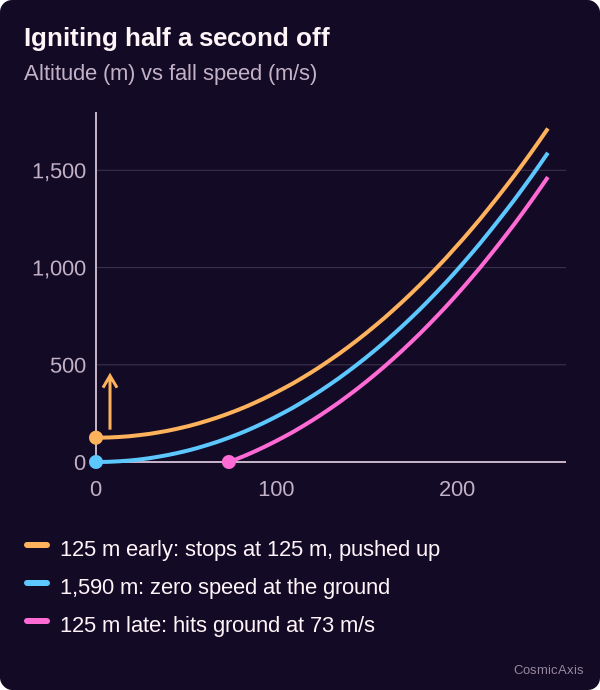
Off by +125 m: stops at 125 m, touchdown 0 m/s
Off by -125 m: stops at 0 m, touchdown 73 m/s
Thrust 2.0 g: costs 500 m/s to cancel 250 m/s
Thrust 1.1 g: costs 2750 m/s to cancel 250 m/s
Source
CosmicAxis calculation in Python; thrust: SpaceX, Falcon User's Guide (March 2025); 250 m/s speed: SpaceX (16 December 2014)
- Constant mass gives 1,702 m instead of 1,590 m, an error of 112 m: enough to crash or stop in mid-air. That is why mass is subtracted at every step, a simple numerical (Euler) integration.
- A 125 m error, half a second at 250 m/s: igniting early stops at 125 m and pushes the stage back up; igniting late hits the ground at 73 m/s.
- 2,750 / 500 = 5.5: exactly the ratio Musk quoted above.
The real stage burns longer (18 seconds on Transporter-18, per SpaceX) because the engine is throttled continuously. Exercise: set M0 to 40,000 and ISP to 260. Next step: add a PID controller that adjusts throttle so the stage corrects its own errors during the burn.
03Reality
How did the first Falcon 9 landing happen?
A Falcon 9 first stage landed successfully for the first time on 21 December 2015 on the ORBCOMM-2 mission, touching down at Landing Zone 1 at Cape Canaveral. SpaceX called it the first recovery of an orbital-class rocket.
Two failed ship landings came first, both reported by SpaceX (SpaceX, 25 June 2015; Musk, 21 December 2015):
- 10 January 2015 (CRS-5): the hydraulic fluid driving the grid fins ran out too early, and the stage hit the deck hard and exploded.
- 14 April 2015 (CRS-6): about 10 seconds before touchdown, the thrust throttle valve responded slowly, so the engine throttled down a few seconds late; the stage landed within 10 m of the ship’s center but too hard, and tipped over.
Two months later, the CRS-7 flight on 28 June 2015 lost the entire rocket during ascent (see the Falcon 9 CRS-7 failure). ORBCOMM-2 was the return to flight, with a more powerful Falcon 9 able to place 11 satellites in orbit and still bring stage 1 back to land (Musk, 21 December 2015). The first ship landing came on the CRS-8 mission of 8 April 2016; that same stage flew again on 30 March 2017 with the SES-10 satellite, the first reflight of an orbital-class rocket (SpaceX).
How many times has one Falcon 9 booster flown again?
One Falcon 9 first stage has flown 37 times: the Starlink 10-49 mission of 25 August 2026 was that booster’s 37th flight, the highest count CosmicAxis found when scanning 207 SpaceX Falcon 9 mission pages from June 2025 to 2 October 2026. The same booster launched both crew rotation flights Crew-3 and Crew-4 before 26 Starlink missions (SpaceX).
| Milestone | Value | Source, date viewed |
|---|---|---|
| Falcon 9 launches to 3 Oct 2026 | 690 | SpaceX, 2026-10-03 |
| Booster reflights to Feb 2025 | more than 384 | Falcon User’s Guide, 2026-10-03 |
| Booster landings to 3 Oct 2026 | 643 | SpaceX, 2026-10-03 |
| Booster reflights to 3 Oct 2026 | 609 | SpaceX, 2026-10-03 |
| Most flights by one booster | 37 | SpaceX Starlink 10-49, 2026-10-03 |
Repeated reflights change the reliability question from manufacturing defects to fatigue and wear, the end of the bathtub curve.
How do the Space Shuttle and New Shepard reuse differ from Falcon 9?
The Space Shuttle reused hardware in part and recovered its boosters at sea, while New Shepard lands under engine power like Falcon 9 but never reaches orbit. Each orbiter was designed to fly at least 100 missions (NASA).
- Two solid rocket boosters deployed parachutes that slowed them from 230 to 51 mph before they hit the Atlantic; the ships Liberty Star and Freedom Star towed them back for disassembly, refurbishment and reloading with propellant (NASA KSC, 2006).
- The external tank mostly burned up in the atmosphere, the one part not reused (NASA).
SpaceX pointed to a weakness: boosters soaked in salt water corrode and take long to refurbish, and a soft land landing shortens that work (SpaceX, 25 June 2015). Even with most hardware reflown, the Shuttle remains the most expensive per kg in the launch cost article linked earlier.
Blue Origin’s New Shepard made its first powered landing on 23 November 2015, almost a month before ORBCOMM-2: the capsule reached 100.5 km, the BE-3 booster relit at 4,896 ft (1,492 m) and touched the pad at 4.4 mph (7.1 km/h) (Blue Origin, 24 November 2015). The difference is energy: New Shepard flies suborbital, while Falcon 9 stage 1 hands stage 2 about 300 GJ of kinetic energy for a ship landing and 120 GJ for a return to the launch site (Musk, 2015).
04Milestone
Milestone: check yourself
If you can do all of these, move on to the next article in this phase.
- Can you list the burns of a Falcon 9 first stage in order and explain why a drone-ship landing usually skips the boostback burn?
- Can you calculate the thrust-to-weight ratio at minimum throttle and explain why Falcon 9 cannot hover?
- Can you run the Python code, change the assumed mass and see how the ignition height changes?
Frequently asked questions
What was the first reusable rocket?
The Space Shuttle was the first reusable spacecraft but discarded its external tank after every flight (NASA). The first orbital booster to land was a Falcon 9 on 21 December 2015, and the first to fly again did so on 30 March 2017 (SpaceX).
What is a fully reusable rocket?
A fully reusable rocket recovers every stage. Falcon 9 is not one, because stage 2 is deorbited under control (SpaceX); Starship is designed to bring back both stages.
What is a hoverslam?
A hoverslam (suicide burn) is a landing that ignites the engine as late as possible so speed reaches zero exactly at touchdown. Falcon 9 must do this because one engine at minimum throttle pushes about 1.6 times harder than the nearly empty stage weighs (CosmicAxis calculation).
References
- SpaceX — X Marks the Spot: Falcon 9 Attempts Ocean Platform Landing (16 December 2014), Wayback copy — accessed
- SpaceX — The why and how of landing rockets (25 June 2015), Wayback copy — accessed
- SpaceX (Elon Musk) — Background on Tonight's Launch (21 December 2015), Wayback copy — accessed
- SpaceX — Falcon User's Guide, revision 8 (March 2025) — accessed
- SpaceX — Capabilities & Services (Wayback copy, 8 December 2023) — accessed
- SpaceX — Falcon 9 statistics — accessed
- SpaceX — ORBCOMM-2 Mission (21 December 2015) — accessed
- SpaceX — SES-10 Mission (30 March 2017) — accessed
- SpaceX — Transporter-18 Mission (1 October 2026) — accessed
- SpaceX — Starlink 15-27 Mission (19 September 2026) — accessed
- SpaceX — Starlink 10-49 Mission (25 August 2026) — accessed
- Blackmore — Autonomous Precision Landing of Space Rockets, NAE The Bridge (Winter 2016) — accessed
- Braun, Sforzo, Campbell — Advancing Supersonic Retropropulsion Using Mars-Relevant Flight Data, NASA NTRS 20170008725 — accessed
- NASA — The Space Shuttle — accessed
- NASA KSC — Space Shuttle Solid Rocket Booster Retrieval Ships (2006) — accessed
- Blue Origin — Blue Origin Makes Historic Rocket Landing (24 November 2015), Wayback copy — accessed
Cite this article
CosmicAxis. (2026). Reusable Rockets: How Falcon 9 Lands. https://cosmicaxis.space/en/reusable-rockets/