
Soyuz 11 disaster (1971)
Source
NASA OCHMO-TB-003 Rev A (2023); NASA System Failure Case Studies, 9/2010; NASA RP-1357 (1995)
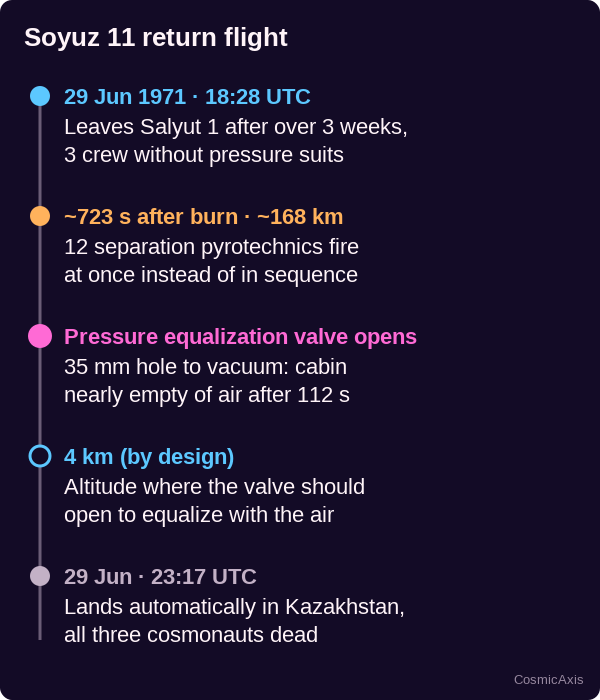
The Soyuz 11 disaster occurred on 30 June 1971 as the crew returned to Earth: at module separation, about 168 km up, a pressure equalization valve opened early, the cabin air escaped to vacuum, and cosmonauts Dobrovolsky, Volkov and Patsayev died because they wore no pressure suits (NASA OCHMO-TB-003, TB-038).
01Knowledge
When and where did the Soyuz 11 disaster happen?
The Soyuz 11 disaster happened on the night of 29–30 June 1971, as the first crew to live aboard a space station, Salyut 1, returned to Earth: the descent module lost all its air above the atmosphere, and all three crew had died when the capsule landed itself in Kazakhstan (NASA OCHMO-TB-003).
The crew were commander Georgy Dobrovolsky, Vladislav Volkov and Viktor Patsayev (NASA History, 2021). In NASA’s accounts:
- 6 June 1971: Soyuz 11 launches and docks with Salyut 1 on 7 June.
- 7–29 June: more than 140 experiments, beating the 18-day continuous-flight record (NASA System Failure Case Studies, September 2010, SFCS).
- 18:28 UTC on 29 June: the craft undocks; the crew wear flight coveralls with hoods, which cannot protect against decompression (NASA RP-1357).
- 23:17 UTC on 29 June: the module lands automatically, 02:17 on 30 June Moscow time (CosmicAxis conversion at UTC+3).
Because of the time-zone shift, OCHMO-TB-003 gives 29 June and TB-038 gives 30 June. This article belongs to the life support phase, with the Apollo 13 oxygen tank explosion.
Why did the Soyuz 11 descent module lose pressure?
The Soyuz 11 descent module lost pressure because the separation pyrotechnics fired simultaneously instead of in sequence; the shock opened a pressure equalization valve at about 168 km, although the valve was designed to open only at 4 km (NASA OCHMO-TB-003, TB-038).
After the retrofire burn, the orbital and service modules are jettisoned, and only the descent module goes on to atmospheric reentry. According to NASA SFCS, there were four steps:
- About 723 seconds after the burn, 6 explosive blocks and 6 explosive bolts for separation fired together instead of with delays.
- A shock beyond the design level loosened a ball joint in the firing mechanism of one of two ventilation and pressure equalization valves.
- The valve opened to vacuum, although it should open only at 4 km. The hole is 35 mm wide; when found, the valve was still open 10 mm, with explosive residue in its throat.
- The cabin reached near vacuum after 112 seconds, according to the onboard data recorder.
The valve sat under the commander’s seat, out of reach. SFCS names three root problems: no warning of the open valve, no way to plug it, and no worst-case shock test. NASA documents differ on the altitude:
| NASA document | Altitude of valve opening (km) | Cabin depressurization time | Date accessed |
|---|---|---|---|
| OCHMO-TB-003 Rev A (2023) | about 168 | not stated | 2026-10-02 |
| System Failure Case Studies (2010) | 170 (105 miles) | 112 s | 2026-10-02 |
| NASA History (2021), altitude of separation | about 129 (80 miles, CosmicAxis conversion) | under 1 minute | 2026-10-02 |
| Mir Hardware Heritage, RP-1357 (1995) | not stated | within 30 s | 2026-10-02 |
This article uses the roughly 168 km of OCHMO-TB-003, the technical brief behind the NASA-STD-3001 standard; it agrees with the 170 km of SFCS.
How long can a person stay conscious when a cabin loses pressure?
A person stays conscious enough to act for only about 9–12 seconds when cabin pressure drops quickly to the level of an altitude above 43,000 ft (13.1 km): that is the time for blood to travel from the lungs to the brain plus the oxygen reserve in the brain (FAA AC 61-107B).
This interval is the time of useful consciousness (TUC). The FAA table for a seated person:
| Altitude (ft) | Altitude (km, CosmicAxis conversion) | TUC | TUC after rapid decompression | Source, date accessed |
|---|---|---|---|---|
| 25,000 | 7.6 | 3–5 min | 1.5–2.5 min | FAA AC 61-107B, 2026-10-02 |
| 35,000 | 10.7 | 30 s–1 min | 15–30 s | FAA AC 61-107B, 2026-10-02 |
| 43,000 and above | 13.1 | 9–12 s | 9–12 s | FAA AC 61-107B, 2026-10-02 |
According to NASA OCHMO-TB-003, decompression to vacuum is harmful at three thresholds:
- Hypoxia: below 130 mmHg (2.5 psia, 17.2 kPa), equal to 41,500 ft, even pure oxygen through a mask is not enough.
- Decompression sickness: nitrogen dissolved in the blood comes out as bubbles when outside pressure falls fast.
- Ebullism: body fluids boil below 6.27 kPa (47 mmHg) at 37 °C.
The Soyuz 11 data fit these thresholds: 4 seconds after depressurization, the commander’s breathing rate rose from 16 to 48 breaths per minute (NASA SFCS), and the post-mortem findings are consistent with decompression (NASA OCHMO-TB-038). SFCS puts the time of death within 40 seconds; NASA History (2021) says within 2 minutes.
Cabin pressure in a crewed spacecraft must therefore stay between 34.5 and 103 kPa (5.0–15.0 psia) for long-stay crews (NASA-STD-3001 volume 2, requirement V2 6006). The ISS keeps 101.3 kPa with 21% oxygen, like sea level.
Why was the Soyuz 11 crew not wearing pressure suits?
The Soyuz 11 crew wore no pressure suits because the three-person capsule had no room for them, and the designers judged suits redundant once the cabin was sealed (NASA SFCS; OCHMO-TB-003).
According to NASA RP-1357, Soyuz crews of that period wore pressure suits only outside the craft. The craft had no second layer of protection such as oxygen masks or a valve-open warning; SFCS says the designers wanted a fail-safe system. Twenty years later, chief designer Vasily Mishin still held that a multi-seat craft should duplicate the pressure-holding systems of the whole cabin, because suits add equipment, mass and volume (NASA SFCS).
Redundancy covers only the failure modes designers have thought of, and testing did not include every pyrotechnic firing at once. A failure modes and effects analysis (FMEA) table lists each failure mode and its effect, the tool for catching such a gap before flight.
02Practice
How long does a Soyuz-size cabin take to vent through a 35 mm hole, in Python?
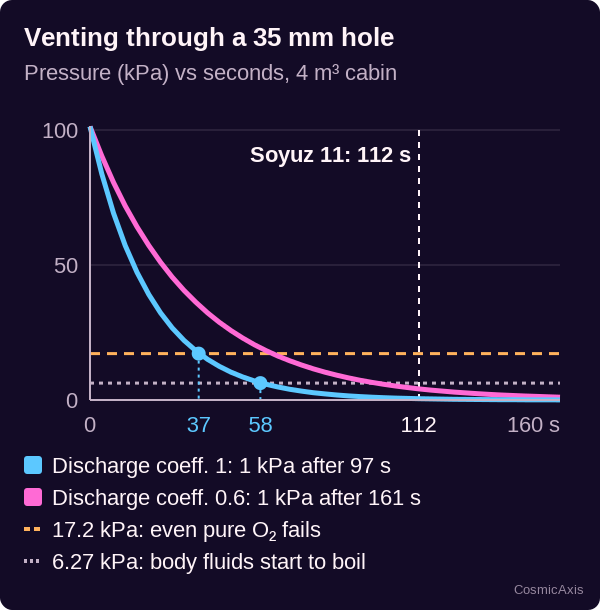
A 4 m³ cabin venting through a 35 mm hole into vacuum takes about 97 seconds to fall from 101.3 kPa to 1 kPa (simple model, CosmicAxis calculation in Python), the same order as the 112 seconds the Soyuz 11 recorder shows (NASA SFCS).
The model uses choked flow: with vacuum outside, gas in the hole reaches the speed of sound, as at the throat of a de Laval nozzle, and mass flow is hole area times inside pressure over the square root of temperature, times a gas factor: ṁ = A · p / √T · √(γ/R) · ((γ+1)/2)^(−(γ+1)/(2(γ−1))) (NASA Glenn). Flow is proportional to pressure, so pressure decays exponentially: p(t) = p₀ · e^(−t/τ), where τ is the time constant: the larger the cabin and the smaller the hole, the longer τ.
Inputs and assumptions:
- Volume 4 m³: the habitable volume of today’s Soyuz descent module (ESA); no separate figure exists for 1971.
- Hole 35 mm (NASA SFCS), discharge coefficient C_d = 1 (ideal hole) and 0.6 for sensitivity.
- 101.3 kPa, constant 293 K: Soviet craft usually used ground-level air (NASA RP-1357).
- Air: R = 286 J/(kg·K), γ = 1.4 (NASA Glenn).
import math

R_AIR = 286.0   # J/(kg·K), gas constant of air (NASA Glenn)
GAMMA = 1.4     # specific heat ratio of air (NASA Glenn)

def tau_vent(v_m3, d_m, t_k, cd=1.0):
    # time constant (s): choked flow through a round hole into vacuum, constant temperature
    a = math.pi * d_m**2 / 4
    k = math.sqrt(GAMMA / R_AIR) * ((GAMMA + 1) / 2) ** (-(GAMMA + 1) / (2 * (GAMMA - 1)))
    return v_m3 / (cd * a * k * R_AIR * math.sqrt(t_k))

def seconds_to(p_kpa, tau, p0=101.3):
    return tau * math.log(p0 / p_kpa)

tau = tau_vent(4.0, 0.035, 293)
print(round(tau, 1))
# 21.0
for p in (17.2, 6.27, 1.0):
    print(p, round(seconds_to(p, tau)))
# 17.2 37
# 6.27 58
# 1.0 97
print(round(seconds_to(1.0, tau_vent(4.0, 0.035, 293, cd=0.6))))
# 161
print(round(seconds_to(1.0, tau_vent(4.0, 0.001, 293)) / 3600, 1))
# 33.0
Source
CosmicAxis calculation from NASA Glenn, ESA and NASA System Failure Case Studies (9/2010)
The results show three things. Pressure falls below 17.2 kPa, where even pure oxygen is not enough, after about 37 seconds, close to the SFCS 40-second mark. The 112 seconds lies between C_d = 1 (97 seconds) and C_d = 0.6 (161 seconds), so a 35 mm hole explains the data. A 1 mm hole, as one sentence in RP-1357 has it, would need about 33 hours, so “1 mm” is unlikely to be the diameter of the open passage.
The model ignores gas cooling and gradual valve opening; it is an order-of-magnitude estimate, not a reconstruction.
Paper calculation only: do not try to pull a vacuum on a container or chamber with people in it; pressure vessels can fail under pressure difference.
03Reality
What changed in Soyuz and NASA standards after Soyuz 11?
After Soyuz 11, the Soviet Union redesigned Soyuz for 2 crew in pressure suits, and NASA-STD-3001 requires that spacecraft let the crew wear pressure suits during dynamic phases such as launch, entry and landing (NASA SFCS; OCHMO-TB-003). According to SFCS and RP-1357:
- A manual valve in series with the pyrotechnic valve on both the intake and vent lines, within the crew’s reach; the valve withstands shock better, and an emergency pressurization device is added.
- Suits mandatory for launch and landing. The Sokol suit came after Soyuz 11 and holds 5.8 psi (40 kPa) if the cabin loses pressure (NASA OCHMO-TB-038).
- Reduced to 2 crew, because suit air-supply equipment took the place of the third seat. Soyuz 12 (27–29 September 1973) was the first crewed flight of the redesign.
- Back to 3 crew with Soyuz-T: Soyuz-T 3 (27 November–10 December 1980) was the first 3-person crew to go to a station since Soyuz 11.
NASA-STD-3001 volume 2, requirement V2 11100, says a spacecraft must let the crew wear pressure suits during launch, entry, landing and any high-risk activity for depressurization such as docking or complex maneuvers (quoted in OCHMO-TB-003).
A suit alone is not enough: in the Columbia disaster, several crew members were not wearing gloves or had their helmet visors open when only about 40 seconds remained to respond (NASA OCHMO-TB-038). The lesson stands: test at the real worst case, give every path to vacuum a warning and a manual way to close it, and make the suit quick to put on.
04Milestone
Milestone: check yourself
If you can do all of these, move on to the next article in this phase.
- Can you retell the four steps from simultaneous pyrotechnic firing to a depressurized cabin?
- Can you explain why the useful consciousness time above 43,000 ft is only 9–12 seconds?
- Can you run the Python venting code and explain why a 1 mm hole does not fit the flight data?
- Can you name the NASA-STD-3001 requirement tied to the lessons of Soyuz 11?
Frequently asked questions
What caused the deaths of the Soyuz 11 crew?
The Soyuz 11 crew died of exposure to near-vacuum after the cabin lost pressure, because nobody wore a pressure suit (NASA OCHMO-TB-038).
Would the Soyuz 11 crew have survived in pressure suits?
Yes. NASA OCHMO-TB-038 concludes that the Soyuz 11 and Columbia crews would have survived decompression in properly worn launch, entry and abort suits (LEA suits).
How many people did Soyuz carry after Soyuz 11?
Soyuz carried 2 people in pressure suits from 1973, until Soyuz-T 3 took 3 people to the station again in November 1980 (NASA RP-1357).
References
- NASA OCHMO-TB-003 Rev A — Habitable Atmosphere (30 November 2023) — accessed
- NASA OCHMO-TB-038 Rev B — Decompression Mishaps, LEA Suits (11 October 2023) — accessed
- NASA System Failure Case Studies — Descent into the Void (September 2010), Internet Archive copy — accessed
- Portree — Mir Hardware Heritage, NASA RP-1357 (1995), sections 1.7–1.8 — accessed
- NASA History — Remembering the Crew of Soyuz 11 (30 June 2021) — accessed
- FAA AC 61-107B CHG 1, figure 2-3 — Times of Useful Consciousness — accessed
- ESA — The Russian Soyuz spacecraft — accessed
- NASA Glenn — Mass Flow Choking — accessed
- NASA Glenn — Equation of State (gas constant of air) — accessed
- NASA Glenn — Specific Heats (specific heat ratio of air) — accessed
Cite this article
CosmicAxis. (2026). Soyuz 11 disaster (1971): what caused the depressurization. https://cosmicaxis.space/en/soyuz-11-disaster/