
What Is Space Debris?
Source
ESA Space Environment Report 2026, section 2.4
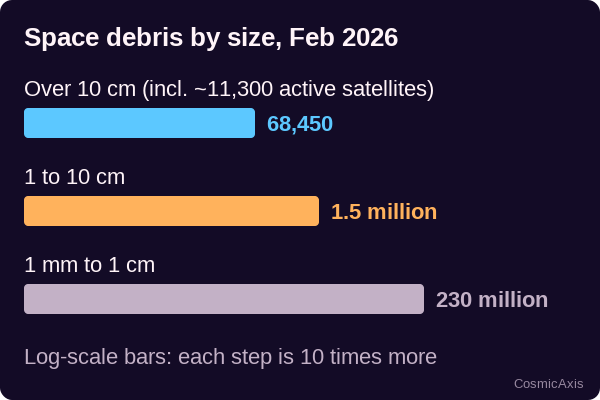
Space debris is human-made objects that no longer work in orbit: dead satellites, rocket stages and fragments. ESA's MASTER model estimates that on 1 February 2026 there were 68,450 objects larger than 10 cm (about 11,300 active satellites among them), 1.5 million fragments of 1–10 cm and 230 million of 1 mm–1 cm.
01Knowledge
What is space debris, and how many pieces are there?
Space debris is any human-made object in orbit that no longer has a function: dead satellites, abandoned rocket stages, released objects, and fragments from explosions and collisions. ESA’s Space Environment Report (version 10.1, 8 September 2026) states that debris has outnumbered working satellites since 1957.
| Size class | Estimated count | Source (viewed 2026-10-02) |
|---|---|---|
| Larger than 10 cm | 68,450 (about 11,300 active satellites among them) | ESA 2026, section 2.4 |
| 1–10 cm | 1.5 million | ESA 2026, section 2.4 |
| 1 mm–1 cm | 230 million | ESA 2026, section 2.4 |
These MASTER figures are for 1 February 2026; catalogued objects at the end of 2025 numbered 44,964, totaling 15,883 tonnes (ESA, tables 3.1 and 3.3).
A 1 cm fragment is already dangerous: an object at 400 km moves at 7.67 km/s, objects on crossing orbits can meet at over 11 km/s (NASA ODQN 13-2), and a 1.4 g aluminum sphere at 10 km/s carries 71 kJ (CosmicAxis calculation). An end-of-life plan therefore belongs to the manufacturing, cost and regulation phase, and station modules resist small fragments with a Whipple shield.
What is Kessler syndrome?
Kessler syndrome is a chain reaction in which collisions create fragments that cause new collisions, until the orbit is too dangerous to use. ESA’s 2026 report credits Donald Kessler with first describing it, in 1978.
In every ESA simulation, even with launches stopped, fragments in low Earth orbit keep growing through collisions among existing objects. Unintentional breakups average 9.8 events per year over the last 20 years.
How much debris did the Iridium–Cosmos collision and the ASAT tests create?
Two anti-satellite (ASAT) weapon tests, in 2007 and 2021, and the Iridium 33–Cosmos 2251 collision of 2009 created the most fragments (NASA ODQN bulletins).
| Event | Date | Altitude (km) | Tracked fragments | Source (viewed 2026-10-02) |
|---|---|---|---|---|
| China’s ASAT test destroys Fengyun-1C | 11 January 2007 | 845–865 | > 1,600 (31 March 2007) | NASA ODQN 11-2 |
| Iridium 33 hits Cosmos 2251 | 10 February 2009 | 790 | 823 catalogued (end of March 2009) | NASA ODQN 13-2 |
| Russia’s ASAT test destroys Cosmos 1408 | 15 November 2021 | 465–490 | 1,604 catalogued (7 March 2022) | NASA ODQN 26-1 |
NASA called Fengyun-1C the worst contamination of low Earth orbit in 50 years: up to 35,000 fragments of 1 cm or more, most staying decades to hundreds of years. Iridium–Cosmos was the first accidental collision between two intact satellites. Cosmos 1408 fragments were low, so over 90% were expected to reenter within 5 years, yet they raised the risk to the International Space Station about 2 times.
Which space debris rules are mandatory, and which are voluntary?
Most international space debris documents are voluntary guidelines; a rule is mandatory only when a national agency writes it into a license or contract, and FCC decision 22-74 states that the earlier guidelines were not legally binding.
| Document | Status | Main content | Source (viewed 2026-10-02) |
|---|---|---|---|
| IADC guidelines (Rev. 4, January 2025) | Voluntary, 13 agencies | Leave LEO within 25 years; success ≥ 90% | IADC-02-01 Rev. 4 |
| COPUOS (UN) guidelines | Voluntary; resolution 62/217 (2007) | 7 guidelines, incl. avoiding intentional destruction | UNOOSA ST/SPACE/49 |
| FCC 5-year rule | Mandatory with an FCC license or US market access | Leave orbit below 2,000 km within 5 years after the mission | FCC 22-74 |
| ESA mitigation standard (2023) | Mandatory for ESA projects | Leave LEO in under 5 years; collision probability with objects > 1 cm below 10⁻³ | ESA 2026, section 6.1 |
| Zero Debris Charter | Non-binding | Zero Debris by 2030 | ESA |
Vietnam is not among the 13 IADC members. Per the UNOOSA treaty table of 1 January 2026, it has ratified the 1967 Outer Space Treaty but not the 1972 Liability Convention or the 1975 Registration Convention. A team using a foreign launch provider should ask which debris requirements apply to its payload, as it would ask for the ITAR classification before buying US parts.
What are the 25-year rule and the FCC 5-year rule?
The 25-year rule requires an object in the protected low Earth orbit region (LEO, below 2,000 km) to leave orbit within 25 years after its mission ends; the FCC 5-year rule cuts that to 5 years for satellites with a US license. FCC decision 22-74 (29 September 2022) has three key points:
- Date: satellites launched after 29 September 2024 must comply; satellites already flying are exempt.
- Scope: it covers foreign satellites seeking US market access, and the experimental (Part 5) and amateur (Part 97) licenses a CubeSat may use.
- “End of mission” is when a satellite can no longer avoid collisions, so a CubeSat without propulsion can comply only by being released low enough.
How can space debris be reduced?
Four measures reduce space debris: passivation, deorbiting, moving geostationary satellites to a graveyard orbit, and collision avoidance, according to the IADC Rev. 4 guidelines.
- Passivation: vent leftover propellant, drain batteries and depressurize tanks so the spacecraft cannot explode.
- Deorbit: IADC recommends no more than 1 expected casualty in 10,000 on the ground for each atmospheric reentry.
- Graveyard orbit: a geostationary satellite such as VINASAT is raised above the protected GEO region (35,786 km ± 200 km) and must stay outside it for at least 100 years.
- Collision avoidance: change orbit when the collision probability exceeds a threshold.
The minimum raise to a graveyard orbit is 235 km plus 1,000 times the solar radiation pressure coefficient times the area-to-dry-mass ratio: Δh = 235 + 1,000 · C_R · A/m (IADC). For an assumed C_R = 1.5 and A/m = 0.02 m²/kg, the raise is 265 km and costs about 9.6 m/s of delta-v with two Hohmann transfer burns (CosmicAxis calculation).
02Practice
How do you compute CubeSat decay time in Python?
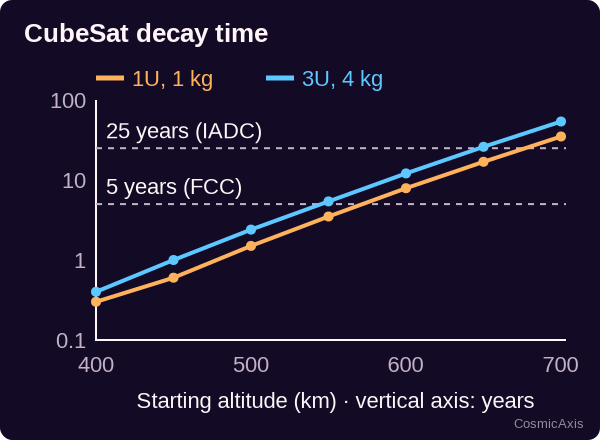
Decay time of a CubeSat without propulsion follows from letting the circular-orbit radius a shrink under drag: da/dt = −ρ · (C_D · A / m) · √(μ · a), with ρ from the exponential atmosphere table of Vallado (2013), drag coefficient C_D, cross-section A, mass m and Earth’s gravitational parameter μ.
Source
CosmicAxis own calculation from Vallado (2013) table 8-4
from math import exp, sqrt

# Exponential atmosphere, Vallado (2013) table 8-4: (base altitude km, density kg/m³, scale height km)
TABLE = [(180, 5.464e-10, 29.740), (200, 2.789e-10, 37.105), (250, 7.248e-11, 45.546),
         (300, 2.418e-11, 53.628), (350, 9.518e-12, 53.298), (400, 3.725e-12, 58.515),
         (450, 1.585e-12, 60.828), (500, 6.967e-13, 63.822), (600, 1.454e-13, 71.835),
         (700, 3.614e-14, 88.667), (800, 1.170e-14, 124.64)]
MU, RE = 3.986004418e14, 6.378137e6  # m³/s², m

def decay_years(h_km, m, A, cd=2.2, scale=1.0):
    a, t = RE + h_km * 1e3, 0.0  # circular orbit, stop at 180 km
    while a - RE > 180e3:
        h0, rho0, H = max(d for d in TABLE if d[0] <= (a - RE) / 1e3)
        da = scale * rho0 * exp(-((a - RE) / 1e3 - h0) / H) * cd * A / m * sqrt(MU * a)
        dt = min(86400.0, 100.0 / da)  # step <= 1 day and <= 100 m of altitude
        a, t = a - da * dt, t + dt
    return t / 3.15576e7  # seconds to years

# ASSUMPTION: tumbling CubeSat, mean drag area = 1/4 of surface area
for name, m, A in (("1U, 1 kg", 1.0, 0.015), ("3U, 4 kg", 4.0, 0.039)):
    print(name, " ".join(f"{h}:{decay_years(h, m, A):.1f}" for h in range(400, 701, 50)))
    heights = [h for h in range(400, 801, 10)]
    print("  5 years up to", max(h for h in heights if decay_years(h, m, A) <= 5), "km,",
          "25 years up to", max(h for h in heights if decay_years(h, m, A) <= 25), "km")
for scale in (0.5, 2.0):  # density x0.5 and x2, weak / strong Sun
    print(f"1U at 500 km, density x{scale}: {decay_years(500, 1.0, 0.015, scale=scale):.1f} years")
1U, 1 kg 400:0.3 450:0.6 500:1.5 550:3.5 600:7.9 650:16.9 700:35.0
  5 years up to 570 km, 25 years up to 670 km
3U, 4 kg 400:0.4 450:1.0 500:2.4 550:5.4 600:12.1 650:26.0 700:53.8
  5 years up to 540 km, 25 years up to 640 km
1U at 500 km, density x0.5: 3.1 years
1U at 500 km, density x2.0: 0.8 years
CosmicAxis ran this with Python 3.14: every extra 100 km multiplies decay time by 4–5, so a 1U CubeSat should be released below about 570 km to decay within 5 years, and a 4 kg 3U below 540 km.
Limits: the model ignores the solar cycle (density ×0.5 or ×2 moves the 500 km result from 0.8 to 3.1 years), covers only circular orbits, and C_D and area are assumptions. Real filings use software such as NASA’s DAS 3.2.1 (ODQN 26-1).
03Reality
How many times has the ISS dodged space debris?
The International Space Station has changed orbit 41 times since 1999 to avoid objects tracked by the US space surveillance network, up to the maneuver of 30 April 2025 (NASA ODQN 29-3). The count was 32 in October 2022, so the station dodged 9 more times in about 2.5 years (ODQN 26-4; CosmicAxis calculation).
NASA (Cooney, 2016) computes a collision probability for any object predicted to enter a ±2 km × 25 km × 25 km box around the station within 72 hours; one action threshold is 1 in 10,000. A Pre-Determined Avoidance Maneuver (PDAM) uses 0.3–1.0 m/s of Δv.
- 30 April 2025: the station rose about 0.53 km to avoid a fragment that appeared to come from a CZ-2D upper stage launched in 2005.
- 24 October 2022: the station dodged a Cosmos 1408 fragment, its second dodge of 2021 ASAT test debris.
- 12 March 2009: a fragment was predicted too late, so the crew sheltered in Soyuz TMA-13; it passed almost 4 km away (ODQN 13-2).
Debris was also one cause that investigators examined and ruled out in the Columbia disaster.
Do Vietnamese CubeSats meet the 5-year and 25-year rules?
All three small Vietnamese satellites that have decayed left orbit within 25 years. F-1 and PicoDragon, released from the ISS, decayed after 217 and 101 days; MicroDragon stayed 2,083 days, about 5.7 years (CelesTrak; CosmicAxis calculation from launch to decay date). F-1 and PicoDragon also appear in the CubeSat failure rate statistics.
| Satellite | Release altitude (km) | Actual (CelesTrak) | CosmicAxis model | Altitude source (viewed 2026-10-02) |
|---|---|---|---|---|
| PicoDragon (1U, 1 kg) | 380–420 | 101 days | 94 days (from 400 km) | JAXA J-SSOD |
| MicroDragon (50.5 kg) | About 500 | 5.7 years | 3.1 years | Spaceflight Now |
For MicroDragon (a 50 cm tumbling cube, assumed drag area 0.375 m²) the model gives a time nearly 2 times shorter than reality, so hand calculation only suits choosing an altitude band. The FCC 5-year rule applies only to satellites launched after 29 September 2024 with an FCC license or US market access, so it cannot grade MicroDragon. VEGAFLY-1 (launched 30 March 2026) is flying at 504–506 km (CelesTrak).
04Milestone
Milestone: check yourself
If you can do all of these, move on to the next article in this phase.
- Can you name the three size classes of space debris and the number of objects ESA estimates in each for 2026?
- Can you tell mandatory rules (FCC, ESA standard) from voluntary guidelines (IADC, United Nations)?
- Can you use Python to find the highest altitude from which a 1U CubeSat decays within 5 years?
Frequently asked questions
What is the difference between space debris and orbital debris?
They mean the same thing. NASA prefers orbital debris and ESA prefers space debris. Both name human-made objects without a function in orbit, and neither includes natural meteoroids.
Does space debris fall back to Earth?
Yes: ESA counted 1,881 objects reentering in 2025. Most burn up; IADC recommends that the risk of casualties stay at or below 1 in 10,000 for each reentry.
What is Kessler syndrome?
Kessler syndrome is a chain of collisions in which fragments cause new collisions. Donald Kessler described it in 1978, according to ESA's 2026 report.
References
- ESA Space Environment Report 2026 (version 10.1) — accessed
- IADC-02-01 Rev. 4 (January 2025) — accessed
- UNOOSA ST/SPACE/49 — accessed
- FCC 22-74 (29 September 2022) — accessed
- ESA Zero Debris Charter — accessed
- NASA ODQN 11-2 (April 2007) — accessed
- NASA ODQN 13-2 (April 2009) — accessed
- NASA ODQN 26-1 (March 2022) — accessed
- NASA ODQN 26-4 (December 2022) — accessed
- NASA ODQN 29-3 (September 2025) — accessed
- Cooney, NASA NTRS 20160012726 (2016) — accessed
- UNOOSA A/AC.105/C.2/2026/CRP.9/Rev.1 — accessed
- Vallado (2013) table 8-4, via SatelliteToolbox — accessed
- CelesTrak SATCAT MicroDragon — accessed
- Spaceflight Now (18 January 2019) — accessed
Cite this article
CosmicAxis. (2026). Space Debris: 25-Year Rule, 5-Year Rule, How to Reduce It. https://cosmicaxis.space/en/space-debris/