
How Does a Whipple Shield Protect Spacecraft From Micrometeoroids?
Source
NASA JSC-64399 (2009), figures 1-1 and 4-8; CosmicAxis concept diagram
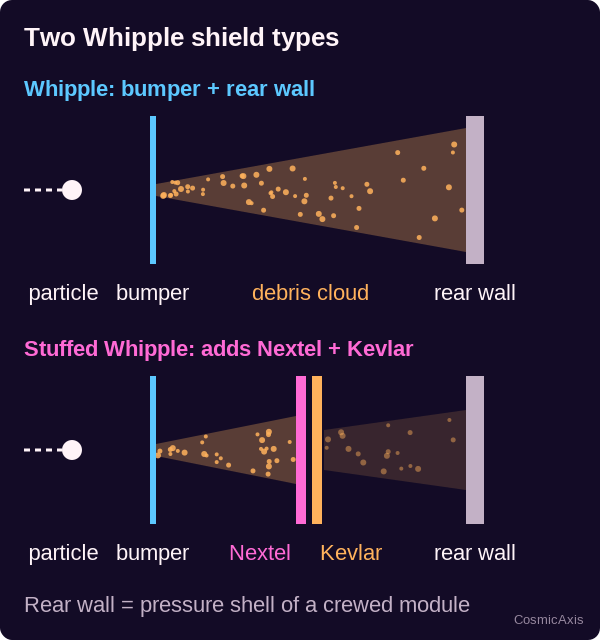
A Whipple shield is a thin bumper placed a gap in front of the hull: micrometeoroids and orbital debris moving 1–15 km/s hit the bumper, break into a debris cloud, and only then reach the rear wall. The ISS uses Whipple and stuffed Whipple shields that stop 1–1.3 cm aluminum particles at 9 km/s (NASA JSC-64399).
01Knowledge
How fast do micrometeoroids and space debris hit a spacecraft?
Micrometeoroids and orbital debris (MMOD) hit spacecraft at hypervelocity: debris at 1–15 km/s and meteoroids at 10–70 km/s, according to NASA’s shielding handbook JSC-64399 (2009). Orbital debris is mostly dense metal; the fragment counts and the Kessler syndrome are covered in space debris. Debris crosses from other orbits, averaging about 9 km/s in low Earth orbit (section 2.4).
| Aluminum particle | At 7 km/s | At 15 km/s | Source (viewed 2026-10-03) |
|---|---|---|---|
| 5 mm, 0.18 g | 4.5 kJ = 1.1 g TNT | 20.6 kJ = 4.9 g TNT | CosmicAxis calculation |
| 1 cm, 1.46 g | 35.9 kJ = 8.6 g TNT | 164.7 kJ = 39.4 g TNT | CosmicAxis calculation |
A 1 cm aluminum particle at 15 km/s carries the energy of nearly 40 g of TNT, about 27 times its own mass (density 2.796 g/cm³ per JSC-64399; 1 ton of TNT = 4.184 × 10⁹ J per NIST SP 811).
How does a Whipple shield work?
A Whipple shield sacrifices a thin bumper set a standoff distance in front of the rear wall: the bumper shatters the particle into a debris cloud, and the cloud expands across the gap so its momentum spreads over a wide area of the rear wall (JSC-64399, section 1.1).
Fred Whipple proposed the idea in 1947 in the Astronomical Journal, ten years before the first satellite. A single plate must absorb all the energy at one small spot; two layers split the job, so the shield is much lighter at the cost of extra volume, a familiar trade in the structures, materials and reentry stage.
What the cloud looks like depends on the velocity normal to the plate, Vn (section 4.2.1, aluminum on aluminum):
- Below 3 km/s: the particle only deforms, keeping over 80% of its velocity at the rear wall. A Whipple shield is weakest near 3 km/s.
- 3–7 km/s: the particle shatters, and from about 5.5 km/s it starts to melt.
- Above 7 km/s: the cloud is mostly liquid metal, with vapor above 10 km/s.
The bumper must be thick enough to melt the particle without shedding solid fragments itself: NASA sets thickness tb = 0.25 · d · ρp/ρb, with d the particle diameter and ρp, ρb the particle and bumper densities, when the standoff is under 30 particle diameters (equation 4-21).
How is a stuffed Whipple shield different from a standard Whipple shield?
A stuffed Whipple shield adds layers of cloth in the middle of the gap: 3M’s Nextel ceramic cloth breaks up and heats the remaining solid fragments, and Kevlar cloth slows the cloud and catches leftovers (JSC-64399, section 4.3).
The bumper and rear wall stay aluminum: 6061-T6 for the bumper and 2219-T87 for the rear wall.
| Shield for a 1 cm aluminum particle at 7 km/s | Standoff (cm) | Mass (kg/m²) | Source (viewed 2026-10-03) |
|---|---|---|---|
| Aluminum Whipple | 10.2 | 24.2 | JSC-64399, figure 2-11 |
| Nextel–Kevlar stuffed Whipple | 10.2 | 17.3 | JSC-64399, figure 2-11 |
| Aluminum Whipple | 30 | 13.1 | JSC-64399, figure 2-11 |
| Multi-shock (multiple Nextel layers) | 30 | 9.0 | JSC-64399, figure 2-11 |
At the same 10.2 cm standoff, the stuffed Whipple shield is 29% lighter than the aluminum Whipple shield (CosmicAxis calculation from the table). At about 11 km/s, a 0.85 cm aluminum particle did not penetrate a 1.78 g/cm² SW-3 stuffed Whipple shield, while a 0.84 cm particle punched a 4.3 cm hole in a 1.73 g/cm² all-aluminum three-wall shield (tables 4-7, 4-8).
What is the ballistic limit equation?
The ballistic limit equation (BLE) gives the particle size, density, velocity and impact angle at which a shield just fails, meaning the rear wall is perforated or spalls on its inner face (JSC-64399, section 2.3). Most BLEs are semi-empirical, fitted to test shots. A performance equation returns the critical particle diameter dc of an existing shield; for a Whipple shield at Vn ≥ 7 km/s (equation 4-23):
dc = 3.918 · tw^(2/3) · ρp^(−1/3) · ρb^(−1/9) · (V·cos θ)^(−2/3) · S^(1/3) · (σ/70)^(1/3)
Here tw is the rear-wall thickness, S the standoff, and θ the impact angle from the plate normal, so V·cos θ is Vn. Units: d, t, S in cm, ρ in g/cm³, V in km/s, σ (rear-wall yield strength) in ksi (1 ksi = 6.895 MPa). Below 3 km/s use equation 4-24, from 3 to 7 km/s interpolate linearly (4-25), above 65° use the 65° value (4-26). Above 7 km/s there is almost no test data, so NASA extrapolates conservatively (section 4.2.1).
How is the probability of no penetration (PNP) calculated?
The probability of no penetration (PNP) follows a Poisson distribution: PNP = e^(−N), where N is the expected number of penetrations over the whole mission (JSC-64399, equations 2-1 to 2-3). NASA has used this method since Apollo.
N is the sum, over every surface zone, of the flux of particles larger than dc times area times time: N = Σ F · A · t. Flux comes from NASA’s environment models and dc from each zone’s BLE; the ISS has more than 500 shielding zones.
| Vehicle | PNP requirement | Time basis | Source (viewed 2026-10-03) |
|---|---|---|---|
| Apollo command and service module | 0.995 | 8.3 days | JSC-64399, table 2-7 |
| Hubble Space Telescope | 0.95 | 2 years | JSC-64399, table 2-7 |
| ISS, each critical element | 0.98–0.998 | 10 years | JSC-64399, table 2-7 |
A PNP of 0.98 equals N = 0.0202, about 1 penetration in 50 repeats of 10 years (CosmicAxis calculation). Because N is proportional to A and t, doubling size or duration nearly doubles the risk.
02Practice
How do you compute the critical aluminum particle diameter in Python?
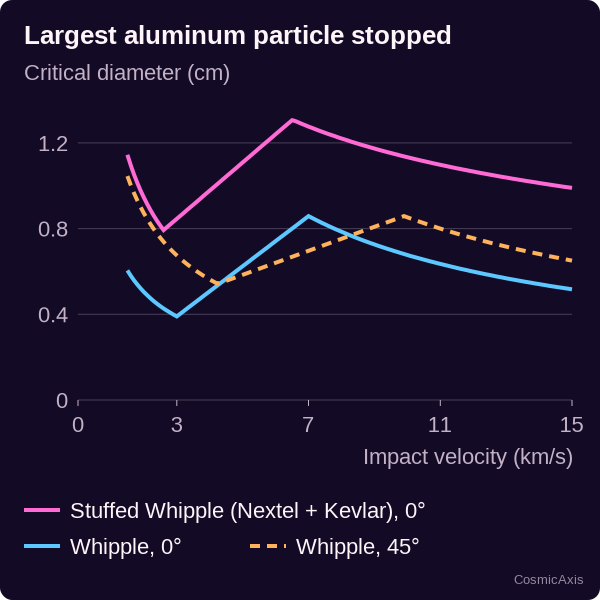
A short Python script computes the critical diameter of a Whipple shield: equations 4-23 to 4-26 of JSC-64399 with the US Lab cylinder dimensions of the ISS (table 4-5), swept over velocity, compared with the stuffed Whipple shield of figure 4-9 (equations 4-48 to 4-50).
from math import cos, radians

# NASA JSC-64399 (2009): cm, g/cm³, km/s, ksi
RHO_P, RHO_B, SIGMA = 2.796, 2.713, 57.0   # Al particle, 6061-T6 bumper, 2219-T87 rear wall
TB, S, TW = 0.20, 10.7, 0.48               # US Lab cylinder Whipple (table 4-5)

def whipple(v, angle=0):                   # equations 4-23 to 4-26
    c = cos(radians(min(angle, 65)))       # angles above 65° use the 65° value
    vn = v * c
    high = 1.071 * TW**(2/3) * RHO_P**(-1/3) * RHO_B**(-1/9) * S**(1/3) * (SIGMA/70)**(1/3)
    if vn >= 7:
        return high * (7 / vn)**(2/3)
    if vn <= 3:
        return ((TW*(SIGMA/40)**0.5 + TB) / (0.6 * c**(5/3) * RHO_P**0.5 * v**(2/3)))**(18/19)
    low = ((TW*(SIGMA/40)**0.5 + TB) / (1.248 * RHO_P**0.5 * c))**(18/19)
    return low * (1.75 - vn/4) + high * (vn/4 - 0.75)   # linear blend from 3 to 7 km/s

M_B = TB*RHO_B + 6*0.1 + 6*0.032           # bumper + 6 Nextel AF62 + 6 Kevlar 710, g/cm²
RHO_W = 2.87                               # ASSUMPTION: inferred from figure 2-11

def stuffed(v):                            # 0°, equations 4-48 to 4-50
    vat = TW*(SIGMA/40)**0.5 + 0.37*M_B
    high = (TW*RHO_W)**(1/3) * RHO_P**(-1/3) * (SIGMA/40)**(1/6) * S**(2/3)
    if v >= 6.5:
        return 0.6 * high * v**(-1/3)
    if v <= 2.6:
        return 2.35 * v**(-2/3) * RHO_P**-0.5 * vat
    k = (v - 2.6) / (6.5 - 2.6)
    return 1.243 * vat / RHO_P**0.5 * (1 - k) + 0.321 * high * k

print("V km/s  Whipple 0°  Whipple 45°  stuffed 0°   (cm)")
for v in (3, 5, 7, 9, 11, 15):
    print(f"{v:6}  {whipple(v):10.2f}  {whipple(v, 45):11.2f}  {stuffed(v):9.2f}")
print(f"Whipple {(TB*RHO_B + TW*RHO_W)*10:.1f} kg/m², stuffed {(M_B + TW*RHO_W)*10:.1f} kg/m²")
V km/s  Whipple 0°  Whipple 45°  stuffed 0°   (cm)
     3        0.39         0.67       0.85
     5        0.62         0.58       1.11
     7        0.86         0.70       1.28
     9        0.73         0.81       1.17
    11        0.64         0.80       1.10
    15        0.52         0.65       0.99
Whipple 19.2 kg/m², stuffed 27.1 kg/m²
Source
CosmicAxis calculation from equations 4-23 to 4-26 and 4-48 to 4-50 of NASA JSC-64399 (2009)
Results from Python 3.14 (CosmicAxis calculation):
- The dip at 3 km/s: the shield stops only a 0.39 cm particle at 3 km/s but 0.86 cm at 7 km/s, because the slow particle does not shatter.
- 45° impact at 9 km/s: dc = 0.81 cm, below the 1–1.3 cm NASA quotes for the ISS, which also has MLI, stuffed shields and calibrated BLEs.
- Stuffing layers: an extra 7.9 kg/m² raises dc at 7 km/s from 0.86 to 1.28 cm, a particle about 3.3 times heavier.
Limits: the density of 2219-T87 aluminum (2.87 g/cm³) is inferred from figure 2-11, and the 0.20 cm bumper is thinner than the 0.22 cm equation 4-21 asks for a 0.86 cm particle, so results above 7 km/s are slightly optimistic.
03Reality
Where does NASA test shields with light-gas guns?
NASA tests shields at the Remote Hypervelocity Test Laboratory (RHTL) of the White Sands Test Facility (WSTF), where two-stage light-gas guns fire 0.05–25.4 mm particles at 1.5–7.5 km/s into shield samples designed by the Johnson Space Center’s HVIT team (NASA HVIT fact sheet).
The first stage drives a piston that compresses hydrogen, which pushes the particle down the barrel into a vacuum chamber; cameras at up to 200 million frames per second film the debris cloud (WSTF fact sheet). Light-gas guns reach only about 7 km/s, while average debris impacts are about 9 km/s, so direct testing covers only about 40% of the threat (JSC-64399, section 2.4). The rest relies on hydrocode simulation, which treats metal as a fluid because impact pressure far exceeds its strength.
How is the ISS shielded against micrometeoroids?
Most critical ISS hardware facing the flight direction and the sides stops aluminum particles of 1–1.3 cm hitting at 9 km/s and 45°; Mir stopped about 0.3 cm, the Space Shuttle 0.1–0.5 cm, and Apollo and Skylab 0.15–0.2 cm (JSC-64399, section 2.10.1).
The ISS is larger and flies longer than any earlier vehicle, so it needs better shielding to keep the same PNP. On the US Lab and Node modules, Whipple shields usually sit in low-hit areas and stuffed Whipple shields in high-hit areas (section 4.2.6). The rear wall is the pressure shell itself; cabin-pressure stress stays below 25% of yield strength on most modules, so it does not lower the ballistic limit (section 4.2).
Shielding is only one layer of defense in the systems engineering sense (section 2.9): the station dodges debris that radar tracks from about 5–10 cm, closes hatches to seal little-used modules, carries patch kits and always has an escape vehicle docked. For the Space Shuttle, the accident board ruled out meteoroids and space debris as the cause of the Columbia disaster.
How did a 0.8 mm hole hit Soyuz MS-22 in 2022?
On 14 December 2022, Soyuz MS-22, docked at the ISS Rassvet module, leaked coolant through a 0.8 mm hole in the radiator of its service module; Roscosmos attributed it to a meteoroid or orbital debris and ruled out the Geminid meteor shower (NASA NTRS 20230003611, Minow 2023).
- 14 December 2022: a Russian spacewalk was cancelled with the crew already suited up; the crew was safe (NASA ISS blog).
- 11 January 2023: Roscosmos limited Soyuz MS-22 to emergency escape; Soyuz MS-23 launched uncrewed to replace it.
- 11 February 2023: the Progress MS-21 cargo ship also leaked coolant, through a 12 mm hole, which Roscosmos called an “external impact”.
- 27 September 2023: the crew returned on the replacement ship; Frank Rubio’s planned 6-month flight became 371 days, the longest for an American astronaut.
A 0.8 mm hole in a part that is not the pressure shell still took away a crewed ship’s role of bringing its crew home. Radiators must stay exposed to reject heat, so they are hard to shield; pipes, tanks and radiators each need their own BLE when computing the PNP of the whole vehicle.
04Milestone
Milestone: check yourself
If you can do all of these, move on to the next article in this phase.
- Can you explain why a thin bumper set apart from the rear wall stops a particle better than a single plate of the same mass?
- Can you name the three velocity regimes of the ballistic limit equation and say why the curve dips near 3 km/s?
- Can you compute with Python the critical aluminum particle diameter of a Whipple shield at 7 km/s?
- Can you convert a PNP requirement of 0.98 over 10 years into an expected number of penetrations N?
Frequently asked questions
What is MMOD?
MMOD stands for micrometeoroid and orbital debris, two sources that hit spacecraft at hypervelocity: 1–15 km/s for debris and 10–70 km/s for meteoroids (NASA JSC-64399).
What is a spacecraft hull made of to resist impacts?
The US modules of the ISS (US Lab, Nodes) have a 0.41–0.64 cm 2219-T87 aluminum pressure shell behind a 0.13–0.20 cm 6061-T6 bumper and MLI insulation; high-hit areas add Nextel and Kevlar cloth (JSC-64399, table 4-5).
Can a Whipple shield stop every piece of debris?
No. ISS shielding stops aluminum particles of about 1–1.3 cm, while ground radar tracks debris only from about 5–10 cm so the station can dodge (JSC-64399, section 2.9.1). The sizes in between are an accepted risk, counted as a probability of no penetration.
References
- Christiansen et al., Handbook for Designing MMOD Protection, NASA JSC-64399 (January 2009) — accessed
- NASA HVIT, Hypervelocity Impact Technology Team (fact sheet) — accessed
- NASA WSTF, Hypervelocity Impact Testing (fact sheet) — accessed
- NASA ISS blog, Mission Controllers Assess Soyuz Coolant Leak (15 December 2022) — accessed
- NASA ISS blog, Soyuz Status Update (11 January 2023) — accessed
- Minow, Spacecraft Anomalies and Failures Workshop 2023, NASA NTRS 20230003611 — accessed
- NASA, Frank Rubio — accessed
- NIST SP 811, appendix B.9 — accessed
Cite this article
CosmicAxis. (2026). Whipple Shield: How Spacecraft Stop Micrometeoroids. https://cosmicaxis.space/en/whipple-shield/